Trump administration Christmas messages emphasize Jesus in overtly religious terms
‘Let Earth Receive Her King,’ the Department of Labor posted
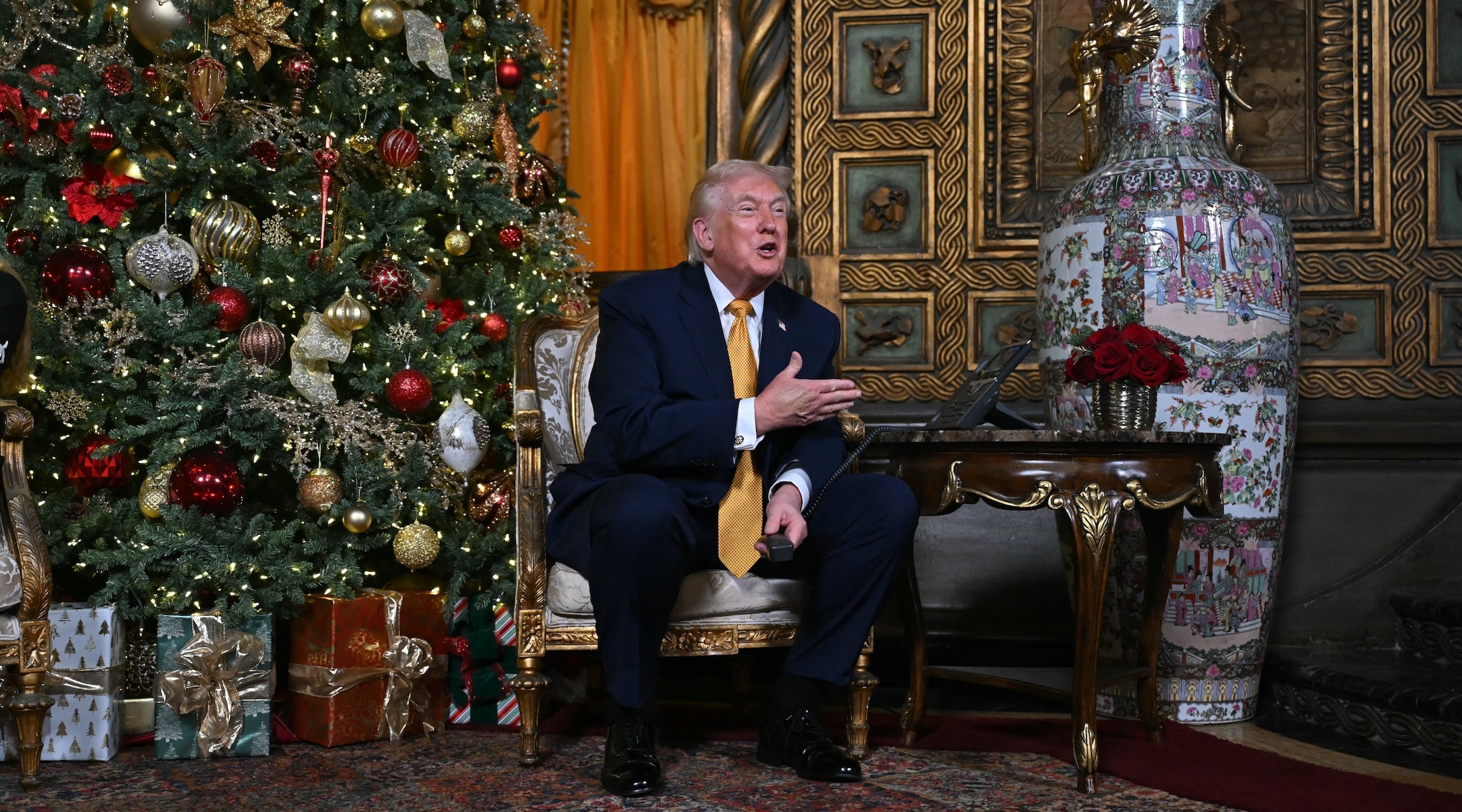
President Donald Trump participates in NORAD Santa tracker phone calls from Mar-a-Lago on Dec. 24. Photo by Andrew Caballero-Reynolds/AFP

By Asaf Elia-Shalev December 26, 2025
The Trump White House marked Christmas with a formal message that celebrated “the birth of our Lord and Savior, Jesus Christ,” extending a week of overtly religious holiday communications from federal agencies and prompting renewed debate over church-state boundaries.
“The First Lady and I send our warmest wishes to all Americans as we share in the joy of Christmas Day and celebrate the birth of our Lord and Savior, Jesus Christ,” the presidential message, posted on the White House website on Thursday, began.
The statement went on to recount the Nativity story in devotional language, calling Jesus “the Light of the World, the source of eternal salvation, and the living Son of God,” and praising “the graces of Christ’s life, death, and resurrection.”
While previous presidents have routinely issued Christmas greetings, they have typically emphasized themes of charity, family and goodwill in language meant to include Americans of many faiths. The White House message this year asserted a specifically Christian vision of faith and national identity.
The presidential message followed a series of social media posts from federal departments that also invoked Jesus directly. Defense Secretary Pete Hegseth wrote, “Today we celebrate the birth of our Lord and Savior, Jesus Christ.” The Department of Labor posted, “Let Earth Receive Her King.” A video from the Department of Homeland Security declared, “We are blessed to share a nation and a Savior,” alongside images of a Nativity scene and the American flag.
The president of Americans United for Separation of Church and State, Rachel Laser, who is Jewish, called the messaging “divisive” in a statement to The New York Times, saying that citizens “should not have to sift through proselytizing messages to access government information.”
Some Jewish commentators reacted with unease, saying the cumulative effect of the posts was to define the American “we” in explicitly Christian terms. Critics see something closer to Christian nationalism, the idea that the United States is fundamentally a Christian nation and should be governed accordingly.
“This is not a comforting message for American Jews,” one Jewish writer posted in response to the Homeland Security video.
Others emphasized that the objection was not to Christmas itself, but to the government’s role in promoting religious belief. Seth Abramson, an author and political commentator who is Jewish, wrote on X that while he enjoys celebrating Christmas with relatives, “separation of church and state is vital.”
The First Amendment prohibits the government from establishing a religion or favoring one faith over others. Jewish organizations have historically viewed that principle as a key protection for religious minorities. As of Friday afternoon, major Jewish groups had not issued statements specifically addressing the Christmas messages.
Supporters of the administration say its messaging is merely stating the obvious, and serving to restore space for faith in public life. According to an editorial in The Nevada Globe, “For many Nevadans — and millions of Americans nationwide — it was a welcome return to the simple truth of the season: Christmas is about Christ, family matters, faith still belongs in public life, and America is worth praying for.”
This article originally appeared on JTA.org.