Jewish New Yorkers say concerns about Mamdani are real, new poll shows. Most other voters say they’re overblown.
The new survey finds deep divide over whether Mayor Zohran Mamdani’s rhetoric signals risk or robust debate
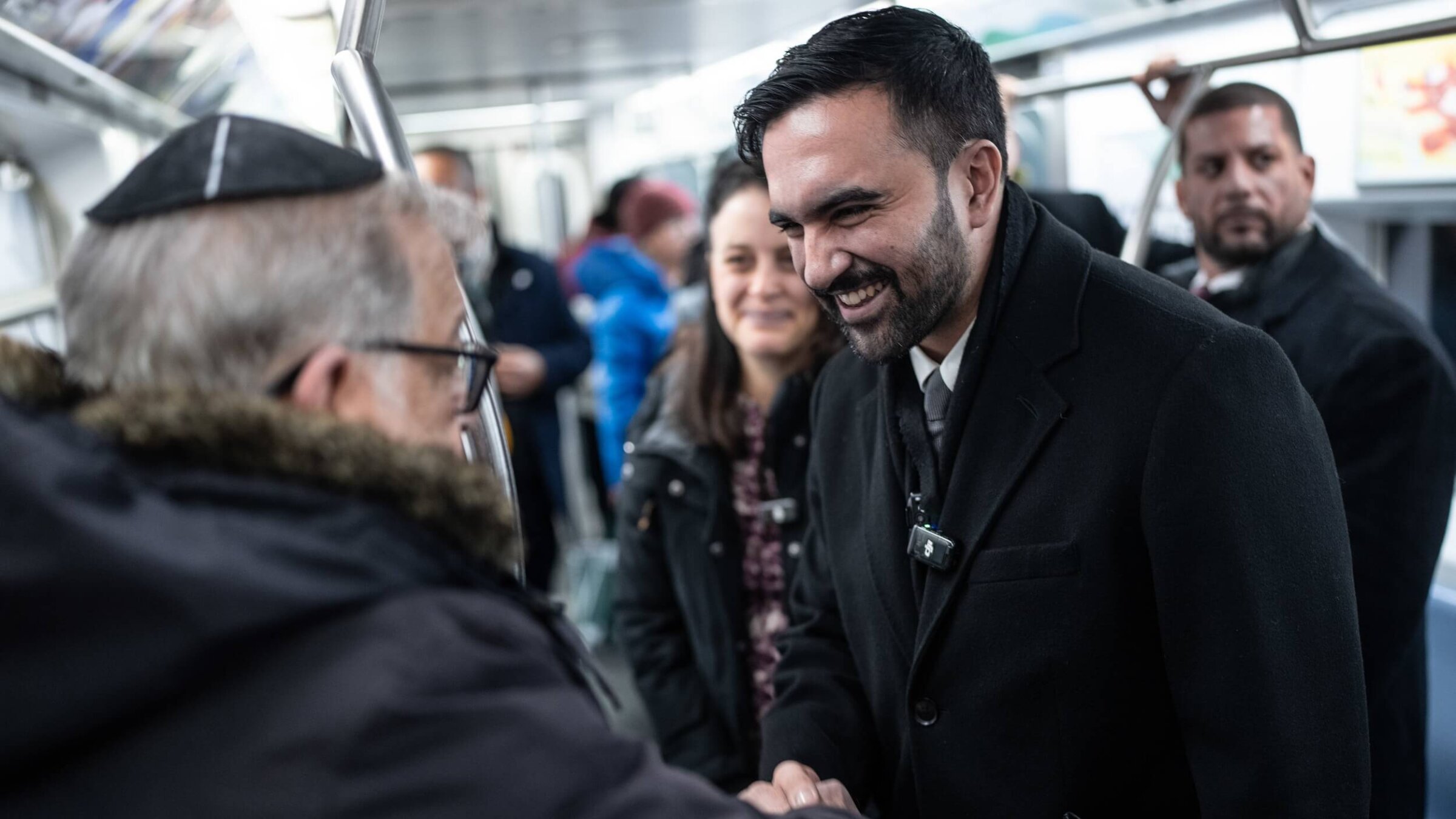
New York City Mayor Zohran Mamdani on Jan. 2. Photo by Michael Appleton/Mayoral Photography Office

By Jacob Kornbluh January 7, 2026
A majority of New York City voters believe that Mayor Zohran Mamdani’s harsh criticism of Israel is a legitimate policy disagreement and that elected officials should challenge U.S. support for Israel, even if it upsets some voters, a new poll found. Views differ sharply among Jewish New Yorkers.
The Honan Strategy Group survey of 703 voters, conducted from Dec. 4 to 12, found that 55% of non-Jewish respondents say Jewish concerns about feeling threatened by Mamdani’s statements on Israel are an overreaction fueled by politics. By contrast, among the smaller sample of 131 Jewish respondents, 53% say they have reason to feel that way, given Mamdani’s statements and associations.
The poll, first shared with the Forward, was conducted via text-to-web and analyzed separately for Jewish and non-Jewish respondents. The overall sample has a reported margin of error of plus or minus 3.7%, while the Jewish subsample has a margin of error of plus or minus 8.6%.
New York City is home to the largest Jewish community outside of Israel. Jewish voters make up an estimated 15% of the electorate. New York Police Department data shows that antisemitic acts made up 57% of all reported hate crimes citywide in 2025.
Mamdani, a democratic socialist whose strident criticism of Israel deepened rifts within New York City’s Jewish community during the election, spent the months after his surprising Democratic primary victory in direct outreach to clergy and prominent Jews to ease concerns about his record.
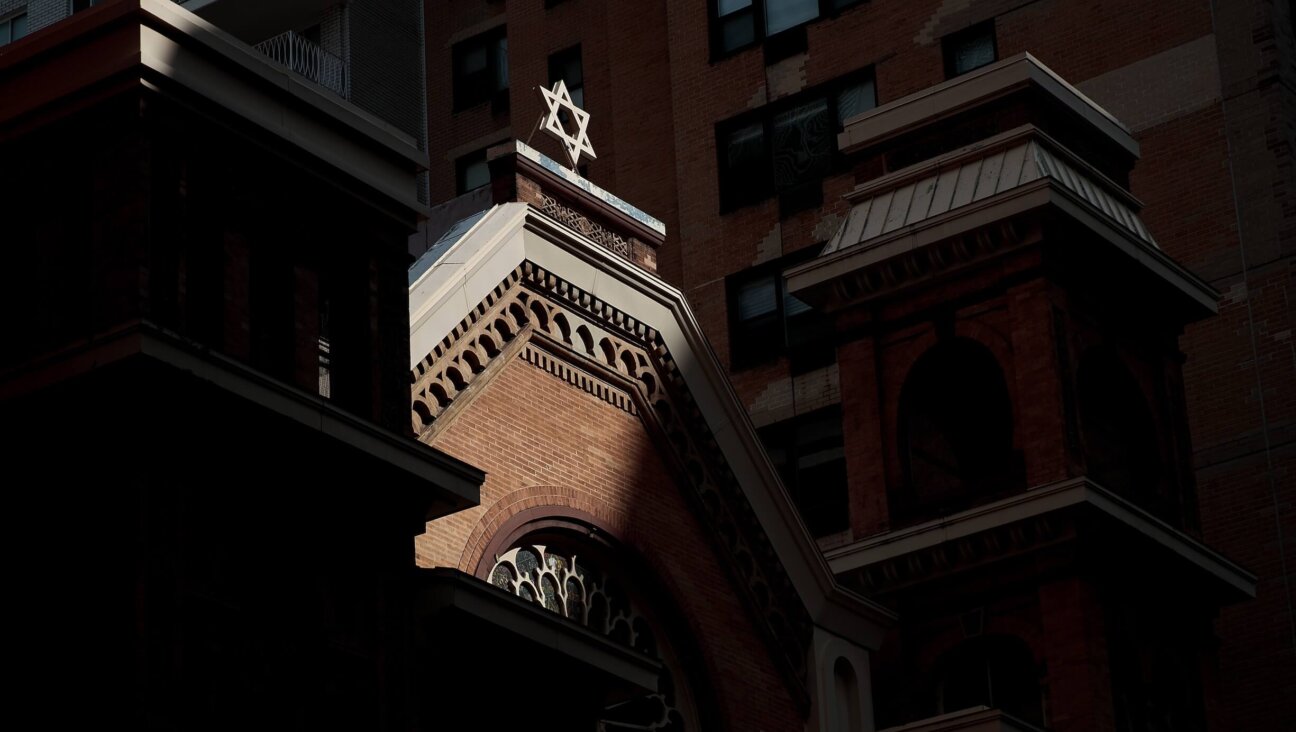
But his support for the Boycott, Divestment and Sanctions movement and his refusal to explicitly condemn the “globalize the intifada” slogan used at some pro-Palestinian protests, perceived by many as a call for violence against Jews, fueled backlash. The city’s Jewish voters were divided in the competitive mayoral election. Concern intensified after Mamdani’s mixed response to a demonstration outside Park East Synagogue that included anti-Israel and antisemitic slogans, in which he questioned the use of a sacred place for an event promoting migration to Israel.
Mamdani reignited deep suspicions about what kind of mayor he intends to be within hours of taking office, revoking two executive orders by former Mayor Eric Adams that many Jews felt supported them and Israel. Mamdani insisted that the move was not intentional or targeted at the Jewish community. He said he wanted to begin his administration with a “clean slate,” clearing away measures signed by Adams so he could enact his own agenda that he said would protect Jewish New Yorkers. But that explanation was met by skepticism. The New York Times reported that the revocations were planned well in advance and rolled out in a way that aimed to minimize backlash.
In a rare joint statement, a coalition of mainstream Jewish organizations said they were deeply concerned by Mamdani’s actions. It called for “clear and sustained leadership that demonstrates a serious commitment to confronting antisemitism” and one that ensures that the mayor’s office is not used to advance BDS.
The Honan Strategy Group found that 53% of non-Jewish voters and 47% of Jewish voters think Mamdani’s criticism of Israel reflects legitimate policy disagreements over the Israeli-Palestinian conflict. However, 40% of Jewish voters believe it crosses a line and fuels antisemitism. Similarly, 51% of Jews view Mamdani’s rise as a troubling sign that antisemitism is being normalized, while 61% of non-Jewish voters see it as evidence of healthy debate and diversity. Fifty-four percent of Jewish voters say Mamdani’s positions deepen division and tension.
Pollster Bradley Honan described the positions on Mamdani and Israel as a “temperature gap” between communities in the Mamdani era. “This issue is turning into a defining political fault line in New York City,” he said. “Jewish voters are significantly more likely to say it’s making public antisemitism more acceptable and driving division.”
Mamdani has repeatedly defended his stance on Israel and the administration’s appointments of individuals who share his views. “We must distinguish between antisemitism and criticism of the Israeli government,” Mamdani said during a recent press conference, responding to an ADL report that scrutinized many of his transition team members. He also accepted the resignation of his newly appointed director of appointments, Catherine Almonte Da Costa, after her past antisemitic posts resurfaced.
Mamdani kept open the recently created mayor’s office to combat antisemitism that pursued the measure he revoked adopting the controversial International Holocaust Remembrance Alliance definition of antisemitism, which considers most forms of anti-Zionism as antisemitic. Mamdani also promised to divest from city investments in Israel and pledged to arrest Prime Minister Benjamin Netanyahu if he comes to New York in compliance with an International Criminal Court warrant.
The poll shows that Jews and non-Jews hold sharply different views on Mamdani’s foreign policy focus. Large majorities of Jewish voters — 71% and 69% respectively — say that speaking out against Israel’s military actions is likely to be viewed as antisemitic and that arresting Netanyahu would harm New York’s global standing. By contrast, 51% of non-Jewish voters say criticism of Israel reflects legitimate policy debate, 53% say it is appropriate for leaders to challenge U.S. support for Israel, and 40% say Mamdani has a moral obligation to uphold international human rights standards by ordering Netanyahu’s arrest.
In his inauguration speech, Mamdani reassured Jewish New Yorkers, “some who view this administration with distrust or disdain,” that he will protect them.
This is a moment of great uncertainty. Here’s what you can do about it.
We hope you appreciated this article. Before you go, we’d like to ask you to please support the Forward’s independent Jewish news this Passover. All donations are being matched by the Forward Board - up to $100,000.
This is a moment of great uncertainty for the news media, for the Jewish people, and for our sacred democracy. It is a time of confusion and declining trust in public institutions. An era in which we need humans to report facts, conduct investigations that hold power to account, tell stories that matter and share honest discourse on all that divides us.
With no paywall or subscriptions, the Forward is entirely supported by readers like you. Every dollar you give this Passover is invested in the future of the Forward — and telling the American Jewish story fully and fairly.
The Forward doesn’t rely on funding from institutions like governments or your local Jewish federation. There are thousands of readers like you who give us $18 or $36 or $100 each month or year.
Support our mission to tell the Jewish story fully and fairly.