Super Bowl ad combatting antisemitism draws criticism from Jews
A $15 million Super Bowl spot funded by Robert Kraft aimed to model allyship — but instead ignited a fierce debate among Jews over how antisemitism should be confronted now
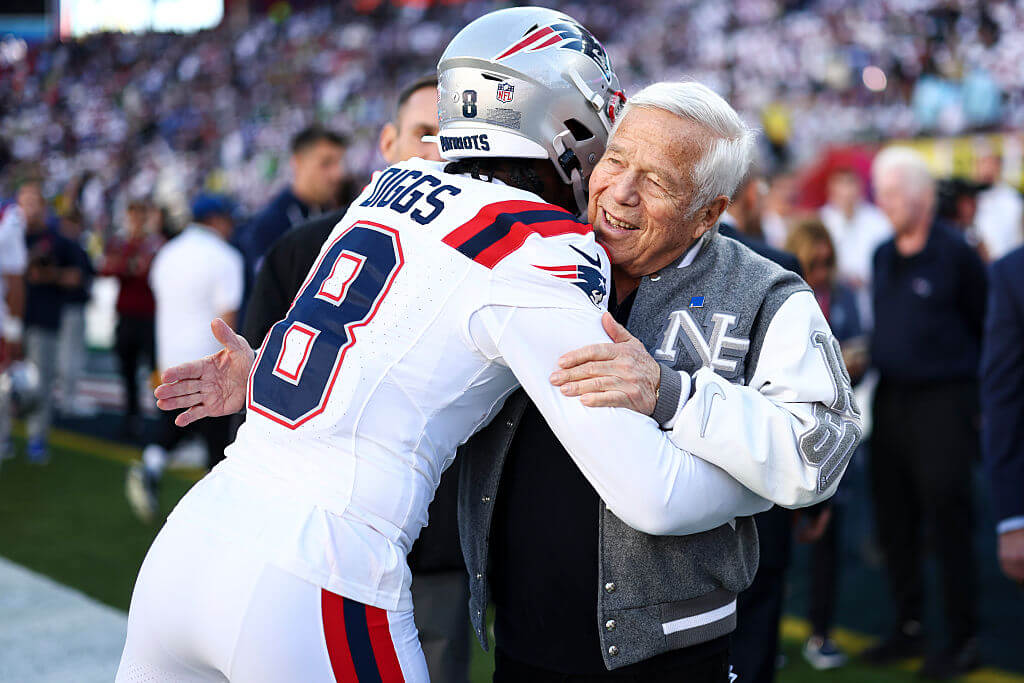
Stefon Diggs of the New England Patriots embraces team owner Robert Kraft at Levi’s Stadium in Santa Clara, California, on Feb. 8. Photo by Kevin Sabitus/Getty Images

By Benyamin Cohen February 9, 2026
Artificial intelligence, Uber Eats, Steven Spielberg’s next film — and antisemitism.
Those were among the topics competing for attention during Sunday’s Super Bowl ads. The antisemitism commercial showed a white Jewish high school student being taunted with the slur “Dirty Jew,” until a taller Black classmate steps in to defend him.
The high-profile spot was funded by New England Patriots owner Robert Kraft’s Blue Square Alliance Against Hate, formerly known as the Foundation to Combat Antisemitism.
For Kraft, 84, the moment was meant to model allyship. Through Blue Square, he has partnered with Hillel International and the United Negro College Fund to host “unity dinners” bringing together Jewish and Black students, and he told CBS News that he hopes Palestinian students attend as well. The ad, Kraft said, was about solidarity.
This is not Kraft’s first Super Bowl ad. In 2024, he paid for an ad featuring Martin Luther King Jr.’s speechwriter in a spot that leaned on similar themes of Black-Jewish collaboration and a shared history of Civil Rights activism. And he began running ads about antisemitism several years before that during Patriots games.
But instead of unifying viewers, the commercial quickly became one of the night’s most divisive spots. Critics — including many Jews — derided it as “dated” and “disconnected” from the way antisemitism actually shows up in 2025, especially on college campuses and online. To some, the ad seemed stuck in a moral universe where antisemitism is an interpersonal problem solved by a well-timed intervention, rather than a systemic one fueled by ideology, institutions and, increasingly, online indoctrination.
Online, the backlash was swift. Many Jewish commenters argued that the estimated $15 million Kraft spent on the campaign, which is also slated to air during the Winter Olympics, would have been better spent elsewhere.
A sharp backlash has emerged against the brand of advocacy that Kraft has undertaken, with some Jewish leaders decrying efforts to combat antisemitism as ineffective and misguided.
“What we call the fight against antisemitism, which consumes tens of millions of dollars every year in Jewish philanthropy and has become an organizing principle across Jewish organizations, is a well-meaning, but mostly wasted effort,” the center-right New York Times columnist Bret Stephens said in a “State of World Jewry” address last week in New York. Instead, he called for large-scale investment in Jewish day schools, cultural institutions, philanthropy, media, publishing and religious leadership.
Others simply found the ad tone-deaf and potentially even harmful.
In an open letter addressed to Kraft, Shabbos Kestenbaum, a Harvard graduate who sued the university over alleged antisemitism, put it bluntly. “You’re a smart guy,” he wrote, “but the people you have hired either are morons or are taking advantage of the money you pay them.”
Emily Tamkin, a contributing columnist at the Forward, posted on social media: “I know in my heart that somewhere in this country of ours a Jewish kid is getting bullied with a Post-it today because of that ad.”
“This Super Bowl ad was clearly well intentioned, but it missed the mark,” posted Margot Touitou, a Tel Aviv-based content creator. “If legacy orgs want to understand what antisemitism looks like for young Jews today, they need to actually be online and tapped into internet culture. Without that, campaigns like this won’t ever land, and that hallway scene especially felt stuck in a ’90s movie, which just isn’t how Gen Z moves or experiences this stuff.”
The team behind the ad pushed back, insisting the criticism misunderstands its intent — and its data. In a letter to the Forward, Adam Katz, president of Blue Square Alliance Against Hate, said online use of the slur “Dirty Jew” has increased 174% over the past three years, arguing that the ad reflects real trends affecting younger Jews in particular. “We test all of our ads,” Katz wrote, adding that early results have been “promising.” He said the decision to set the ad in a high school was deliberate: “That is where we have seen the most concerning trends in antisemitism data.”
The Anti-Defamation League, whose independent research found the ad resonated with audiences, echoed that defense. ADL CEO Jonathan Greenblatt called the spot “powerful” and praised it as “a simple yet moving depiction of resilience in the face of discrimination.”
In response to the criticism, several groups released their own versions of the ad.
On Sunday, the Israel Defense Forces posted its own stark, 11-second video to social media. “This is our Super Bowl commercial,” the IDF wrote, over footage of soldiers carrying machine guns to a soundtrack from Bad Bunny, who performed during halftime. Eylon Levy, who served as an Israeli government spokesperson in the early months of the Gaza war, shared the clip and added a pointed rejoinder: “Much more inspiring for an American Jewish kid who’s getting called a ‘dirty Jew’ than hoping a taller, cooler Black kid will save him.”
Daniel Lubetzky, a Jewish philanthropist and founder of Kind Snacks, released his own version of Kraft’s ad, reimagining the bullied Jewish teen not as a victim in need of rescue, but as a future doctor: accomplished and confident. The video went viral almost immediately, drawing praise from viewers who found it more empowering, and scorn from others who felt it simply swapped one trope for another.
Together, the competing ads — and the arguments around them — revealed a deeper divide: not just over tactics, but over what kind of story American Jews want to tell about themselves at a moment when antisemitism feels both newly visible and painfully unresolved.
JTA contributed to this report.
This is a moment of great uncertainty. Here’s what you can do about it.
We hope you appreciated this article. Before you go, we’d like to ask you to please support the Forward’s independent Jewish news this Passover. All donations are being matched by the Forward Board - up to $100,000.
This is a moment of great uncertainty for the news media, for the Jewish people, and for our sacred democracy. It is a time of confusion and declining trust in public institutions. An era in which we need humans to report facts, conduct investigations that hold power to account, tell stories that matter and share honest discourse on all that divides us.
With no paywall or subscriptions, the Forward is entirely supported by readers like you. Every dollar you give this Passover is invested in the future of the Forward — and telling the American Jewish story fully and fairly.
The Forward doesn’t rely on funding from institutions like governments or your local Jewish federation. There are thousands of readers like you who give us $18 or $36 or $100 each month or year.
Support our mission to tell the Jewish story fully and fairly.