Trump highlights last year’s Iran strikes in State of the Union delivered as US forces prep for possible new ones
The speech did not address domestic antisemitism or political fractures tied to Israel.
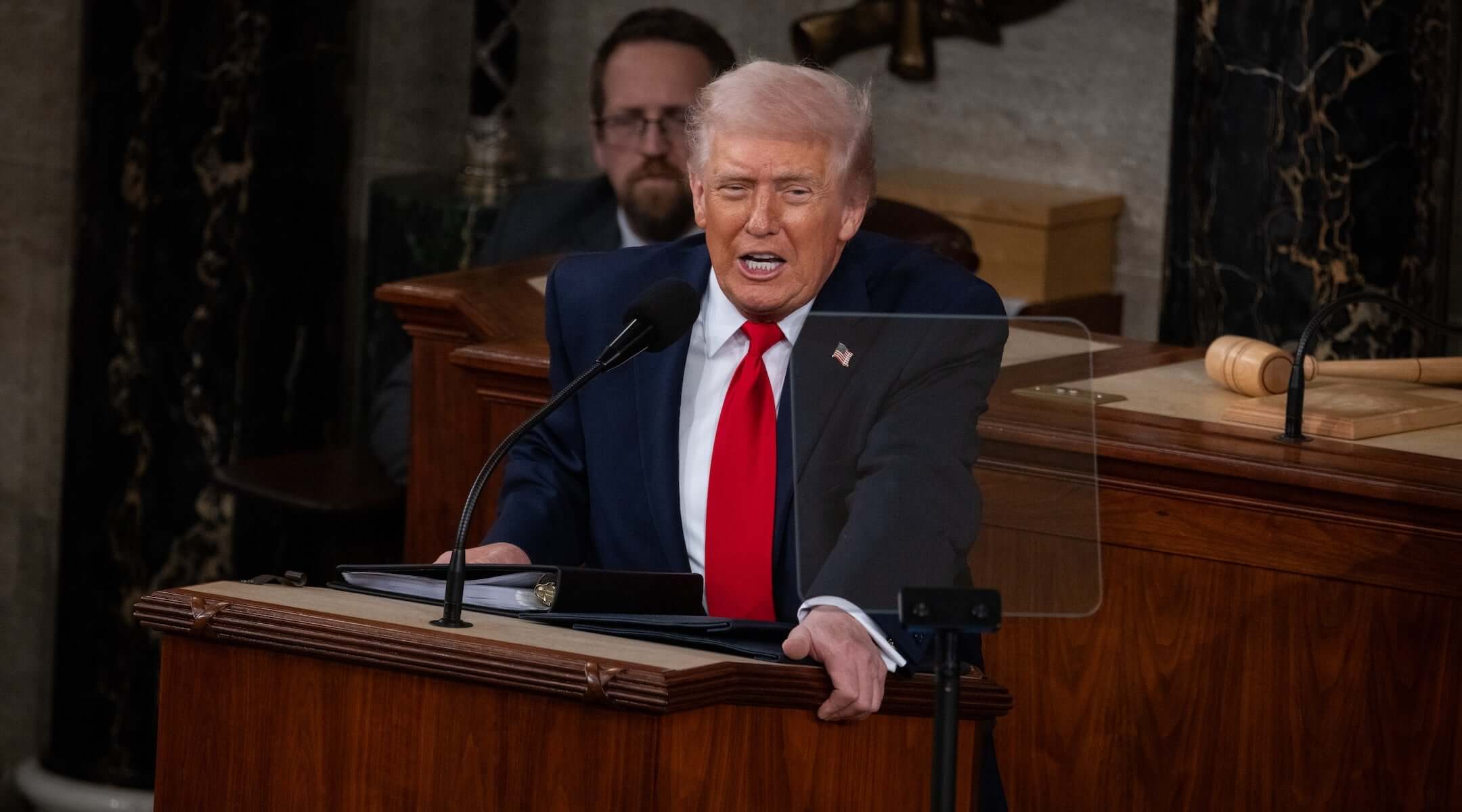
President Donald Trump delivers his State of the Union address to a joint session of Congress in the chambers of the U.S. House of Representatives in Washington, DC on Feb. 24, 2026. Photo by Nathan Posner/Anadolu via Getty Images

By Asaf Elia-Shalev February 25, 2026
(JTA) — President Donald Trump devoted most of his State of the Union address Tuesday night to familiar themes of economic strength and immigration enforcement, but about an hour into the speech he turned to foreign conflicts and issues closely watched by Jewish audiences, including Gaza and Iran.
Speaking to a joint session of Congress for the first State of the Union address of his second term, Trump cast his administration as a global peacemaker while also emphasizing military power.
“We’re proudly restoring safety for Americans at home, and we are also restoring security for Americans abroad,” Trump said, declaring that the United States had “never been stronger.”
In a speech that coincided with the fourth anniversary of the ongoing war between Russia and Ukraine, Trump claimed credit for ending a series of international conflicts, listing flashpoints across multiple regions. Among them, he cited tensions involving Israel and Iran and what he described as “the war in Gaza, which proceeds at a very low level, it’s just about there.” He thanked Steve Witkoff and his son-in-law Jared Kushner, both of whom have played advisory roles on Middle East policy, along with Secretary of State Marco Rubio.
Turning specifically to Gaza, Trump highlighted a ceasefire agreement and efforts to secure the release of hostages. “Under the ceasefire I negotiated, every single hostage, both living and dead, has been returned home,” Trump said. He described the recovery of the bodies of deceased captives in emotional terms, recounting conversations with grieving families and praising the cooperation of Israeli authorities.
The president’s remarks echoed his longstanding effort to frame himself as uniquely capable of brokering Middle East agreements, a message likely aimed at both domestic supporters and international audiences. The status of Gaza and the fate of hostages have been central concerns for many American Jews since the outbreak of the war.
Trump then shifted to Iran, adopting a more confrontational tone. He referenced the U.S. military’s Operation Midnight Hammer which he said “obliterated Iran’s nuclear weapons program.” The strikes targeting Iranian facilities are believed to have caused significant damage but the extent of the impact has not been confirmed by independent assessments.
Reiterating a core pillar of U.S. policy, Trump said his administration would not allow Tehran to acquire a nuclear weapon.
“My preference is to solve this problem through diplomacy, but one thing is certain, I will never allow the world’s number one sponsor of terror, which they are by far, to have a nuclear weapon,” Trump said. “No nation should ever doubt America’s resolve. We have the most powerful military on Earth.”
At least two dozen Democrats stood in a show of approval following Trump’s pledge to prevent Iran from obtaining nuclear arms.
Iran’s nuclear ambitions and regional influence have long been top priorities for pro-Israel advocates and many Jewish organizations, making the issue a recurring feature of Trump’s rhetoric.
While Trump’s comments on Gaza and Iran drew attention, the president did not address other issues that have loomed large in Jewish communal discourse. He made no mention of rising antisemitism in the United States, nor did he acknowledge increasingly visible divisions within his own political coalition over Israel.
Instead, Trump quickly returned to domestic themes, closing the speech, which lasted nearly two hours, as he began it — emphasizing economic performance, border security and what he portrayed as stark contrasts with Democrats.