Jewish Democrats split over Trump’s Iran military strikes as Congress weighs war powers
Some condemn the joint U.S.-Israeli mission while others voice support, amid momentum for congressional oversight
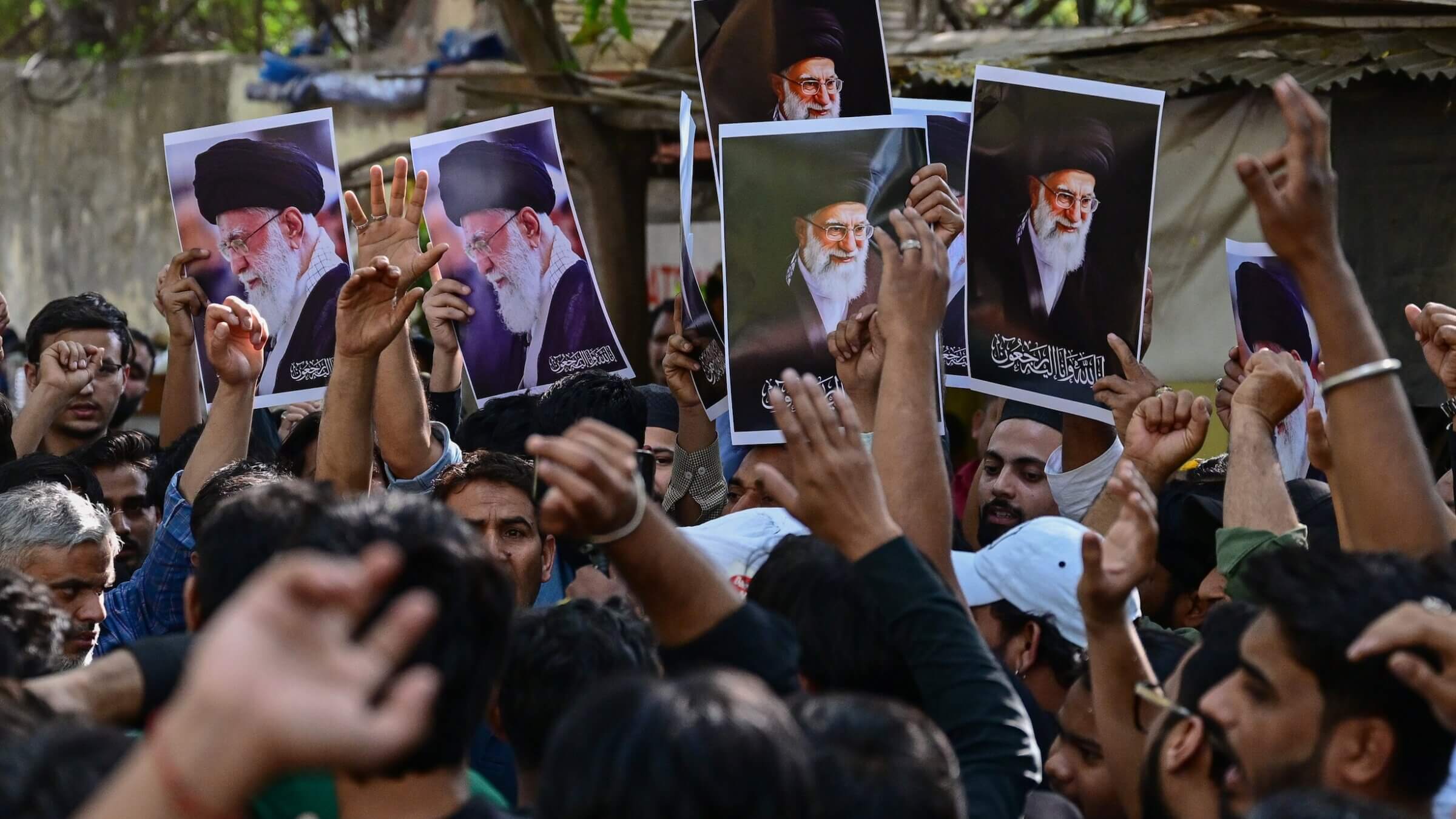
Shiite muslims mourn killing of Iran’s Supreme leader Ayatollah Ali Khammenei on March 01. Photo by Ritesh Shukla/Getty Images

By Jacob Kornbluh March 2, 2026
The joint U.S.-Israel military campaign against Iran, launched with a stealth strike early Saturday, has also prompted a political battle in Washington over waging war without authorization from Congress as required by the constitution.
President Donald Trump has offered mixed signals about the operation’s duration, suggesting that it could be prolonged but also floating a possible immediate return to negotiations with Tehran.
At least 10 Israelis and four U.S. servicemembers were killed in Iranian missile strikes over the weekend.
In recent weeks, as the likelihood of war loomed, Jewish Democrats on the Hill highlighted the need for congressional oversight and a formal vote before the U.S. deepens its role in a war with Tehran. Now, as Israeli civilians shelter under sirens and endure repeated missile strikes, the divide has sharpened between members of Congress with longstanding personal and political ties to Israel and those firmly opposed to expanding American involvement in another Middle East conflict.
The divide reflects wider tensions within the Democratic Party in the wake of the Gaza war that are likely to shape the midterm elections. Recent national polls show that Democratic voters as a group have become less sympathetic to the Jewish state. The latest Gallup annual survey found that only 17% of Democrats sympathize more with the Israelis in the Israeli-Palestinian conflict, while 65% say they are more aligned with the Palestinians. A new Reuters poll showed that 74% of Democrats disapprove of the attack on Iran, and 87% of them think Trump is willing “too much” to use military force to advance U.S. interests.
Rep. Jerrold Nadler of New York, co-chair of the Congressional Jewish Caucus, called the joint US-Israeli mission an “illegal” and unjustified war that “will bring needless death and destruction.” Nadler is among 84 members who co-sponsored the bipartisan War Powers Resolution, introduced by Republican Rep. Thomas Massie of Kentucky, an open critic of Israel. The measure reasserts the 1973 war powers law, which would limit the president’s ability to deploy U.S. forces or declare war without congressional approval.
The House and the Senate could vote on such a measure this week, though the Republican leadership is opposed to it.
“Congress must do everything in our power to stop Trump from continuing his illegal war,” Nadler said in his statement on Saturday. ”I will vote to pass the resolution to bring an end to these illegal attacks, and I urge my colleagues to do the same.”
In contrast, Reps. Josh Gottheimer of New Jersey and Jared Moskowitz of Florida, two Democrats who have at times crossed party lines in support of Israel, have offered forceful support for action against the Iranian regime both before and after the strikes began.
But after previously declaring their opposition to congressional restrictions, Gottheimer is now urging the Trump administration to follow the war powers law, while Moskowitz is asking the president to follow the provision that requires briefing the full Congress within 48 hours of military action. Rep. Debbie Wasserman Schultz of Florida echoed Moskowitz, saying that Trump should immediately consult and fully brief Congress before any further action is taken. “President Trump does not possess a blank check to act without consulting Congress or telling the American people what comes next,” she said.
Rep. Greg Landsman of Ohio, who is running for reelection in a battleground district, defended the action in Iran and said he’d vote against the resolution to restrain Trump. “It’s not an easy position for me to take within the party, but it’s what I believe,” he said. “It has nothing to do with politics, which is what I think people expect when it comes to these big decisions.”
Rep. Brad Schneider of Illinois, the other co-chair of the Jewish Caucus, said he shifted his position in favor of the war powers resolution after Trump ordered the first wave of strikes in Iran and supported the killing of Ayatollah Khamenei without any engagement with Congress. Yet, like House Democratic leader Hakeem Jeffries and Senate Minority Leader Chuck Schumer, he did not explicitly condemn the strikes.
Sen. Elissa Slotkin of Michigan highlighted Trump’s lack of communication in a speech on Saturday. “He’s taken more military action in his first year than any president in our history,” Slotkin, a former CIA intelligence analyst who served three tours in Iraq, said.
“He’s really become a foreign policy president. He seems to like it and seems to sort of easily engage in it,” added Slotkin, a former Pentagon official who served in the Central Intelligence Agency. “I don’t think he’s interested in the views of many others beyond his maybe inner circle. But whether it’s Venezuela or Iran or the Caribbean, he has shown that he is quick to military action, quicker than most presidents we’ve seen in their first year.”
Sen. Bernie Sanders of Vermont, a longtime critic of U.S. military action and Israeli policy, claimed that Israel and Saudi Arabia pressured the United States into attacking Iran. He added that Israeli Prime Minister Benjamin Netanyahu’s conduct in Gaza and Saudi Crown Prince Mohammed bin Salman’s authoritarian rule are at odds with their declared support for freedom in Iran.
What Jewish groups are saying
The divide was reflected in the statements from Democratic-aligned Jewish groups. The Jewish Democratic Council of America said the need to confront Iran’s nuclear ambitions requires close coordination with Congress and said it backed the bipartisan measure to limit Trump’s executive powers. “We are gravely concerned about the safety and security of American troops, Israelis, and other civilians in the region, given the lack of a clearly articulated strategy from this White House about its military objectives and what comes next,” JDCA said in a statement.
Meanwhile, J Street, the self-described pro-Israel, pro-peace organization, said it was opposed to open-ended military action, claiming “Iran does not present an imminent threat that requires launching a ‘preventive’ war.”
Speaking at J Street’s annual conference in Washington, D.C. on Sunday, Sen. Chris Van Hollen of Maryland thanked the Jewish advocacy group for its stance on the war. “I would argue it’s not in the interest of the people of Israel or the region.” He added, “We should not be sending America into war for the political ambitions of Prime Minister Netanyahu and the Saudi Crown Prince.”
The Democratic Majority for Israel called the action against Iran a “positive development.” It also urged the Trump administration to consult with Congress and outline a “credible plan” to prevent escalation and “clear criteria for success and drawdown.”
National Democrats on the war in Iran
Jewish Democratic leaders outside of Congress, including Illinois Gov. JB Pritzker, Pennsylvania Gov. Josh Shapiro and former Chicago Mayor Rahm Emanuel — all considered possible presidential candidates in 2028 — also chimed in.
“Americans asked for affordable housing and health care, not another potentially endless conflict,” Pritzker posted on X.
Shapiro, whose staunch defense of Israel and criticism of the pro-Palestinian protests after the Oct. 7, 2023, Hamas attacks made him a target of progressive backlash, criticized Trump for what he described as a lack of clear objectives and insufficient international backing for the mission.
Emanuel, who was White House chief of staff to former President Barack Obama, said Trump’s remarks that he would seek regime change were a declaration of war that required authorization. It’s a change of government and overthrowing a government,” he said on CNN. “This is not a limited military action.”
This is a moment of great uncertainty. Here’s what you can do about it.
We hope you appreciated this article. Before you go, we’d like to ask you to please support the Forward’s independent Jewish news this Passover. All donations are being matched by the Forward Board - up to $100,000.
This is a moment of great uncertainty for the news media, for the Jewish people, and for our sacred democracy. It is a time of confusion and declining trust in public institutions. An era in which we need humans to report facts, conduct investigations that hold power to account, tell stories that matter and share honest discourse on all that divides us.
With no paywall or subscriptions, the Forward is entirely supported by readers like you. Every dollar you give this Passover is invested in the future of the Forward — and telling the American Jewish story fully and fairly.
The Forward doesn’t rely on funding from institutions like governments or your local Jewish federation. There are thousands of readers like you who give us $18 or $36 or $100 each month or year.
Support our mission to tell the Jewish story fully and fairly.