A suspect in the 1994 bombing of Buenos Aires’ AMIA Jewish center now leads Iran’s Revolutionary Guard
Ahmad Vahidi was appointed head of the IRGC on Sunday
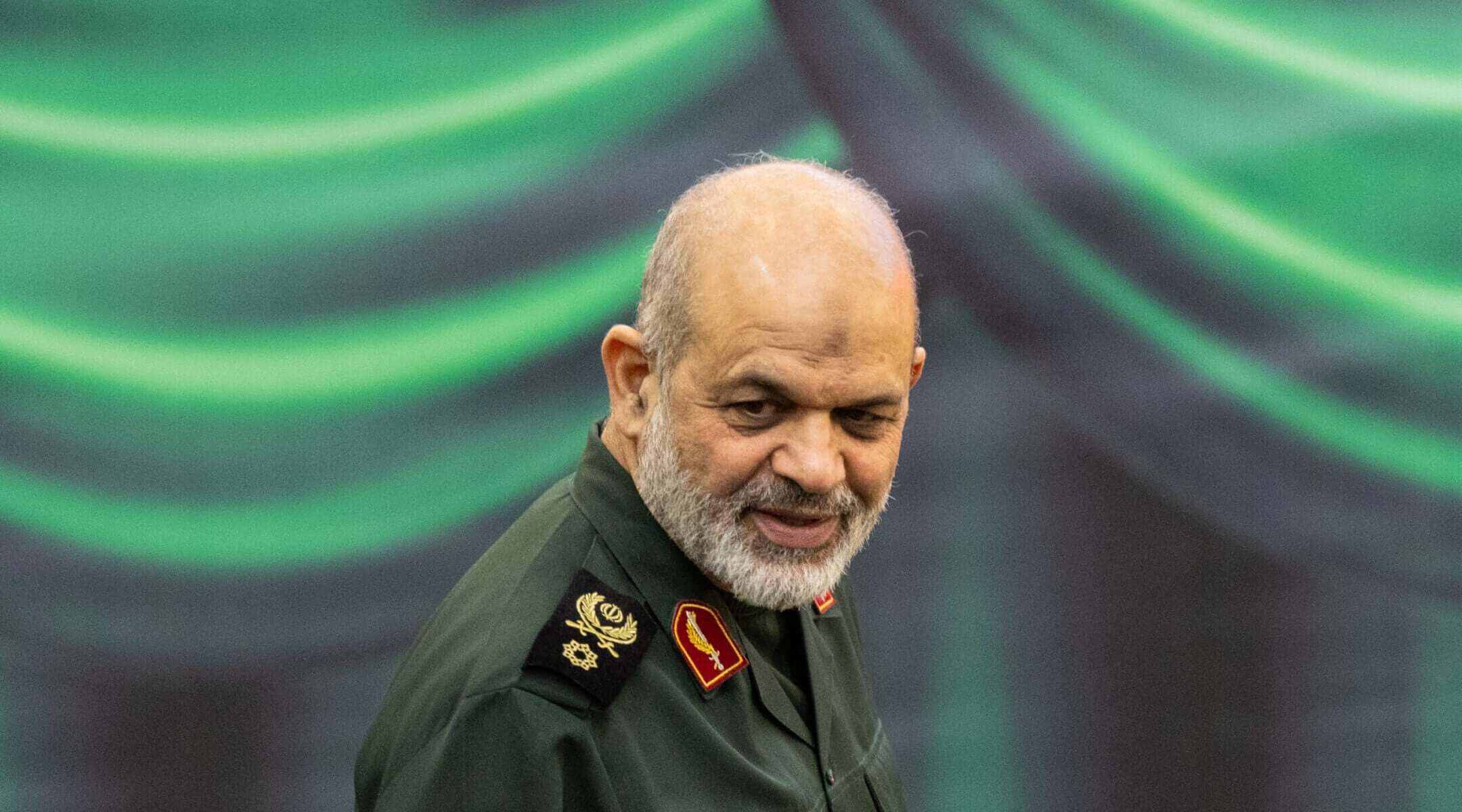
Ahmad Vahidi, then deputy commander of Iran’s Islamic Revolutionary Guard Corps, arrives at the sixth anniversary of Qassem Soleiman’s killing at Tehran’s Musalla. Soleimani, the former commander of the Quds Force of the IRGC, was killed in 2020 in a U.S. missile strike in Iraq. Photo by Sobhan Farajvan/Pacific Press/LightRocket via Getty Images
(JTA) — BUENOS AIRES — Argentina has issued a new arrest warrant for an Iranian official in connection with the 1994 AMIA Jewish community center bombing in Buenos Aires, at the same time that the alleged mastermind was named the new head of Iran’s Islamic Revolutionary Guard Corps.
Ahmad Vahidi was appointed head of the IRGC on Sunday, a day after the unit’s previous leader was killed in the first wave of U.S.-Israeli strikes. Vahidi helmed the IRGC’s Quds Force paramilitary arm responsible for attacks abroad at the time of the AMIA bombing.
Argentinians see poetry in the first strikes, which killed Iran’s supreme leader, Ayatollah Ali Khamenei, and dozens of his deputies as they met in Tehran. The street where they were meeting was named for Louis Pasteur — the same name as the street in Buenos Aires where the AMIA Jewish community organization is located.
Eighty-five people, including children, were killed in the 1994 AMIA bombing. Hezbollah, the Iranian proxy in Lebanon, was quickly identified as having executed the attack, and an arrest warrant for Vahidi was first issued in 2006.
But efforts at accountability faltered for years. A Jewish prosecutor who accused the Argentine president of covering up Iran’s role in exchange for trade benefits, Alberto Nisman, was shot to death in 2015.
Since 2023, when a pro-Israel president was elected, the Argentine government has reinvigorated the investigation and prosecution efforts, as well reopened an inquiry into Nisman’s death, now considered a homicide. A landmark legal ruling in 2024 officially declared that Iran and Hezbollah were responsible for the bombing, setting the state for potential international legal action.
“The pursuit of justice for the 85 victims is a matter of national policy and will continue until the last person responsible pays for this horrific crime, either with their freedom or their life,” Argentine President Javier Milei said in response to the start of the war on Saturday.
He continued, “The Argentine Republic hopes that this joint military action by our allied countries will put a definitive end to what were more than 40 years of oppression and human rights violations in Iran, and that the Iranian people will finally have peace and regain their democracy.”
On Wednesday, federal prosecutor Sebastián Basso asked a judge to formally charge 10 additional Iranian and Lebanese suspects in the AMIA case. The chief of the AMIA investigative unit also issued an international arrest warrant for Ali Asghar Hejazi, a senior Iranian official described as a close aide to Khamenei who so far has apparently survived the attacks on Iran’s leadership.
The moves seek to advance under Argentina’s recently approved trial-in-absentia framework, which would allow courts to try suspects who remain outside the country and have never appeared before Argentine justice.
“Last year we also obtained important information from an Iranian dissident group. What I asked the judge yesterday was to move quickly against the 10 suspects we have identified so we can hold a trial in absentia as soon as possible and show society the evidence the Argentine state has gathered over the past 30 years,” Basso said in an interview with Radio Mitre. “Hezbollah carried out the attack, but it acted as a puppet of the Iranian regime.”
According to a filing submitted to federal judge Daniel Rafecas, prosecutors say Hejazi played a role in the decision-making structure behind the attack. Investigators believe he chaired the Omure Vijeh Committee, a body within the Iranian leadership where intelligence about the target was gathered and the plan to attack the AMIA building was allegedly developed.
This is a moment of great uncertainty. Here’s what you can do about it.
We hope you appreciated this article. Before you go, we’d like to ask you to please support the Forward’s independent Jewish news this Passover. All donations are being matched by the Forward Board - up to $100,000.
This is a moment of great uncertainty for the news media, for the Jewish people, and for our sacred democracy. It is a time of confusion and declining trust in public institutions. An era in which we need humans to report facts, conduct investigations that hold power to account, tell stories that matter and share honest discourse on all that divides us.
With no paywall or subscriptions, the Forward is entirely supported by readers like you. Every dollar you give this Passover is invested in the future of the Forward — and telling the American Jewish story fully and fairly.
The Forward doesn’t rely on funding from institutions like governments or your local Jewish federation. There are thousands of readers like you who give us $18 or $36 or $100 each month or year.
Support our mission to tell the Jewish story fully and fairly.