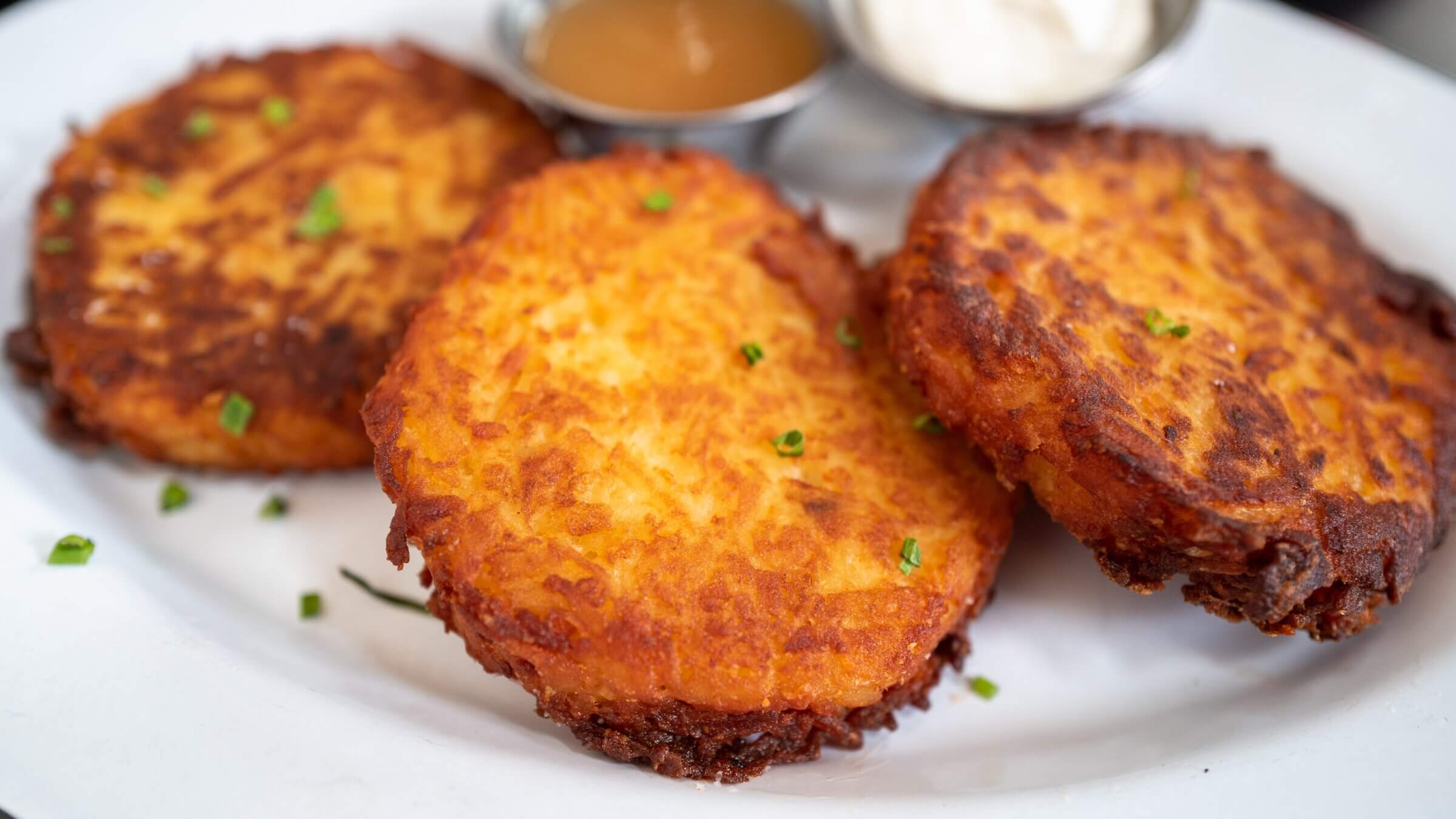
Potato latkes at Wise Sons deli at the Contemporary Jewish Museum in San Francisco. Photo by Gado/Getty Images

By Rob Eshman December 12, 2025
Peak Latke is upon us. Cruise the web and socials this time of year and the varieties of latke experience are astonishing. Umpteen variations on the standard Ashkenazi potato latke, endless takes on Sephardic vegetable latkes, and then, the most arresting category of all, the novelty latke.
Take Carolina Gelen, the Romanian-born Jewish queen of nouveau latke. Each day, or so it seems, Gelen fries up another twist: the pickle latke, for instance, the schnitzel latke (a pounded, fried chicken breast coated in shredded potato and onion), a cinnamon sugar noodle latke, the lemon latke, a miso mushroom latke, and the falatke, which combines falafel ingredients with shredded potatoes and onion and is, at the very least, the best name of all.
But wait, as they say, there’s more!
Onion ring latkes, really?
Online food-fluencer Dan Seidman just completed his own “Eight Days of Latkes” — right before the start of Hanukkah — featuring spicy tuna latkes, scallion latkes and a latke burger, which is Gelen’s schnitzel in burger form.
Jacqueline Spiegel, owner of Jaxsnaxx in New York, makes latkes topped with BBQ short ribs. Mandy Silverman’s onion ring latkes went viral, prompting many variations, as have latke boards, a holiday take on TikTok’s viral cheese and dessert boards. Chef Rafi Hasid at New York’s Miriam restaurant made garbanzo bean latkes, which I actually did cook myself.
The Israel-based cookbook author Adeena Sussman’s own take on the latke board is the latke sheet pan board, wedding the board idea to the many sheet pan latke recipes also out there. She roasts a sheet pan worth of latke batter in the oven, cuts the thing into squares, and tops them with labne, pear gorgonzola, avocado chili crisp. These presentations are all quite beautiful, something I never thought I’d say about latkes.
The latke board and viral Judaism
Sussman also has a latke tutorial for making the classic potato pancake: Alternately grate your onions and potatoes to keep the potatoes from quickly oxidizing. Squeeze the liquid out of your onions and potatoes. Use potato starch to bind, never flour or matzo meal. Fry in a heavy pan, preferably cast iron. Use plenty of oil. Freeze and reheat your latkes — it makes serving them to a crowd easier, and they actually taste better.
I’ve known and written about these latke non-negotiables many times, but now such advice goes viral, along with all those variations.
Think about it. For years, when Hanukkah came around, we’d pull out one of our favorite, reliable Jewish cookbooks — for me it was always Joan Nathan’s The Jewish Holiday Kitchen — find the dog-eared, oil-stained page with the latke recipe, and that was that.
Of course, those analogue days are gone. Now we go online for latkes because, well, we’re online anyway. Joan herself did a popular video of her recipe with Saveur this week.
Peak Latke is partly a function of the fact that Jewish culture mirrors the larger culture, and both are extremely online. We create the recipes we like, sure, but also the recipes that will get likes. I don’t know how many grilled cheese latkes a person can sit down and eat, if any, but I know oozing cheese is clickbait. Same goes for Gelen’s dirty martini latkes, which are packed with sliced green olives and served with a vodka blue cheese sauce. I will never make them, but I couldn’t stop watching her make them.
Beyond the internet’s bottomless content maw, there’s something about all the latke variations that speaks to this Jewish moment.
Latkes are my safe space
Jews are increasingly uncomfortable expressing their identity in public. As I wrote in the Forward this week, 42% of Jewish Americans report feeling unsafe wearing or displaying Jewish symbols in public since the Oct. 7, 2023, Hamas attack on Israel and Israel’s subsequent destruction of Gaza. Some 40% of Jews have avoided doing so, up from 26% in 2023.
Social media is far from neutral territory either, particularly for anything touching Israel. But food? Food feels safe.
Peak Latke is Jews insisting we’re more than one thing in a media environment that flattens Jewish identity into a single, toxic debate. Making and sharing elaborate latke content becomes an act of self-definition: We’re also this. We observe tradition and remix it and argue about potato starch. Not to deflect from the hard stuff, but to assert there’s more to us than crisis and conflict.
Online, Jewish holiday food offers visibility without vulnerability — a way to be publicly, proudly Jewish while staying in culturally neutral territory. It’s community without security guards. Whether this represents creative flowering or strategic withdrawal, or a little of both, I’m not sure. But there’s no question: When the world feels hostile, the kitchen is a refuge. There we find unalloyed joy, then fry it, photograph it and share it with the world.
This is a moment of great uncertainty. Here’s what you can do about it.
We hope you appreciated this article. Before you go, we’d like to ask you to please support the Forward’s independent Jewish news this Passover. All donations are being matched by the Forward Board - up to $100,000.
This is a moment of great uncertainty for the news media, for the Jewish people, and for our sacred democracy. It is a time of confusion and declining trust in public institutions. An era in which we need humans to report facts, conduct investigations that hold power to account, tell stories that matter and share honest discourse on all that divides us.
With no paywall or subscriptions, the Forward is entirely supported by readers like you. Every dollar you give this Passover is invested in the future of the Forward — and telling the American Jewish story fully and fairly.
The Forward doesn’t rely on funding from institutions like governments or your local Jewish federation. There are thousands of readers like you who give us $18 or $36 or $100 each month or year.
Support our mission to tell the Jewish story fully and fairly.