My favorite Christmas scene in literature — and why it makes me feel so Jewish
Louisa May Alcott’s ‘Eight Cousins’ is set in a distinctly un-Jewish milieu, but I saw myself on the page all the same
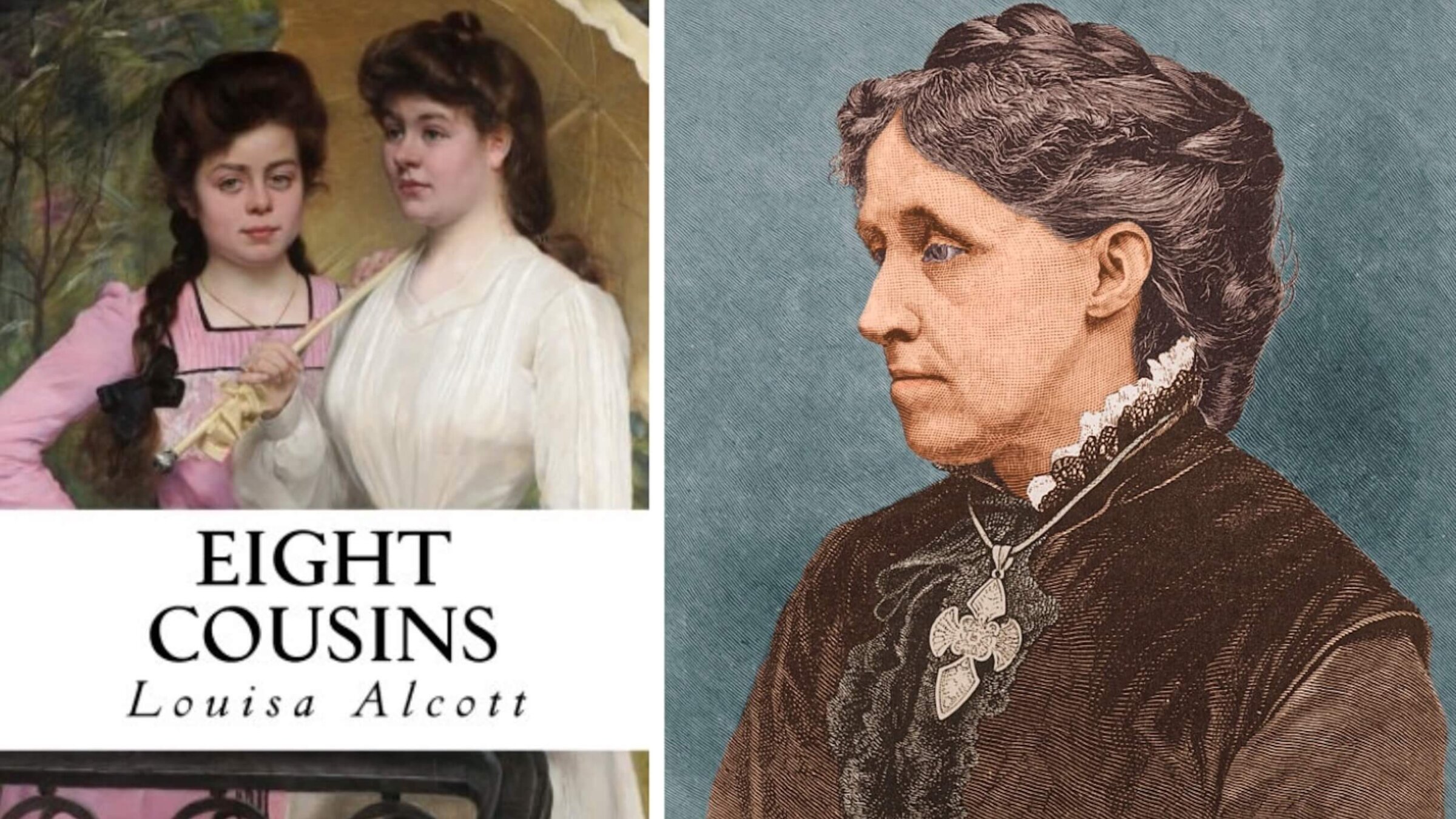
Louisa May Alcott is best known for ‘Little Women,’ but her other novels contain wonders of their own. Photo by Louisa May Alcott photo via Getty Images; Book cover by CreateSpace Independent Publishing

By Talya Zax December 5, 2025
Some years ago, a college friend of my brother’s and mine visited our family home in Denver. “Now I understand it,” he said, sagely, after a couple of hours: “If you aren’t actively making noise in this house, you don’t exist.”
It’s true that I come from a noisy clan. If it is rude to get your family members’ attention by screaming at the top of your lungs, no one ever told me. We grew up far away from our extended family, but on visits to their homes growing up, I saw the same dynamic at play. The louder the gathering, as a general rule, the more successful it was.
I understood, from a young age — years before I learned the term — that “cooperative overlapping” was profoundly Jewish. Our culture celebrated the qualities of being loud and proud.
But I was a bookish child, and my favorite books were old-fashioned ones that chronicle the changes of girlhood: L.M. Montgomery’s Anne of Green Gables series, Noel Streatfield’s Ballet Shoes, and the like. And as I read and re-read them, I noticed something: At some point, the wild girls turned into ladies, and, crucially, quieted down.
Anne Shirley’s maturity is marked by silence: Those who love her notice that, suddenly, she’s stopped the constant stream of chatter that made her both so endearing and so annoying. She starts to speak less often, more thoughtfully, and in more measured tones, and that is how the reader knows she has begun to come into her own.
How could I square the culture of the Jewish family I loved with my desire to be like the girls in my books — full of the quiet magic of young womanhood?
Enter my favorite depiction of Christmas in literature, in Louisa May Alcott’s Eight Cousins.
The novel, a relatively little-known effort by the author of Little Women, centers on a well-off Scottish American clan, bright blonde to the last baby, who live in a WASPy enclave near Boston. It is about, as the title neatly suggests, eight cousins: seven brash boys, and one girl, raised far from her family, who comes into their midst after being orphaned and given over to the care of an uncle with newfangled ideas about childrearing. (Oatmeal and morning sprints in the garden are in; ruffles, long hours shut up indoors, and ladylike affectations are out.)
To a Jewish girl raised in the mountain west, they were an unfamiliar bunch. Except for the sense, fundamental to the book’s premise, that the bonds of family are sacred, and enshrined by ruckus.
I often felt like Rose, the solitary girl, on trips to see my own cousins, in Evanston, Illinois, and the Finger Lakes region of New York. We grew up so far apart that I could not help but feel shy and anxious upon first immersion. My cousins seemed so confident and brilliant, and I would feel small and strange among them. Then the chaos of a happy family would come for me, and in time, I would be shouting and playing along with the rest.
For Rose, that chaos comes to a climax on Christmas, when a seafaring uncle she hasn’t met since she was a baby makes a surprise return home. After many months getting used to the happy, charming, raucous boys who see her as a peer and sometimes a pet, Uncle Jem’s return throws her briefly back into the role of outsider. The family feels complete upon his arrival, in a way it didn’t before. But does that completeness include her?
I knew how the scene ended: with cousin Steve wailing away on a bagpipe, cousin Charlie trying to catch Rose under the mistletoe, everyone dancing a Scottish reel, and cousin Mac — always my favorite — discoursing on grand topics with his elders, while his cousins set loving traps for his embarrassment. But every time I read it, as Rose emerged to meet her long-absent uncle and see if she still fit as well in the family to which she was still getting accustomed, I felt my heart in my throat.
I understood how torn she was between behaving like a ladylike little woman, and like the cheerful, uninhibited, loud girl she had only just learned to embrace being. And in the Christmas gathering she so deeply longed to be a complete part of, I saw my own family — mostly brunette, definitively un-Scottish, highly Jewish, rollicking away.
Yes, it’s odd that, of all things, a scene centered on a Christian holiday would be the one, in all my beloved childhood books, that made me feel like I was seeing my own Jewish family on the page. At the same time, I think there’s something quite dreamy about the connection. And quite American.
The best version of this country is one in which people of all different backgrounds find connection and inspiration in each other. Where a fictional character’s homespun Christmas can provide, unlikely as it is, a strong sense of Jewish affirmation.
The scene ends with the family all singing a ballad called “Sweet Home.” Saccharine? Sure. But every holiday season, I think about Rose, and the home she found, and the different kind of home she and her family gave me. I hope if she could see my Hanukkah celebrations in return — warm candles, loud cousins, some mischief and much merriment — she’d feel the same.