Why am I so much better at singing in Hebrew than in English?
Solving a mystery from my bat mitzvah, two decades later
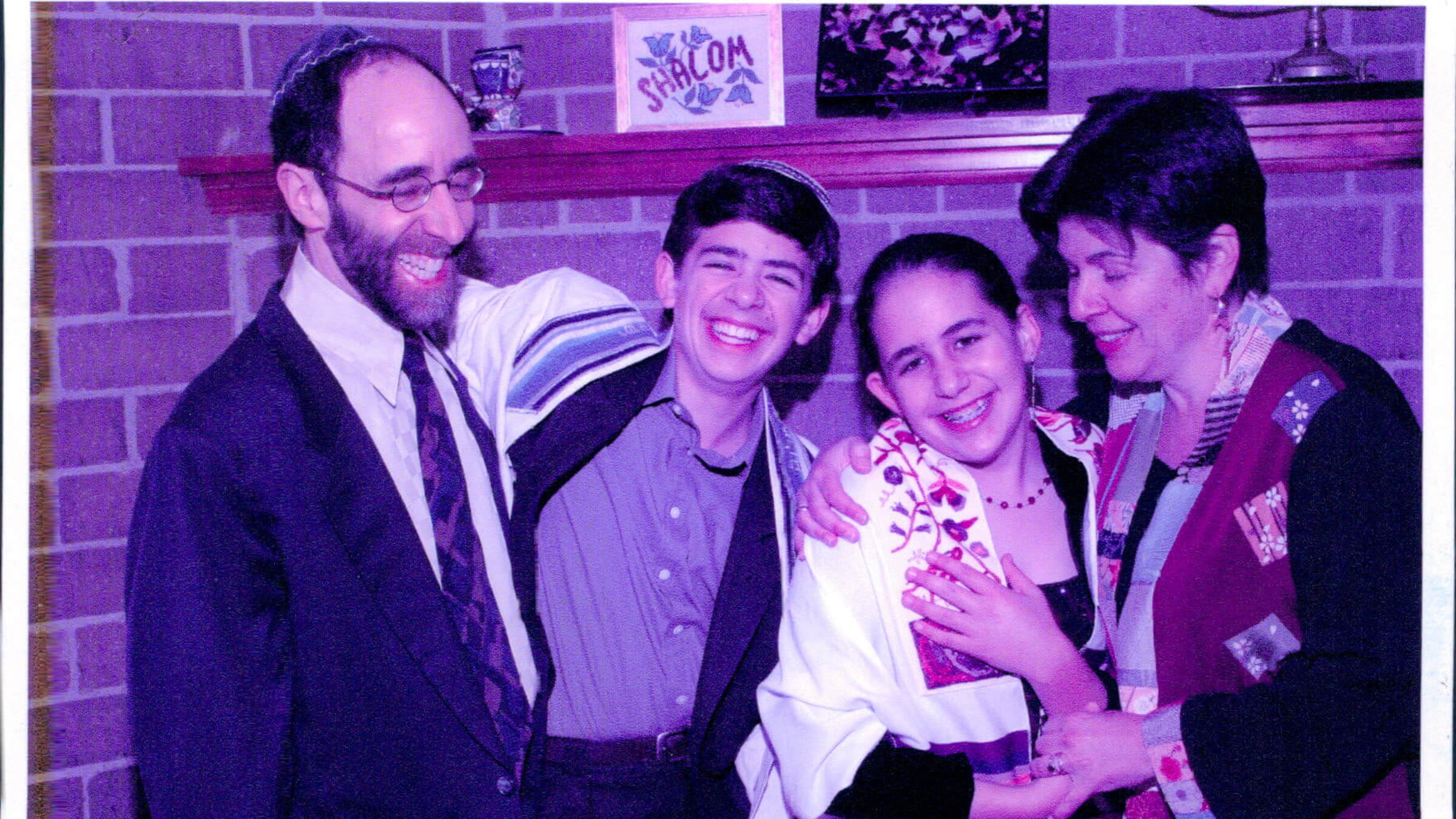
The Zax-Graham family, celebrating the author’s bat mitzvah in 2006. Courtesy of Talya Zax

By Talya Zax February 6, 2026
Twenty years ago this week, I celebrated my bat mitzvah in Denver. Afterward, my voice teacher — oh, the days when I dreamed of Broadway stardom — gave me some puzzling feedback on the ceremony. I sang much better in Hebrew, she said, than I ever had in English.
Since my turn as a teenage Torah-chanting rockstar, others have occasionally complimented my voice — but only when I sing in Hebrew. I’ve been approached swoonily after performing the odd aliyah during High Holiday services, but my efforts at karaoke tend to leave a room cold. (Then again, my toddler nephew seems to like my way with “Old MacDonald”; it’s the quality of your fans, not their quantity, that counts.)
After two decades, I wanted an answer. Why on earth would I have a beautiful voice in Hebrew, a language I have never spoken, but only an OK one in my native tongue?
My old voice teacher shared an idea, back when she first raised the matter: Maybe I was able to produce a less labored sound in Hebrew because it was the first language I ever sang in, from my earliest days going to shul. I floated that theory to my parents, who were skeptical. After all, they rightly noted, there was the matter of my own “Old MacDonald” phase to contend with — although, truthfully, I was more of a “Frère Jacques” girl.
But it turns out that my teacher may not have been that far off.
“The human singing mechanism really organizes itself for expression,” said Nicholas Perna, director of vocal pedagogy at the University of Colorado, Boulder, in a phone interview. (Perna is my dad’s voice teacher; dreams of stardom run in the family, although the talent distribution skews paternal.) In other words: A singer will give their best performances with material that means something to them, not just because the audience can feel their emotion, but because the emotion actually physically changes the way in which the voice produces notes.
So the fact that I started to sing in Hebrew very early in life does matter, only for different reasons than my teacher thought. It’s not that I’m more comfortable with singing in the language. It’s that doing so means more.
My most treasured memories of Jewish practice are all about singing. I learned the melodies I sang at my bat mitzvah not from a rabbi or cantor — the small, lay-led shul in which I grew up had neither — but rather from listening to the whole congregation singing around me. I can still hear some of their voices, all these years later, when I think about certain prayers. A mystical tenor, guiding Kol Nidre; a single quavering soprano, lilting high above “Eitz Chaim”; my father’s firm baritone mixing with my own mezzosoprano as we led Torah services. (I hold the melody; he harmonizes.) To this day, I make a point to join some of my home synagogue’s High Holiday services by Zoom — despite the plethora of in-person options near me in Brooklyn — because of my yearning for the intonations I’ve known since childhood.
When singing anything with such a richness of association attached to it, Perna said, “you are probably optimizing your vocal tract in a way that allows you to express, that your body knows how to innately do.”
The understanding that depth of feeling governs vocal quality dates back millennia, he told me. “The earliest form of music was probably this sort of tribal and/or religious organized voicing,” he said. “Think of King David’s instruction in the Psalms: ‘give a joyful Shout to the Lord.’ Is that scripture, or is that singing instruction?”
Yes, there are some purely mechanical reasons why my voice would be different in the two languages. “English is not an easy language to sing,” Perna said, and it’s true that when I articulate vowels in Hebrew, they feel different: I think I produce them closer to my soft palate, while English expression sits lower, nearer the throat.
And there’s also the fact that I have never considered singing in Hebrew to be a performance. It’s prayer, an experience of communal closeness, not a moment when I wonder if those who listen to me will think I sound nice. Eliminating the kind of stage fright that a sense of performance creates, Perna said, can do wonders.
But really, the emotion is the central thing. Which might explain why “Old MacDonald” is such a hit with my nephew, too. When you sing with love — for a community, a child, or a whole faith tradition — you sing with beauty. E-I-E-I-O.
This is a moment of great uncertainty. Here’s what you can do about it.
We hope you appreciated this article. Before you go, we’d like to ask you to please support the Forward’s independent Jewish news this Passover. All donations are being matched by the Forward Board - up to $100,000.
This is a moment of great uncertainty for the news media, for the Jewish people, and for our sacred democracy. It is a time of confusion and declining trust in public institutions. An era in which we need humans to report facts, conduct investigations that hold power to account, tell stories that matter and share honest discourse on all that divides us.
With no paywall or subscriptions, the Forward is entirely supported by readers like you. Every dollar you give this Passover is invested in the future of the Forward — and telling the American Jewish story fully and fairly.
The Forward doesn’t rely on funding from institutions like governments or your local Jewish federation. There are thousands of readers like you who give us $18 or $36 or $100 each month or year.
Support our mission to tell the Jewish story fully and fairly.