How a song about the food chain became a Seder mainstay
‘Chad Gadya’ is a reminder of our mortality — and the promise it may be temporary
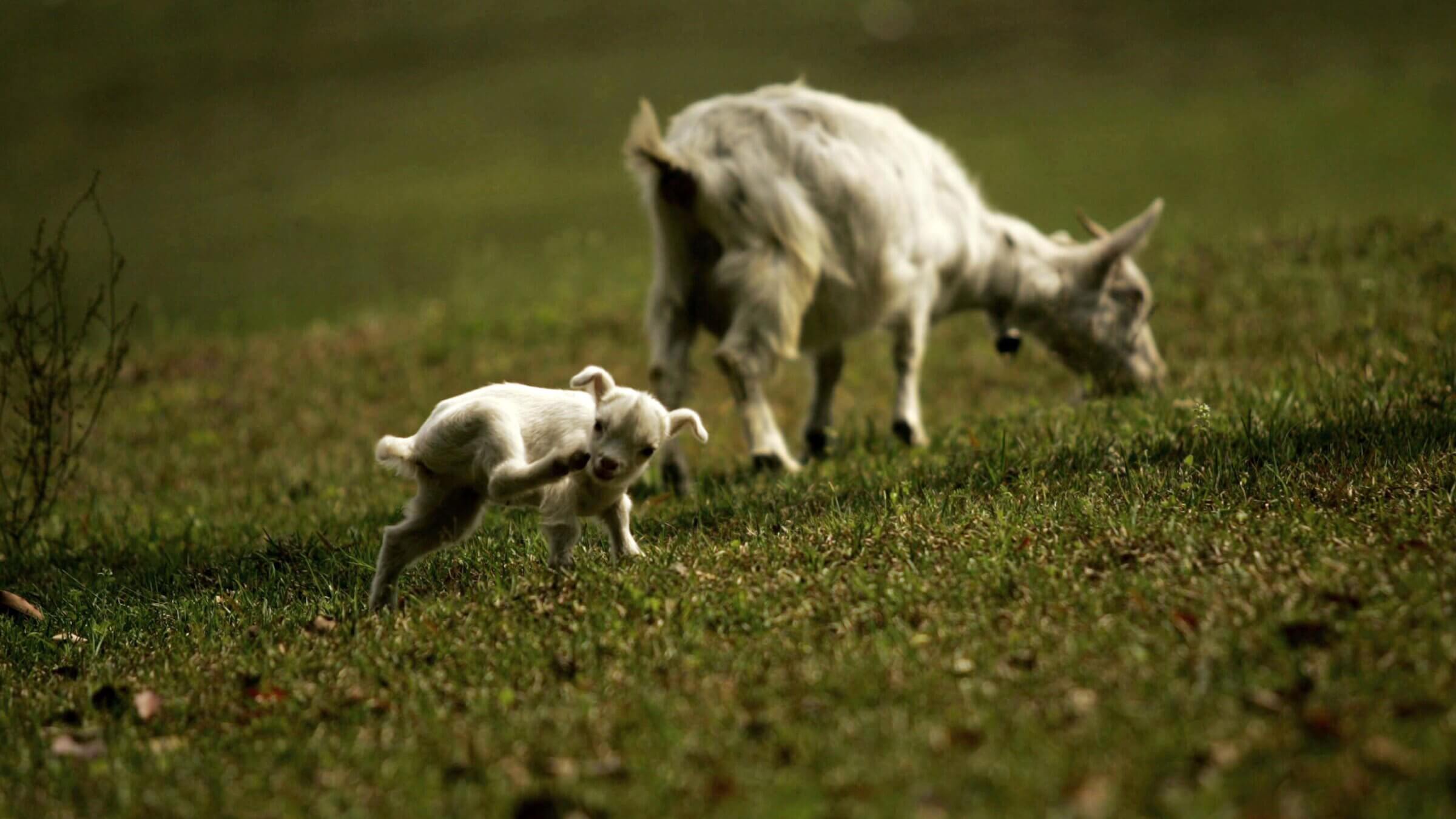
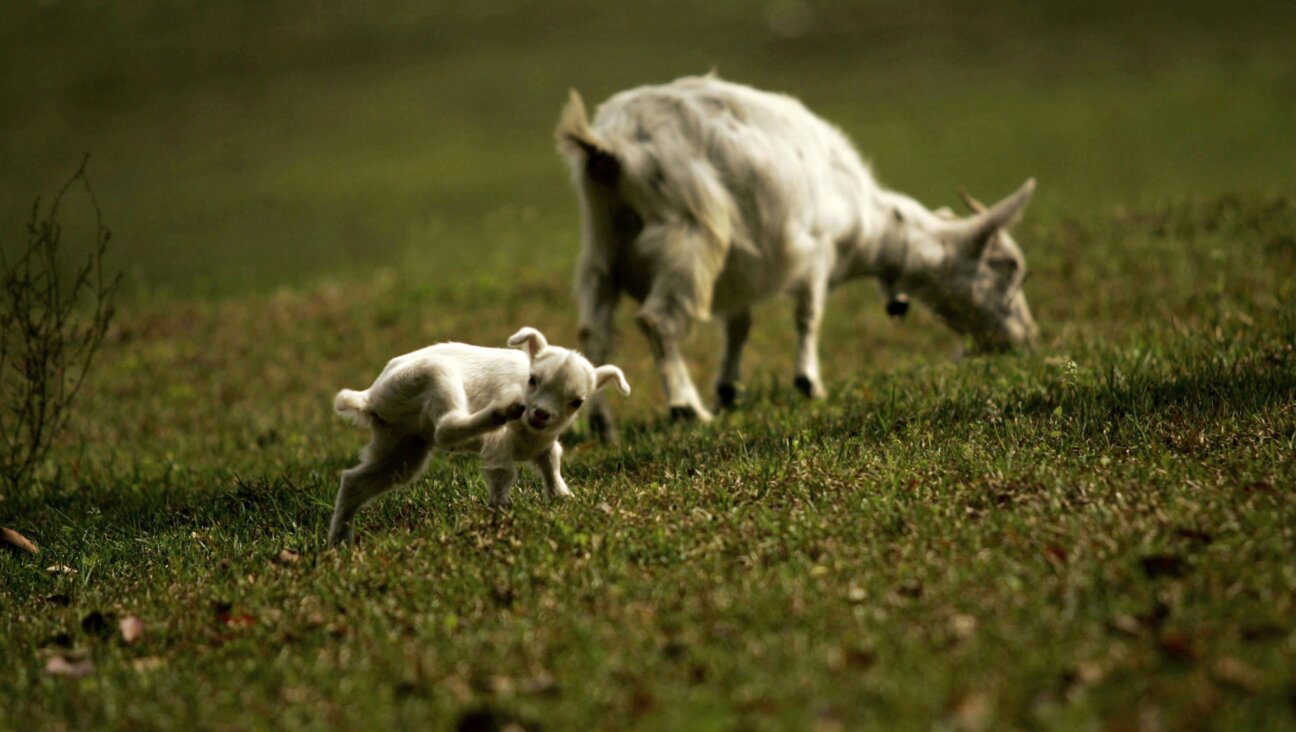
A goat and its kid. Photo by China Photos/Getty Images

By PJ Grisar April 3, 2026
I’m almost positive I heard about the old lady who swallowed a fly before the father who bought a goat for two zuzim.
This occurred to me a few years ago while riding in my sister’s minivan. My niece was in her car seat fidgeting with a toy that plays a catalogue of public domain children’s songs. But unlike the version I’d grown up hearing, where the old lady’s ravenous habit of devouring ever-larger animals is met with the prognostic shrug of “perhaps she’ll die,” the refrain was changed to the more kid-friendly “oh me oh my.”
The Seder tune “Chad Gadya,” which involves a quite similar conceit, has no such timidity when it comes to the ravages of death.
Jack Black once described it as the “original heavy metal song” for the way it progresses along the chain of life from a little goat bought for two zuzim, to the cat who ate the goat, to the dog who bit the cat, all the way up to the angel of death. (“Very Black Sabbath.”)
It is pretty metal — in a kosher Kidz Bop, tot Shabbat kinda way. But why we sing it should, in Jewish circles, be as popular a seasonal question as what a bunny with a clutch of eggs has to do with Jesus’ resurrection. (Some Haggadot explain the greater significance of “Chad Gadya;” my Maxwell House does not.)
Dating the song or rooting out its precise origins is not easy.
As historian Henry Abramson wrote, scholars have noted the song’s similarities to a late Medieval German folk rhyme. While the fact that it is mostly in Aramaic, not the vernacular in Europe in the Middle Ages, suggests an earlier provenance, it is missing from extant Sephardic and Yemenite Haggadot, where one would expect to find texts originating in the language, and the Aramaic itself has many errors.
Abramson reasons that, given the surviving written versions, it was likely adapted sometime in the 14th century from a German children’s rhyme called “The Foreman that Sent Jockel Out,” about an idler named Jockel who a foreman tries to rouse to fieldwork with an escalating series of messengers, ending with a hangman. (Abramson notes the original is characterized by “some Teutonic weirdness,” like a witch sent to subdue a vulture.)
“Chad Gadya” belongs, like its Seder companion “Echad Mi Yodea,” to a genre called “cumulative song,” where verses build with new information a la “12 Days of Christmas.” But “Chad Gadya” stands out for its strangeness and its more oblique message.
Abramson and others see the goat, small and vulnerable, standing in for the Jewish people, and the ensuing parade of antagonists corresponding to historical enemies (Assyrians, Babylonians) and periods of time (Exodus, various conquests), ending with redemption in the Messianic age when the Holy One smites death.
As Rabbi Jonathan Sacks wrote in a commentary for his Haggadah, the song “teaches the great truth of Jewish hope: that though many nations (symbolized by the cat, the dog, and so on) attacked Israel (the goat), each in turn has vanished into oblivion.”
That this truth is conveyed in song, with much banging on the table or animal noises, speaks to the centrality of children in the Passover Seder. And, some think, its inclusion serves a practical purpose: keeping the kids awake through the last leg of a long ritual meal.
My own interpretation is admittedly less lofty. I don’t think of Israel’s tribulations. I do think of the abundance of stray cats in Jerusalem, said to have originated during the British mandate when the city had a rat problem.
And, in the years since my own days as designated Four Questions asker, I’ve been reading “Chad Gadya” into non-Jewish contexts. “The White Cat,” off of Mitski’s new album, Nothing’s About to Happen to Me, contains a lyric that recalls the song, only altered to be a metaphor for the predations of capitalism.
In it, the speaker says she must work to pay for the cat’s house and “for the bugs who drink my blood/and the birds who eat those bugs/so that white cat can kill the birds.”
These cycles speak across cultures and time because they represent a fundamental rule of nature: There’s always a bigger fish (or cat or dog or stick).
To erase death from the equation, like my niece’s toy does with that hapless, insect-ingesting pensioner, is a concession to today’s sensitivities. That’s not to say “The Old Lady Who Swallowed a Fly” represents anything more homiletic than a choking hazard warning, but in the case of “Chad Gadya,” death is the story, and an end to death is the hope.
“The Haggadah ends with the death of death in eternal life,” Rabbi Sacks concluded his drash on the song, which ends when God strikes down the Angel of Death. “A fitting end for the story of a people dedicated to Moshe’s great command, ‘Choose life.’”
I know it’s a principle of faith all over the Haggadah, but I’m more agnostic as to that Messianic promise and maybe more in the camp of our old lady. My understanding of Jewishness, which accords with Moshe’s command, says life is best lived knowing that — perhaps — we’ll die.
This is a moment of great uncertainty. Here’s what you can do about it.
We hope you appreciated this article. Before you go, we’d like to ask you to please support the Forward’s independent Jewish news this Passover. All donations are being matched by the Forward Board - up to $100,000.
This is a moment of great uncertainty for the news media, for the Jewish people, and for our sacred democracy. It is a time of confusion and declining trust in public institutions. An era in which we need humans to report facts, conduct investigations that hold power to account, tell stories that matter and share honest discourse on all that divides us.
With no paywall or subscriptions, the Forward is entirely supported by readers like you. Every dollar you give this Passover is invested in the future of the Forward — and telling the American Jewish story fully and fairly.
The Forward doesn’t rely on funding from institutions like governments or your local Jewish federation. There are thousands of readers like you who give us $18 or $36 or $100 each month or year.
Support our mission to tell the Jewish story fully and fairly.