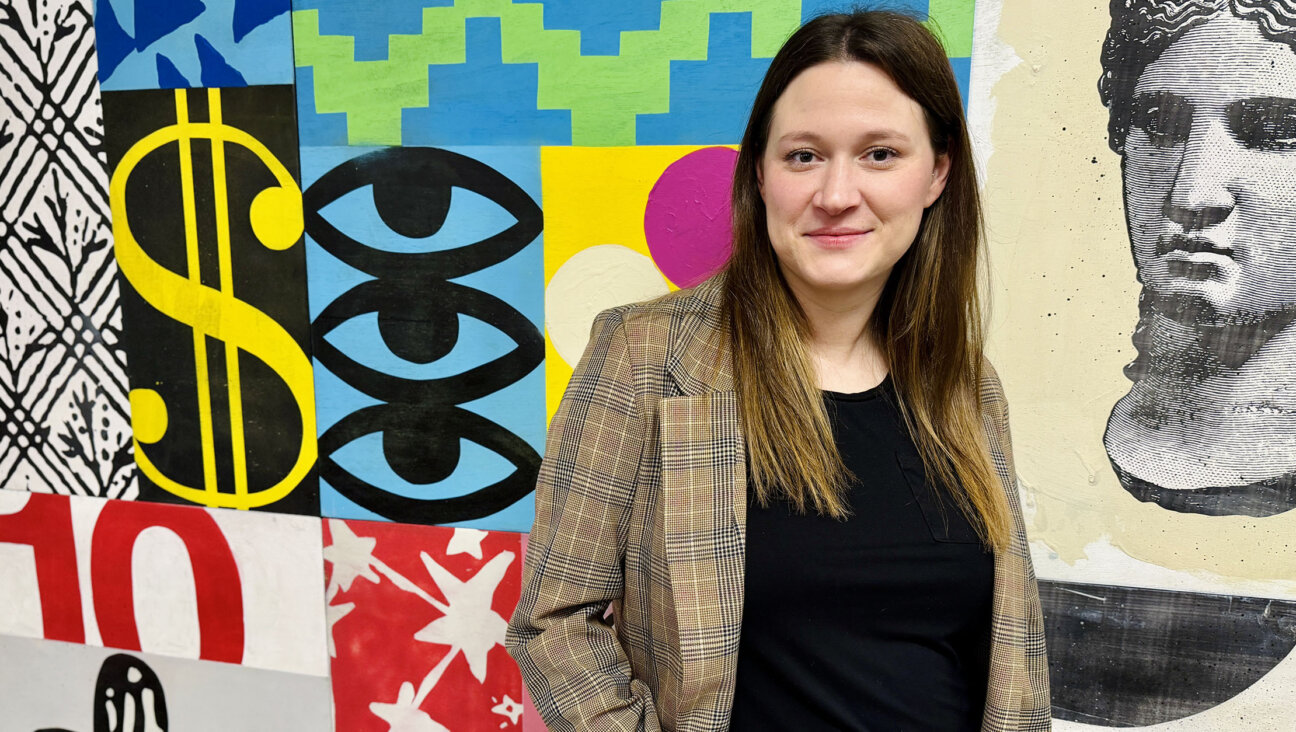
Idit Klein

Graphic by Angelie Zaslavsky
In less than two decades, Keshet has evolved from a small grassroots group in Boston advocating the inclusion of lesbian, gay, bisexual and transgender people in Jewish life to a nationwide organization that, today, operates on a $1.7 million budget and has educators in over 200 Jewish communities across the country.
Much of this success can be attributed to Idit Klein, 40, who became Keshet’s first executive director in 2001. Shocked by a wave of LGBT teen suicides in the 1990s, Klein envisaged eliminating the roots of discrimination by raising the awareness of teachers and parents as well as by boosting the confidence of LGBT youth.
Under her leadership, the organization developed a training curriculum for inclusion, which teaches community leaders about Jewish perspectives on sexual orientation and how to respond to homophobic bullying, among other topics. Keshet also offers support and networking opportunities for Jewish LGBT youth, LGBT parents and, since 2012, parents of LGBT youth.
In 2010, Keshet merged with Jewish Mosaic, a Denver-based Jewish LGBT inclusion organization. In June 2011, Keshet opened its third office in San Francisco.
Klein was the executive producer of the 2005 documentary “Hineini: Coming Out In A Jewish High School,” which screened in more than 14 countries. It depicts the struggle of a lesbian ninth grader, and, according to Keshet, inspired several LGBT youths and their parents to address the issues they faced in their communities.
This spring, a writing contest organized by Keshet lead to the publication of “The Purim Superhero,” the first English LGBT-inclusive Jewish children’s book. The first printing sold out within months.
This is a moment of great uncertainty. Here’s what you can do about it.
We hope you appreciated this article. Before you go, we’d like to ask you to please support the Forward’s independent Jewish news this Passover.
This is a moment of great uncertainty for the news media, for the Jewish people, and for our sacred democracy. It is a time of confusion and declining trust in public institutions. An era in which we need humans to report facts, conduct investigations that hold power to account, tell stories that matter and share honest discourse on all that divides us.
With no paywall or subscriptions, the Forward is entirely supported by readers like you. Every dollar you give this Passover is invested in the future of the Forward — and telling the American Jewish story fully and fairly.
The Forward doesn’t rely on funding from institutions like governments or your local Jewish federation. There are thousands of readers like you who give us $18 or $36 or $100 each month or year.
Support our mission to tell the Jewish story fully and fairly.