Mamdani’s victory is a watershed for Jewish progressives. For the mainstream, it’s wait-and-see.
The Jewish establishment searches for its footing as the balance of power shifts in New York
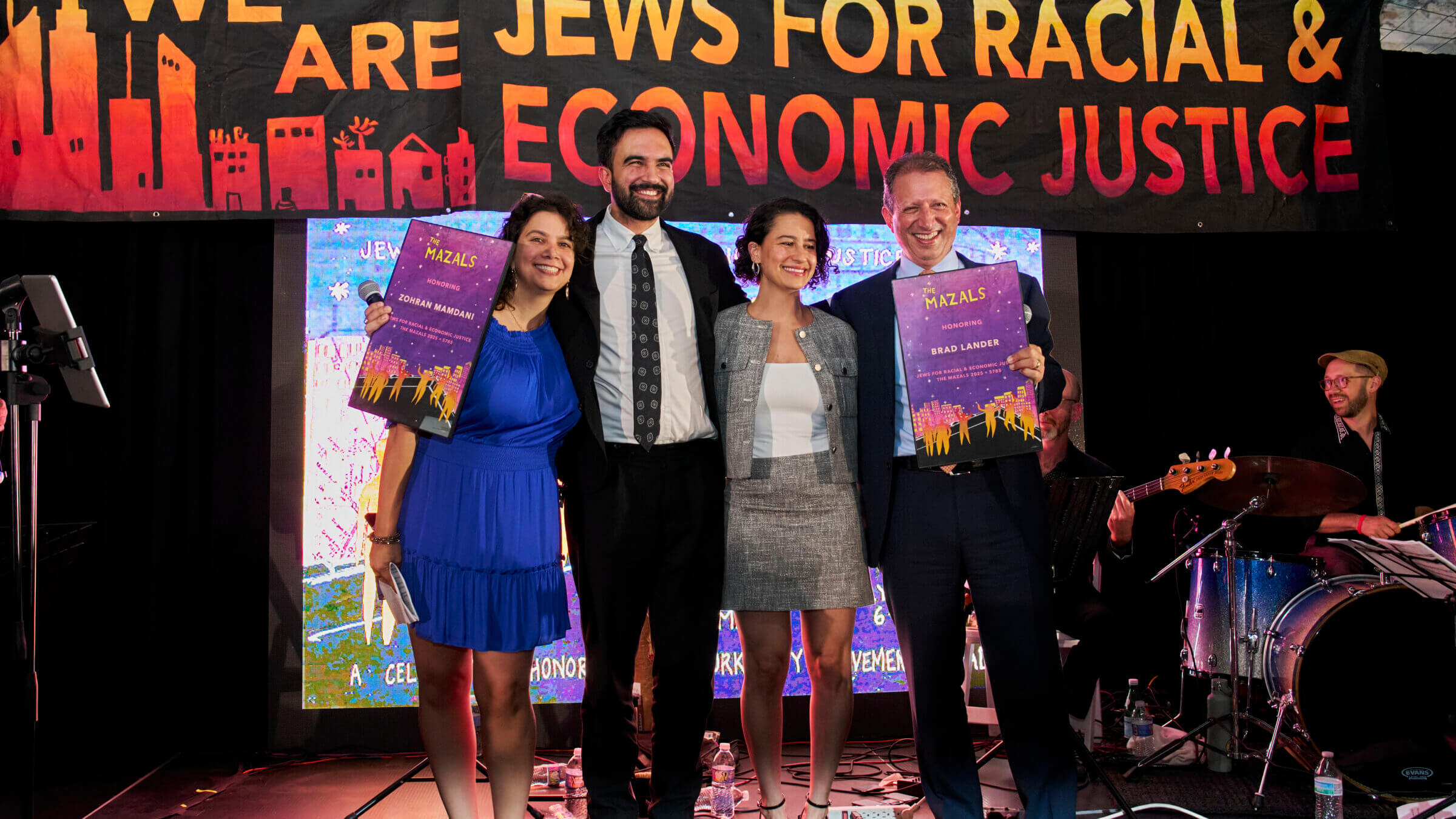
JFREJ executive director Audrey Sasson, left, with Zohran Mamdani at a campaign event in September. Hundreds of the social justice nonprofit’s members volunteered for the Mamdani campaign. Photo by Zachary Schulman

By Louis Keene November 13, 2025
Jewish leaders spent the final weeks of New York City’s mayoral race writing letters, delivering fiery sermons and sharing countless infographics warning about the threat an anti-Zionist mayor would pose for Jews.
Zohran Mamdani won anyway.
Now, those in charge of institutions that have shaped Jewish life in New York for decades are facing a new challenge: How to work with an incoming mayor after joining in a scorched earth campaign against him?
“I genuinely want to be like, ‘The water is warm — just come on in!’” said Audrey Sasson, chief executive of Jews for Racial and Economic Justice, a social justice group that campaigned aggressively for Mamdani. “It’s actually going to be so awesome.”
It’s safe to say many Jewish leaders are skeptical of Sasson’s invitation. The mayor-elect is such a divisive figure among Jewish New Yorkers — a majority of whom backed his opponents, exit polls showed — that a mere meeting with his transition team can be too inflammatory for some Jewish leaders to share publicly.
And yet the old guard will still need to work with the new mayor’s office. For example, UJA-Federation of New York, whose post-election statement vowed to hold Mamdani accountable, partners with health and human service agencies that receive millions of dollars from the city. Rabbis who signed a letter condemning Mamdani’s rhetoric will want the mayor to be attentive to their concerns.
“The Jewish community needs to figure out a way to work with the administration however possible,” said Amy Spitalnick, chief executive of the Jewish Council for Public Affairs, which did not take a position on Mamdani’s candidacy.
Even Jewish groups whose entire focus is Israel and antisemitism hope the mayor-elect reaches out once he’s in office. Jewish on Campus, a student group, praised Mamdani this week for giving “voice to young New Yorkers on issues such as affordability” while simultaneously asking him to meet with pro-Israel leaders at local universities.
Interviews with community leaders revealed a range of approaches to managing a relationship with Mamdani. Some are anticipating a delicate balancing act, cooperating professionally even amid public disagreements. Others, bracing for the worst, may become resistance-like figures, expecting to go all-in on their opposition, as the Anti-Defamation League did in creating a Mamdani Monitor.
Navigating impasse
Jewish New Yorkers who criticized Mamdani for his stance on Israel had lots to point to.
He was reluctant to condemn “globalize the intifada,” a controversial slogan some Jews consider to be a call for violence, and he called Israel’s war in Gaza a genocide. As a state lawmaker, he introduced the Not On Our Dime bill, which he said would strip tax-exempt status from nonprofits that fund Israeli settler violence in the West Bank but which critics claimed targeted mainstream Jewish charities. He has raised the possibility of the city divesting from Israel bonds and said he would seek to arrest Israeli Prime Minister Benjamin Netanyahu if he traveled to New York City.
And Mamdani repeatedly declined to assert Israel’s right to exist “as a Jewish state,” instead stating his belief that Israel has a right to exist with equal rights for all.
Many seized on that as incontrovertible proof of Mamdani’s animus toward Jews who support Israel, unsatisfied by a later commitment to hire Zionists to work in his administration.But he also promised an eightfold increase in city funding for anti-hate crime initiatives, including security grants for houses of worship.
Hindy Poupko, UJA-Federation’s senior vice president of community strategy and external relations, doesn’t know which promises he’d make good on.
“The question is really for mayor-elect Mamdani: how is he going to work with us?” Poupko said. “He needs to demonstrate through actions and not just words that he will protect Jewish New Yorkers and that he will not seek to weaponize City Hall in an effort to demonize the State of Israel.”
There are reasons for Poupko to be optimistic.
Mamdani’s circle is stocked with people who have worked in the New York government for years — Bill de Blasio alumni, former Kathy Hochul advisers, Jewish state assemblymen — and with whom UJA-Federation and its dozens of local agencies have long-established professional relationships.
The strength of those ties may enable the federation to continue to lead opposition on Israel-related matters without undermining the work of partners like the Met Council, which fights hunger, or the Hebrew Free Burial Association.
“Our agencies will continue to work with relevant city agencies that they need to advance their priorities,” Poupko said. “We will continue our close partnership with NYPD to ensure that Jewish communities are safe, and at the same time, we will continue to make our values and priorities clear.”
Wait and see
Israel policy was not central to Mamdani’s campaign or his platform, and he has insisted that his focus as mayor will be on making New York safe and affordable for everyone. But that does not preclude him from taking steps to roll back the city’s cozyness with Israel. He has said, for example, that he plans to discontinue the New York City-Israel Economic Council established by current Mayor Eric Adams, who has professed his love for Israel and said he wants to retire in the Golan Heights.
And Mamdani could influence the future of Cornell Tech, a partnership between Cornell University and the Technion-Israel Institute of Technology, whose campus is on city-owned Roosevelt Island. A Mamdani spokesperson told The New York Times prior to the election that Mamdani — who as an assemblyman urged a boycott of the campus — would “assess” the partnership if he won.
New York Solidarity Network, a pro-Israel advocacy group, issued multiple statements criticizing Mamdani during the campaign and executive director Sara Forman said she’s not waiting for a call from Mamdani’s office.
“What are we going to talk about?” Forman said. “I just don’t think there’s any moderation on his part in regard to many of the issues that the mainstream Jewish community holds dear.”
Like most of the leaders I spoke to, Forman was taking a wait-and-see approach to the mayor-elect. But she was also seeing a silver lining in his electoral breakthrough.
“A lot of Jews in New York are now awake,” she said, due to their anxiety about Mamdani. “We need to have more participation. And I think we’re going to get it.”
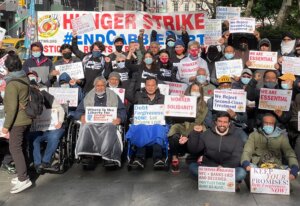
The new power brokers
While many of the largest Jewish groups absorbed the news of Mamdani’s win with trepidation, JFREJ’s Sasson was — in her words — “over the moon.”
The nonprofit, which works on a range of local issues that include housing and immigration and vocally opposed Israel’s war in Gaza, has been connected to the mayor-elect for years, and hundreds of its members canvassed for him.
“This campaign spoke our language,” Sasson said.
Sasson can now imagine a level of influence in city affairs that JFREJ has never before enjoyed.
Where some saw shades of antisemitism in Mamdani’s stances on Israel, JFREJ and other groups on the progressive Jewish flank — organizations such as Bend The Arc, T’ruah and IfNotNow — defended him. Bend The Arc wished Mamdani a “Mazal Tov!” after his victory in stark contrast to the omission of congratulations in statements issued by the UJA-Federation and other groups.
To Sasson, Mamdani’s victory — and the sizable Jewish support he received — is a sign that things are changing in New York as power flows away from traditional Jewish organizations and toward more progressive community nonprofits.
“The Jewish institutions that find themselves a little bit on the back foot right now, I think it’s a moment to do some reflecting and some of their own outreach,” Sasson said.
Spitalnick, who sits on the board of New York Jewish Agenda, a progressive umbrella group, said that while Jewish New Yorkers have “real, legitimate concerns about antisemitism, including the ways in which policies or rhetoric can play a role,” the response of some Jewish organizations threatened to sow division and fear and undermines Jewish safety in the long term.
The appropriate tack for Jewish organizations, Spitalnick said, was to build trust with the administration on areas of policy alignment, whether on crime or education or other issues, to fortify their relationship for moments of opposition.
“Part of what we need to do to advance Jewish safety,” she said, “is to engage across deep lines of disagreement.”
Jacob Kornbluh contributed reporting.
This is a moment of great uncertainty. Here’s what you can do about it.
We hope you appreciated this article. Before you go, we’d like to ask you to please support the Forward’s independent Jewish news this Passover. All donations are being matched by the Forward Board - up to $100,000.
This is a moment of great uncertainty for the news media, for the Jewish people, and for our sacred democracy. It is a time of confusion and declining trust in public institutions. An era in which we need humans to report facts, conduct investigations that hold power to account, tell stories that matter and share honest discourse on all that divides us.
With no paywall or subscriptions, the Forward is entirely supported by readers like you. Every dollar you give this Passover is invested in the future of the Forward — and telling the American Jewish story fully and fairly.
The Forward doesn’t rely on funding from institutions like governments or your local Jewish federation. There are thousands of readers like you who give us $18 or $36 or $100 each month or year.

Support our mission to tell the Jewish story fully and fairly.