The 7 political stories Jews will be watching in 2026
Zohran Mamdani’s agenda, key congressional primaries, and the future of U.S.–Israel relations will dominate the year ahead
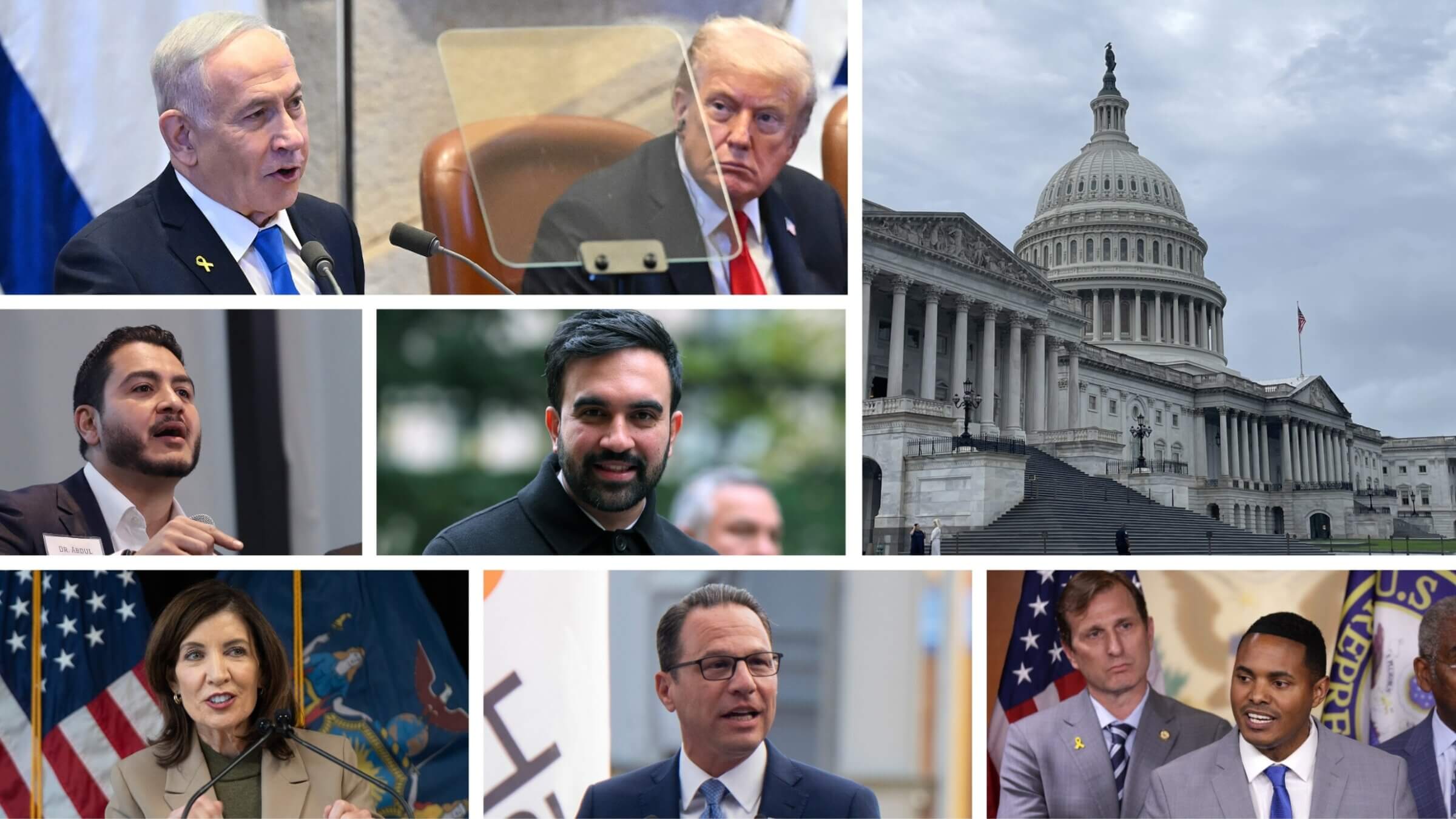
R to L: The U.S. Capitol, Reps. Ritchie Torres and Dan Goldman (D-NY), Pennsylvania Gov. Josh Shapiro, New York Gov. Kathy Hochul, Michigan Senate hopeful Abdul el-Sayed, NYC Mayor-elect Zohran Mamdani, and Israeli Prime Minister Benjamin Netanyahu with President Trump. Photo by Evan Vucci – Pool/Getty Images

By Jacob Kornbluh December 14, 2025
This year brought sweeping change in national politics, in the U.S.-Israel relationship and in New York, the city with the largest Jewish population.
At the Forward, we closely tracked the transition to President Trump’s second term and profiled his cabinet selections and controversial nominees and appointees who trafficked in antisemitism or had ties to white nationalists and expressed admiration for Nazis. We covered the president’s crackdown on the pro-Palestinian campus protests that defined 2024 and the weaponization of antisemitism that led to multimillion dollar settlements with Ivy League universities, including Columbia and Cornell.
We provided exclusive, on-the-ground reporting on the battle for the Jewish vote in the competitive New York City mayoral race. We conducted the first Jewish-media interview with Zohran Mamdani as his campaign began gaining traction, even while he was still polling a distant second in the Democratic primary. We also had inside access to the outgoing Eric Adams administration and its effort to counter rising antisemitism, and had the only local reporter accompanying Adams on his farewell trip to Israel.
Here are the seven political stories we’ll be watching most closely in 2026 that will shape American politics and the Jewish community in the U.S. and abroad.
Zohran Mamdani’s New York City
Mamdani will be sworn into office at midnight on Jan. 1, 2026 as the city’s first Muslim mayor. The swearing-in will be followed by an inauguration ceremony that day at a yet-undisclosed location.
He will immediately face a series of tests on the promises and priorities that carried him through the historic campaign at a moment when the city’s Jewish community remains divided over his stance on Israel. Mamdani’s mixed response to the protest outside the Park East Synagogue, which featured anti-Israel and antisemitic slogans last month, is likely to come under fresh scrutiny as his term begins. Mamdani has remained mum on whether he’d support new legislation that would create a buffer zone outside houses of worship to protect congregants from targeted protests.
Mamdani will also have to decide whether to rescind a recent executive order by Adams barring city agencies from participating in Boycott, Divestment and Sanctions efforts. He will also determine the fate of the recently-created mayor’s office to combat antisemitism, which has pursued a measure adopting the controversial International Holocaust Remembrance Alliance definition of antisemitism, which considers most forms of anti-Zionism as antisemitic. And he will need to decide whether to continue the New York City–Israel Economic Council, an initiative to strengthen economic ties with the Jewish state.
He will file top City Hall and government positions, including the potential appointments of his senior Jewish advisers.
Last month, Mamdani announced he’ll reappoint Jessica Tisch, the Jewish NYC police commissioner, as head of the police department he promised to reform.
The battle for the Jewish vote in the governor’s race
Mamdani’s first months in office and his legislative agenda will also shape the New York governor’s race.
Gov. Kathy Hochul, running for reelection for another full term, endorsed Mamdani in the general election after remaining neutral during the primary. She has signaled reservations about several key Mamdani priorities, like universal free buses, which will need the state’s approval, and has also distanced herself from Mamdani on Israel.
Hochul’s embrace of Mamdani could bolster her standing in the Democratic primary, where she faces a left-wing challenge from her lieutenant governor, Antonio Delgado, who is married to a Jewish woman.
But it could also complicate her outreach to Jewish voters in the general election. Bruce Blakeman, the first Jewish executive of Nassau County on Long Island, and Rep. Elise Stefanik, an upstate congresswoman who has made the fight against antisemitism on college campuses central to her congressional brand, are competing in a GOP primary to challenge Hochul. In 2022, former Rep. Lee Zeldin came within five percentage points of winning the governor’s race, powered by strong Jewish support.
Who will win Jerry Nadler’s seat?
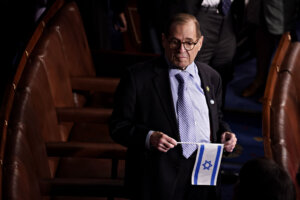
After serving 17 terms in Congress, Rep. Jerry Nadler, co-chair of the Congressional Jewish Caucus, is set to retire to pave the way for generational change, a race that will be closely watched locally and across the nation.
The Manhattan district has one of the largest Jewish electorates in the nation. Jews in the 12th Congressional District account for about 30% of the vote in the Democratic primary. Nadler has, in recent years, campaigned on the need to preserve New York City’s Jewish representation in Congress.
The Jewish candidates vying for the seat include Micah Lasher, Jack Schlossberg, and Cameron Kasky. Assemblymember Alex Bores, whose wife, Darya Moldavskaya, is Jewish, and Councilmember Erik Bottcher are also considered viable candidates. Lasher, a protege of Nadler, has the longtime Jewish congressman’s support. Schlossberg, the grandson of former President John F. Kennedy, has made funding for security measures at synagogues and Jewish institutions a central pillar of his campaign.
Other New York congressional races
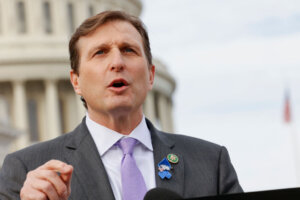
There are a few other House races in New York where pro-Israel incumbents are facing challenges from the left. Those primary contests are a crucial test of whether support for Israel and an alliance with the American Israel Public Affairs Committee has become a political liability.
Rep. Dan Goldman, the Jewish congressman representing the north of Brooklyn and the Lower Manhattan district since 2023, is being challenged in the primary by Brad Lander, the outgoing city comptroller and former mayoral candidate, who has the backing of Mamdani and other progressive firebrands. For his campaign, Lander hired Morris Katz, a Jewish strategist and ad maker who was behind Mamdani’s successful working-class appeal and inspiring TV commercials. Katz produced Lander’s Mr. Rogers-themed launch video.
Lander, who is also Jewish, has become more vocal about Palestinian rights in recent years. He supported Ben & Jerry’s decision to end sales in the occupied West Bank in 2021 and has regularly attended a weekly rally against the Israeli government’s handling of the war in Gaza. Recently, he acknowledged that he divested from Israel Bonds in 2023, ending the city’s decades-long practice of investing millions in Israeli government debt securities. In his candidacy announcement, Lander slammed Goldman’s support for the war in Gaza and accused him of “doing AIPAC’s bidding,” though the incumbent had early on called for humanitarian pauses and criticized Israeli Prime Minister Benjamin Netanyahu’s leadership.
Rep. Ritchie Torres, a three-term pro-Israel progressive from the Bronx, is facing three primary challengers, a crowded field that could ultimately make it easier for him to win reelection. Michael Blake, a former state legislator who ran for mayor in the Democratic primary and later endorsed Mamdani, is making attacks on AIPAC central to his campaign, and Dalourny Nemorin, an organizer for the Democratic Socialists of America’s local chapter, is testing the momentum behind newcomer and socialist candidates. Assemblywoman Amanda Septimo, who joined an AIPAC-sponsored trip to Israel in 2016 and visited Israel again following the Oct. 7, 2023 Hamas attacks, also announced her candidacy. Septimo is considered a member of Mamdani’s inner circle.
Rep. Michael Lawler, a Republican who has been a strong pro-Israel voice since his election in 2022, is expected to face the winner of an eight-person Democratic primary in a tough election cycle for Republicans. Lawler has the support of the growing Hasidic population in Rockland County. The leading candidates in the Democratic primary are Rockland County Legislator Beth Davidson, who is Jewish, and Army veteran Cait Conley.
Michigan Senate race a test for Democrats’ positions on Israel

The Michigan Senate race is shaping up to be one of the clearest tests of the Democratic coalition and of how the party navigates Israel.
The leading candidates in the Democratic primary are Abdul El-Sayed, an Egyptian-American who is seeking to channel the energy of the 2024 Uncommitted movement and build on Mamdani’s surprise success in New York, and Rep. Haley Stevens, a pro-Israel Democrat who defeated progressive Jewish Rep. Andy Levin in 2022 with significant help from AIPAC.
The outcome of the contest will offer an early read on whether the left’s anti-establishment momentum can break through in a battleground state, and how much pro-Israel groups retain their influence in Democratic primaries.
The Jewish governors running for reelection
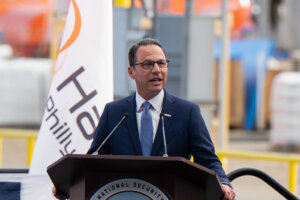
Pennsylvania Gov. Josh Shapiro and Illinois Gov. JB Pritzker are widely expected to win reelection. Their margins, messages and national profile will position both as major figures in the early mix for the 2028 presidential race. Each is navigating the same balancing act that will challenge Democrats with national ambitions: trying to appeal to a base that is growing more critical of Israel while still keeping the trust of Jewish voters and pro-Israel allies.
Shapiro, who was viewed as a potential first Jewish president in 2024, remains on the narrow path he has carved out for himself. He highlights his Jewish identity, support for Israel and bipartisan appeal in all of his public appearances.
Pritzker, who governs a state with one of the largest Palestinian-American populations in the country, has become one of the most prominent voices of resistance to President Donald Trump. He has repeatedly invoked Nazi Germany in criticizing the administration’s policies and endorsed a Senate push to block U.S. arms sales to Israel to pressure Prime Minister Benjamin Netanyahu on the Israeli-Palestinian conflict.
Israeli elections
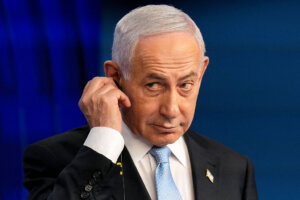
Israeli Prime Minister Benjamin Netanyahu will continue to be in the headlines in America. He is expected to spend New Year’s Eve in the United States after yet another meeting with Trump at the Mar-a-Lago resort — the sixth meeting this year — underscoring the unusually close alignment between the two leaders.
Netanyahu is better known to Americans than most world leaders. He is now Israel’s longest-tenured prime minister, having served for more than 18 years as the country’s leader. He grew up in Philadelphia in the early 1960s, attended college and graduate school in Boston, served as Israel’s ambassador to the U.N. in the mid-1980s, and has delivered four speeches to a joint session of Congress.
Following three tumultuous years, Israeli voters are poised to head back to the ballot box sometime in 2026 — depending on how long the coalition government holds onto power amid legislative challenges — for what will effectively be another referendum on Netanyahu’s leadership. A January 2024 poll found that only 15% of Israelis, including 36% of those who had previously voted for his Likud Party, wanted to see Netanyahu stay on as prime minister following the failure to protect Israel on Oct. 7.
But the landscape has shifted dramatically since then.
All living hostages have been freed, and the remains of all those held by Hamas — but for one — have been returned. Hamas and Hezbollah leaders have been killed, and Iran’s nuclear program was set back after the 12-day war earlier this year, and the conflict in Gaza ended on terms jointly shaped by Washington and Jerusalem. Netanyahu, receiving the political backing from Trump, has also requested a pre-conviction pardon from Israeli President Isaac Herzog. Meanwhile, the opposition remains fractured among several would-be successors, complicating a unified challenge to Netanyahu’s rule.
A majority of American Jews hold an unfavorable view of Netanyahu and senior pro-Israel Democrats have called for a leadership change in Israel.
Netanyahu is also expected to visit New York City, at the latest next September when he comes to address the annual United Nations General Assembly, which will test Mamdani’s pledge to order his arrest if he visits Manhattan.
This is a moment of great uncertainty. Here’s what you can do about it.
We hope you appreciated this article. Before you go, we’d like to ask you to please support the Forward’s independent Jewish news this Passover. All donations are being matched by the Forward Board - up to $100,000.
This is a moment of great uncertainty for the news media, for the Jewish people, and for our sacred democracy. It is a time of confusion and declining trust in public institutions. An era in which we need humans to report facts, conduct investigations that hold power to account, tell stories that matter and share honest discourse on all that divides us.
With no paywall or subscriptions, the Forward is entirely supported by readers like you. Every dollar you give this Passover is invested in the future of the Forward — and telling the American Jewish story fully and fairly.
The Forward doesn’t rely on funding from institutions like governments or your local Jewish federation. There are thousands of readers like you who give us $18 or $36 or $100 each month or year.
Support our mission to tell the Jewish story fully and fairly.