She’s a democratic socialist who affirmed Israel’s right to exist. Can she be LA’s next mayor?
Nithya Raman thinks she can win over the city’s Jewish voters. Step one: Convince them she’s not Zohran Mamdani.
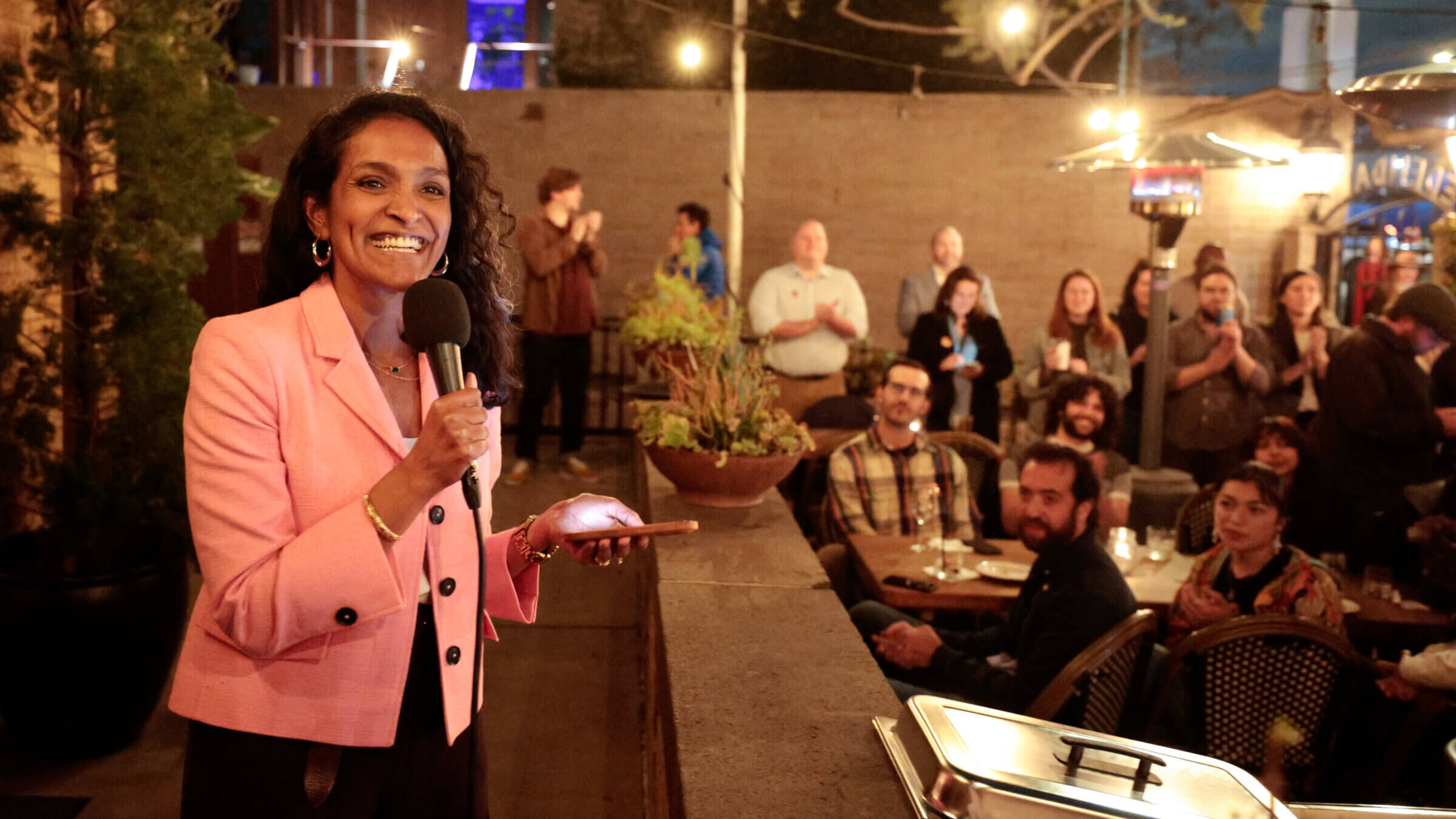
Los Angeles City Councilmember Nithya Raman, like New York City Mayor Zohran Mamdani, drew on a groundswell of progressive support to win elected office in 2020 and 2024. Photo by Myung Chun / Los Angeles Times via Getty Images

By Louis Keene February 18, 2026
Louis spoke to more than a dozen local elected officials, nonprofit executives and communal leaders for this story, including Councilmember Nithya Raman.
LOS ANGELES – City Councilmember Nithya Raman won the backing of two very different organizations the last time she ran for office. One of them was Democrats for Israel Los Angeles, a liberal Zionist group. The other was perhaps the most overtly anti-Israel collective in town — the local chapter of Democratic Socialists of America. Raman’s politics divided both groups, but the unconventional coalition helped lift her to re-election.
Two years later, Raman hopes to recapture that broad appeal in her bid to be the city’s next mayor. The 44-year-old DSA member, who represents parts of the San Fernando Valley, Hollywood and Silver Lake, surprised her colleagues and incumbent Mayor Karen Bass earlier this month with her late entry into the June 2 primary race. And while political observers on both coasts have noted her similarities to New York City Mayor Zohran Mamdani, whose 50,000 campaign volunteers drew from a slew of progressive groups, Raman hopes her tenure on city council — and the Jewish allies she’s made along the way — can attest to the differences.
“Mamdani is clearly a very popular politician, and so to be compared to a popular politician who is very good at communication — it’s a good thing,” Raman told the Forward in a phone interview. “I will also say that I am my own person, and I have a record of service here — five years of service to the city and to my district that clearly lay out who I am, how I have governed, and my approach.”
Raman’s relationship with DSA is something of a rocky symbiosis. In 2020, she became the first member of the movement to win a seat on LA’s city council, with left-wing grassroots organizers helping turn out a record number of voters to defeat an incumbent. Raman has since broken with DSA on votes and in public comments, on both Israel-related issues — for one, she does not support the Boycott, Divest and Sanctions movement — and municipal ones. Yet even as three other DSA members have joined her on city council — and another, Rae Huang, runs for mayor — Raman remains the chapter’s biggest star as well as its strongest candidate in the race.
Her community outreach and her openness to engaging on Israel and antisemitism have endeared her to some Jewish voters in LA’s 4th council district, and she won re-election in 2024 despite a redistricting that largely subtracted the progressive base that put her in office. She touts her second victory as proof of her broadly effective governance. But some Jewish constituents remain ambivalent about or opposed to Raman due to politics they deem insufficiently pro-Israel or because of her affiliation with DSA.
Interviews with 10 local Jewish leaders, including five who live in her district or whose institutions predominantly serve her constituents, underscored both the inroads Raman made with Jewish communities during her tenure and the difficulty she may have winning over voters citywide. (The top two primary finishers advance to a November runoff if no candidate receives a majority of the vote.)
“I know if I had a need, she would take my phone call and would do her best to be of assistance,” said Rabbi Sarah Hronsky, who leads Temple Beth Hillel, a Reform synagogue just outside of Raman’s district in Valley Village. “I think she genuinely cares about humanity. I just don’t think it is very clear to the Jewish community where she stands on the topic of Israel, and where she stands in terms of the increase in antisemitism.”
Those positions are well documented, and in some cases Raman has volunteered them. And though they were a wedge issue inside DSA, they also offer a point of departure from Bass, an establishment Democrat whose handling of Jewish issues — especially on anti-Israel protests — has been called into question.

Building a track record — and Shabbat-friendly crosswalks — in Jewish areas
Even as Raman, a Harvard-educated urban planner, soared from obscurity into office in 2020 on a groundswell of progressive activism, she did not neatly map onto DSA politics.
The national organization calls for an end to U.S. aid to Israel in its national platform, and the 90% of the LA chapter — some 2,000 dues-paying members, according to one longtime organizer — voted in 2017 to endorse the Boycott, Divestment and Sanctions movement. Raman, with DSA’s endorsement already in hand, took a softer tack that summer on a Democrats for Israel questionnaire. In a written response, she affirmed Israel’s “right to exist” and said she did not support BDS, though adding her view that such efforts are protected by the First Amendment.
“I personally am deeply upset by policy decisions in India, my own country of origin, and while I have not participated in a boycott, I understand the argument for withholding economic activity,” she wrote. (Raman moved to the U.S. when she was 6.)
With Raman an outsider candidate for the council seat and not favored in the election, the responses attracted little attention outside of DSA. She eventually won in an unusually shaped jurisdiction that included Jewish and Israeli neighborhoods like Hancock Park and Sherman Oaks and young, progressive pockets like Koreatown and Silver Lake.
“I don’t think she’s afraid to diverge from the points of view of the DSA.”Gregg SolkovitsPresident, Democrats for Israel Los Angeles
Once in office, Raman became a regular guest at Jewish community functions in and around her district. She joined Stephen Wise Temple for High Holiday services and the Silver Lake JCC for an interfaith Passover seder. Hronsky noted that Raman often stayed for the nearly two-hour duration of Valley-wide “Shabbat in the Park” gatherings, rather than the perfunctory photo-op-and-handshakes some might expect of a busy politician. At Raman’s request, Temple Beth Hillel had hosted the councilmember for a forum to take questions from congregants and the broader community.
“Folks got to speak very freely with her,” Hronsky said, “and she went right back and forth and interacted on a one to one basis. You don’t always get that kind of access to your councilmembers.”
Outside Chabad of Sherman Oaks, she helped push through the addition of a timed traffic signal that enabled Orthodox Jews to cross a busy thoroughfare on Shabbat — an improvement the synagogue’s rabbi, Mendel Lipskier, said he had sought for more than a decade.
The Hamas-led Oct. 7, 2023, attacks, in which around 1,200 people in Israel were killed and another 250 taken hostage into Gaza, thrust her connection to DSA into the spotlight.
That day, as Raman issued a statement “condemning the horrific violence by Hamas and praying for a peaceful end to this conflict,” the national DSA in its statement called the massacre a “direct result of Israel’s apartheid regime.” Raman, who had attended an Oct. 9 vigil at Stephen Wise, soon released a longer second statement in which she rejected DSA’s missive as “unacceptably devoid of empathy.”

Split constituencies
Her politics continued to defy easy categorization as the war in Gaza wore on. During a temporary ceasefire in November 2023, Raman adjourned a session of city council by memorializing the 11,000 Palestinians who had reportedly died to that point in Gaza. “My pain is unspeakable,” she said, closing the message by calling for “urgent action to stop these civilian casualties and bring the hostages home.”
The following June, she introduced a municipal resolution calling for an immediate ceasefire and release of hostages. The resolution, which never reached a vote, was slammed by the local Jewish federation and other mainline Jewish groups as “fostering hostility toward the Jewish community.” (The federation declined to comment for this article.)
The ceasefire calls put her at odds with much of her Jewish constituency, which leans heavily pro-Israel. One Jewish leader said his synagogue, which serves many of her constituents, had had to keep Raman at arm’s length because not declaring Hamas entirely responsible for the devastation in Gaza meant Raman failed some congregants’ pro-Israel litmus test.
Yet as her term wound down, Raman found the support of DFI-LA, a Democratic Party club that considers local Jewish issues in addition to candidates’ stances on Israel. Gregg Solkovits, the organization’s president, said the combination of Raman’s public statements on Israel and her community engagement outweighed the ceasefire calls.
“She had reached out to the Jewish community and made clear indications that she was willing to be educated on our issues and to work with us,” Solkovits explained in an interview, “and she has continued to do that as she’s taken office.”
The vote of confidence had been controversial within the organization. “There were members of our executive board that are very bothered by anyone who comes out of DSA world,” he said. But Raman, Solkovits added, was not as ideologically rigid as other DSA politicians.
The independent streak cost her some fans in DSA, whose LA chapter endorsed Raman but also censured her for pursuing the pro-Israel club’s support. Though Council District 4 lost DSA-friendly Koreatown in the redistricting process, Raman won reelection with a majority of votes in the first round of voting.
“I don’t think she’s afraid to diverge from the points of view of the DSA,” Solkovits said. “In fact, I think she’s broadened her base. Which is one of the signs of a smart politician.”
Raman continued to tackle Jewish issues after her re-election. After a pair of Israeli diplomats in Washington, D.C., were assassinated in 2025, allegedly by a pro-Palestinian gunman, Raman issued a statement condemning the attack as a “horrific act of antisemitism.” And when vandals spray-painted antisemitic graffiti in her district, Raman and a staffer went to paint over it.
“Ultimately, my role is to make sure that my residents feel safe, to make sure that my residents know that issues related to violence or antisemitism are being taken seriously — that our response will be aggressive, proactive, preventative,” Raman said.
But not everyone finds her record as convincing as Solkovits does — or feels as heard as Temple Beth Hillel’s Hronsky. Lindsey Imber, who sits on the Sherman Oaks Neighborhood Council, said Raman dodged her question about pro-Palestinian encampments on college campuses and never returned to the neighborhood council meetings after that.
But Imber, who is Jewish, suggested that Raman’s approach to homelessness — which included her opposition to a rule that banned encampments less than 500 feet from schools — may be just as problematic to Jewish voters as any other issue.
“That was one of the things that really created a schism between the council member and the and the actual constituency of the district,” Imber said.
Others outside the district say Raman’s DSA connections are inherently disqualifying. Nate Miller, an LA-based public relations executive who specializes in Jewish affairs, said that while he was frustrated with Bass, he could not vote for a member of the movement.
“I understand those concerns, and I respect those concerns,” Raman said. “But I think that I have been able to really, really work to make sure that the Jewish community in my district knows that I am there for them in the ways that a council member would need to be. And that is exactly the way that I would show up for them if I were to be the mayor.”
Senior leaders of several synagogues in her district — including Stephen Wise, Valley Beth Shalom and Temple Israel of Hollywood — declined to speak on the record for this story. (Lipskier, of Chabad of Sherman Oaks, said he did not follow city politics and that his interactions with Raman were limited but that “whatever we asked for, she was nice, she was available. I don’t have nothing negative to say.”)
Crossing to victory
The incumbent Raman wants to supplant is fighting to retain her own Jewish backing. Bass, who attended public high school in heavily Jewish West Los Angeles, has long enjoyed a broad base of support that includes labor unions, the liberal donor class and a coalition of legacy progressive groups.
But her approval rating has plummeted since the January 2025 wildfires, which wiped out the Pacific Palisades, a wealthy and heavily Jewish enclave. Two candidates running to her right — Adam Miller and Spencer Pratt — may siphon off some votes in the primary.
Jewish leaders also said Bass failed to deliver on commitments she made after a 2024 protest outside a West Los Angeles synagogue descended into chaos. One of those commitments was to establish buffer zones outside synagogues where protesting would be legally prohibited.
Raman told the Forward she was not sure where she stood on the issue. “The idea of protesting outside a religious institution is troubling to me,” she said, “but I also have voted to uphold First Amendment rights to speak up and to protest in the past. I think that we can find a way to balance people’s needs for safety with that First Amendment right.”
Raman will want to reignite the grassroots support that propelled her candidacy in 2020. But her late entry into the mayor’s race isn’t helping.
Raman admitted she had entered the fray too late to seek most primary endorsements, a reality underlined by Councilmember Hugo Soto-Martinez — himself a DSA member — declining to switch allegiances from Bass after her announcement. And Solkovits said he was not sure whether DFI-LA would support Raman this time around. (Bass received its support in 2024, but the group sometimes supports multiple candidates in the same race.)
And her positions on Israel make up only part of the frustrations that may be lingering among her DSA peers.
Raman broke with DSA council members on Measure ULA, a so-called “mansion tax” that had been a major progressive legislation but which Raman said hamstrung multifamily housing construction. She also voted against a $2.6 billion convention center upgrade supported by Soto-Martinez and fellow DSA member Eunisses Hernandez, who represent union-heavy districts. (Raman said the city was already under huge financial pressure and could not afford it.)
If that makes it harder to rally the base that first put her in office — and replicate the massive wave of progressive turnout that got Mamdani elected in New York — Raman says she isn’t worried.
“My goals here are centered around Angelenos, their safety and their ability to thrive in a city that is deeply unaffordable and in a city that is struggling to deliver basic services,” she said. “That’s the message that I think will activate voters.”
This is a moment of great uncertainty. Here’s what you can do about it.
We hope you appreciated this article. Before you go, we’d like to ask you to please support the Forward’s independent Jewish news this Passover. All donations are being matched by the Forward Board - up to $100,000.
This is a moment of great uncertainty for the news media, for the Jewish people, and for our sacred democracy. It is a time of confusion and declining trust in public institutions. An era in which we need humans to report facts, conduct investigations that hold power to account, tell stories that matter and share honest discourse on all that divides us.
With no paywall or subscriptions, the Forward is entirely supported by readers like you. Every dollar you give this Passover is invested in the future of the Forward — and telling the American Jewish story fully and fairly.
The Forward doesn’t rely on funding from institutions like governments or your local Jewish federation. There are thousands of readers like you who give us $18 or $36 or $100 each month or year.
Support our mission to tell the Jewish story fully and fairly.