Indiana Jews race to reclaim a synagogue that shaped the Reform movement
The Lafayette congregation pioneered egalitarian prayer and launched national rabbinic leaders. Now locals hope to reclaim the 1867 building before it’s sold
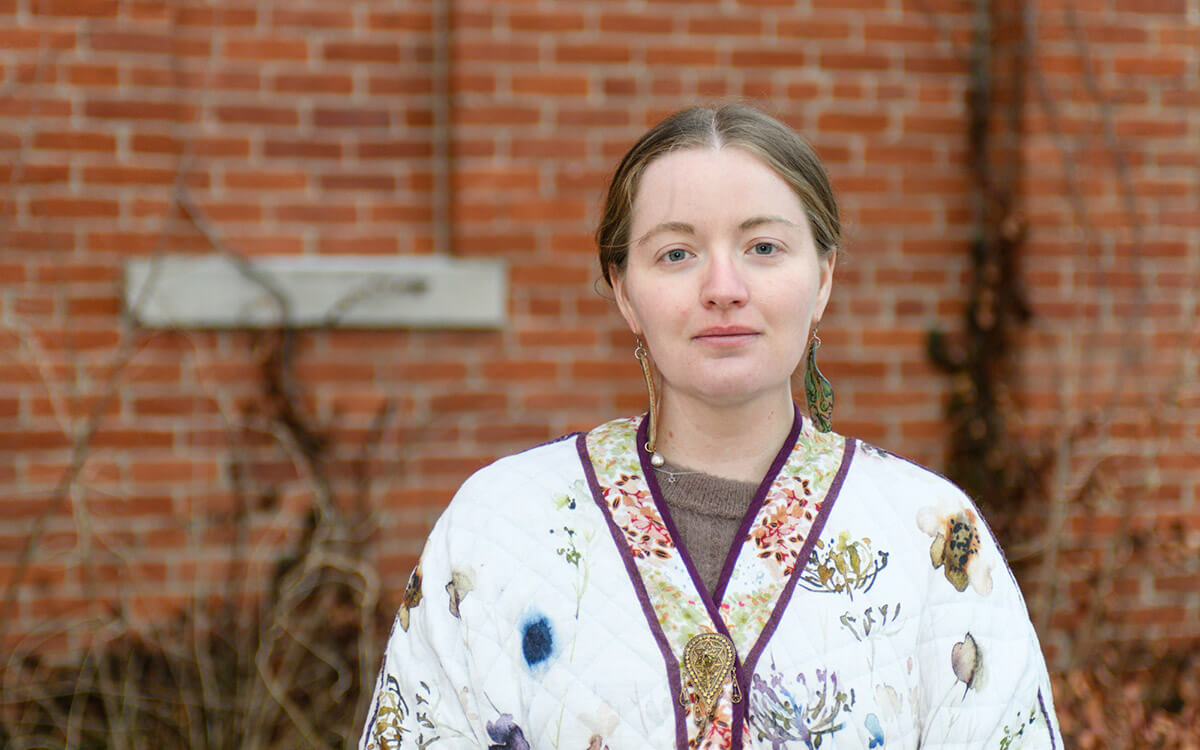
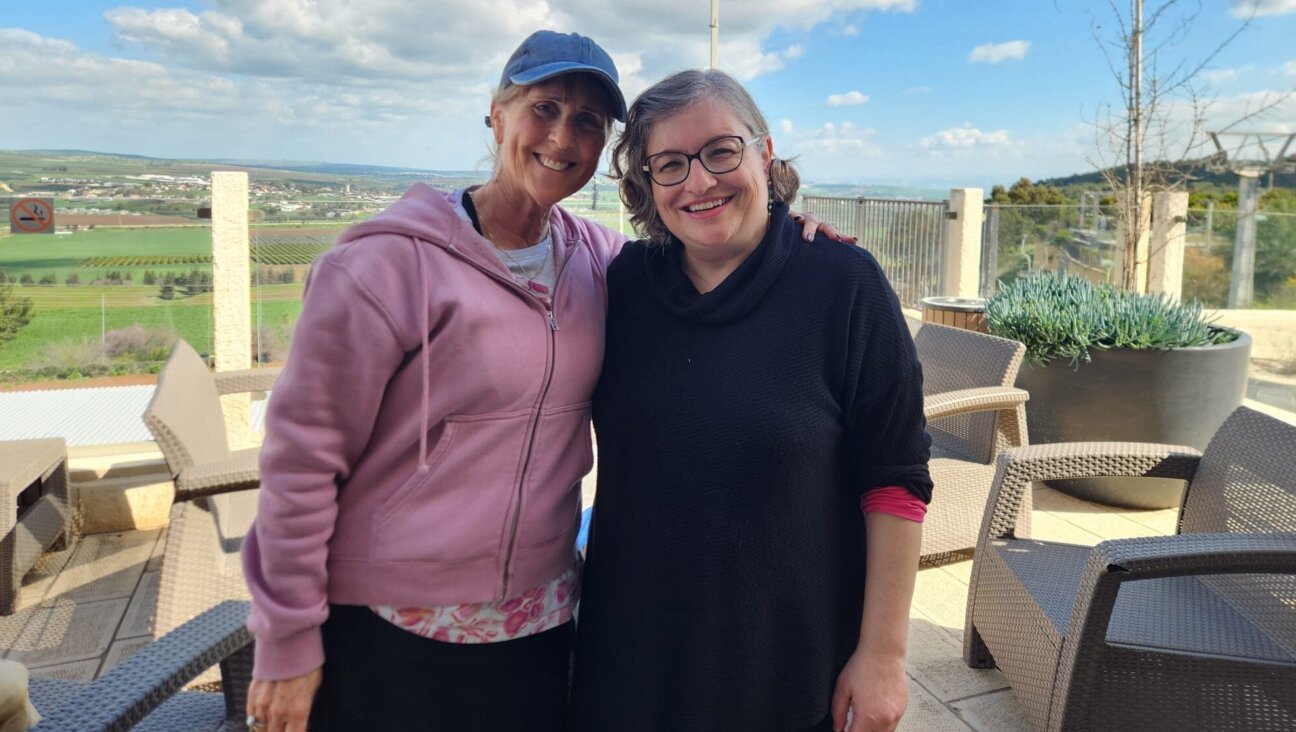
Robyn Soloveitchik outside the original Ahavas Achim synagogue in Lafayette, Indiana. Courtesy of Chris Volansky-Wirth

By Benyamin Cohen February 24, 2026
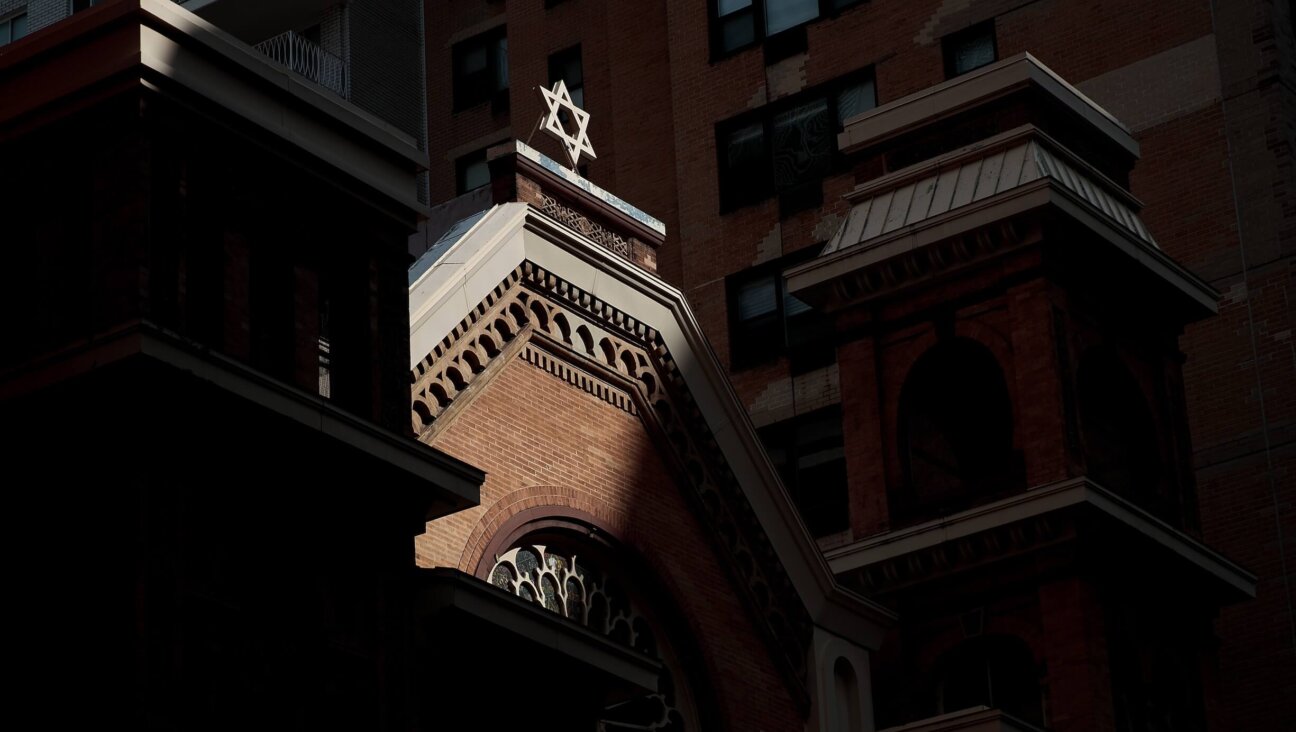
On South Seventh Street in downtown Lafayette, Indiana, a Star of David still crowns a synagogue built in 1867. In the mid-19th century, this congregation became an early laboratory of the Reform movement — and, historians say, the site of the first known egalitarian minyan in America.
Over the decades, it would serve as a proving ground for rabbis who went on to shape American Judaism. One of them, Julian Morgenstern, later rose to lead Hebrew Union College and helped secure visas for several Jewish scholars fleeing Nazi persecution — including Abraham Joshua Heschel.
The congregation moved to a new building in 1969. Since then, the old structure has housed churches, the Red Cross and other nonprofits. Now the building is for sale.
And a group of local Jews is trying to buy it back before it’s sold to someone else.
They have raised $9,751. They need $290,149 more.
A sacred space
The campaign is being shepherded by Robyn Soloveitchik and Tanya Volansky. Both felt something when they stepped inside the old sanctuary last year during a tour.
“With the building being for sale, it is a giant question mark,” said Volansky, a medical massage therapist. “It would be wonderful not only to bring it back into the Jewish community. We want to guarantee it will be there for future generations.”
Soloveitchik, who works in auto manufacturing, looked up at the stained glass and wondered how it had survived. The sanctuary still dominates the upper floor. A wooden wall now covers the original ark.
The building is listed for $299,900.
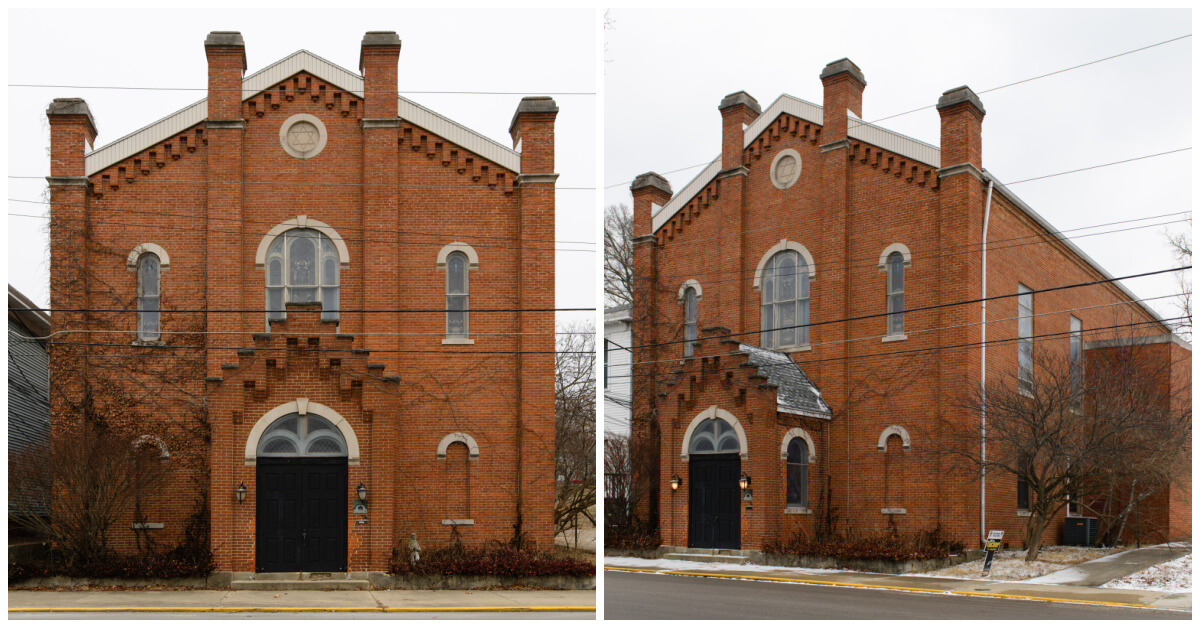
If someone else buys it — a developer, a church, an investor — there’s not much they can do to change the facade. Exterior changes, including alterations to the stained glass windows, must be approved by the Lafayette Historic Commission. But the building’s landmark status does not control who owns it or how the interior is used. Its future purpose would be up to whoever signs the deed.
So the two women and a few others formed a nonprofit, the Ahavas Achim Cultural Center, and began making calls. They built a website. They launched a crowdfunding campaign. They reached out to preservationists and descendants of Lafayette’s early Jewish families.
They are not trying to reopen the sanctuary as a full-time synagogue. Lafayette already has two: Temple Israel, which is Reform, and a small Conservative congregation, Sons of Abraham. It also has a Chabad and Hillel connected to Purdue University. Roughly 1,500 Jews, including students, live in the Greater Lafayette area.
Instead, they imagine something else: a place for adult education classes, film screenings and community events — a visible reminder that Jews have been part of Lafayette’s civic fabric since before the Civil War.
A rich history
Ahavas Achim was founded in 1849, when Lafayette was still a bustling river town along the Wabash. Many of its Jewish families had arrived by way of the Erie Canal, joining the westward stream of peddlers and merchants pushing into the American interior. Many were from Bavaria, accustomed to life as minorities in small European towns. In Indiana, they found familiar rhythms: small communities, German-speaking neighbors and space to build. Lafayette later became a major railroad hub on the way to St. Louis and Chicago.
In 1867, the congregation moved into its home on South Seventh Street. Local newspaper coverage of the dedication spilled across two columns on the front page — speeches transcribed, dignitaries listed, the building described in loving detail — as if the city itself understood that something lasting had been built.
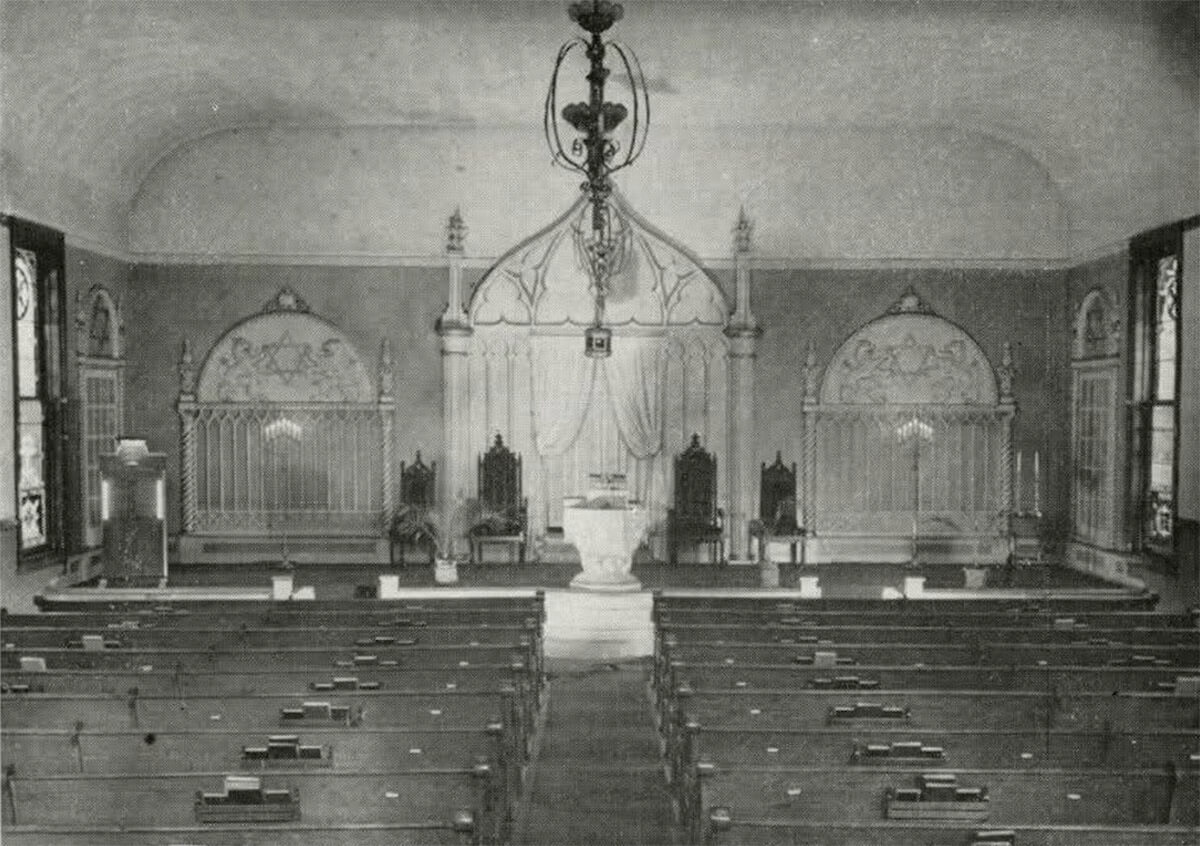
More than 150 years later, the structure is now considered one of roughly a dozen or so 19th-century synagogue buildings still standing in the United States. That history, said Michael Brown of the Indiana Jewish Historical Society, is what moves people. “They see how rare it is,” he said. “It’s pretty important.”
In 1919, the congregation updated its constitution and adopted a new name: Temple Israel. And in 1969, as members increasingly lived across the river in West Lafayette, it relocated — this time to a new building closer to the university community.
Temple Israel never disappeared. It simply moved.
A minor league for Reform heavyweights
In the early 20th century, Lafayette’s temple functioned as something like a minor league franchise for Reform Judaism.
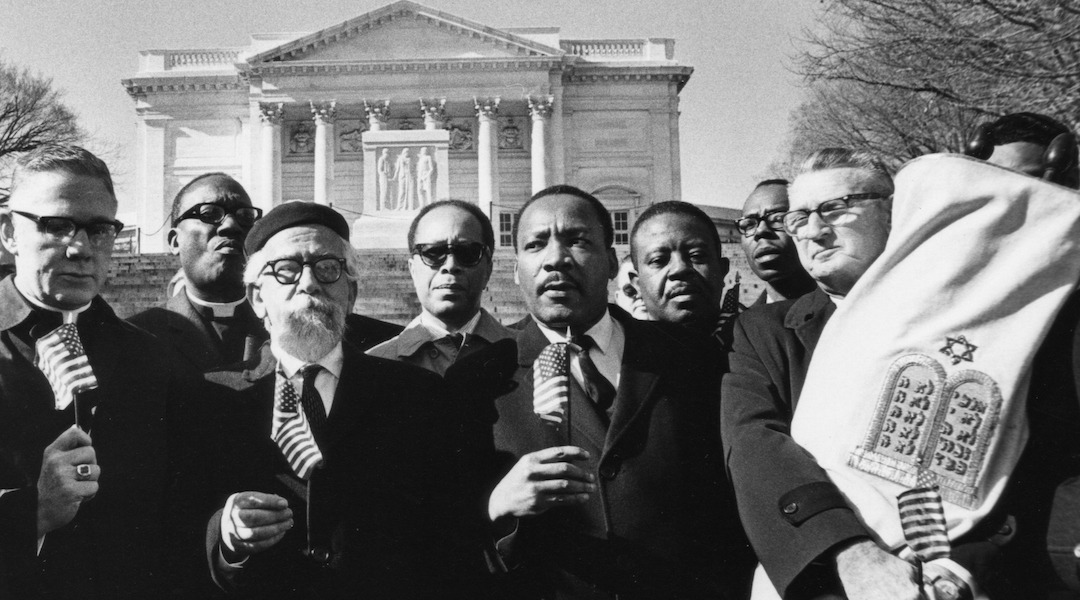
Rabbi Julian Morgenstern served here from 1904 to 1907 before becoming president of Hebrew Union College. From that perch, he watched European scholarship with mounting frustration. As Jewish academics fled rising antisemitism in the 1930s, many gravitated toward the more traditional Jewish Theological Seminary.
“That enraged him,” said Brown.
Morgenstern compiled a list of promising European scholars he believed Reform must recruit. He worked with the State Department to help secure visas for several rabbis and thinkers fleeing Nazi persecution. One of them was Abraham Joshua Heschel.
In the United States, Heschel would later encounter another Indiana rabbi, Abraham Cronbach, who was one of the people who introduced him to the idea that a rabbi could be a public activist as well as a scholar.
Morgenstern was not the only future luminary to pass through Lafayette’s pulpit.
Nathan Krass later served for decades at New York City’s Temple Emanu-El, one of the country’s most prominent Reform congregations. Morris Feurlicht, who stood up to the Ku Klux Klan during the 1920s in its Indiana stronghold, once stood here. Bernard J. Bamberger, a prolific Bible translator, would become president of the Central Conference of American Rabbis. Joshua L. Liebman — whose bestseller Peace of Mind reshaped how rabbis approached counseling — also served in Lafayette before rising to national prominence.
Lafayette’s Jewish footprint extended beyond the sanctuary. The city was also the birthplace of Academy Award-winning director Sydney Pollack and home to Jewish merchants and civic leaders who helped shape the town’s commercial and cultural life.
A fragile model
Wendy Soltz, a history professor at Ball State University who led the federally funded Indiana Synagogue Mapping Project, has documented 66 purpose-built synagogues across the state dating back as far as 1865. Of those, 24 have already been demolished — including nine of Indiana’s original 19th-century synagogues.
The Lafayette building, she said, “has statewide and national significance.”
But she also offered a caution.
Across Indiana, she has seen former synagogues converted into small museums — projects that begin with enthusiasm but struggle to sustain long-term interest.
“You get that initial wave of visitors,” she said. “But then it really dramatically trickles off.”
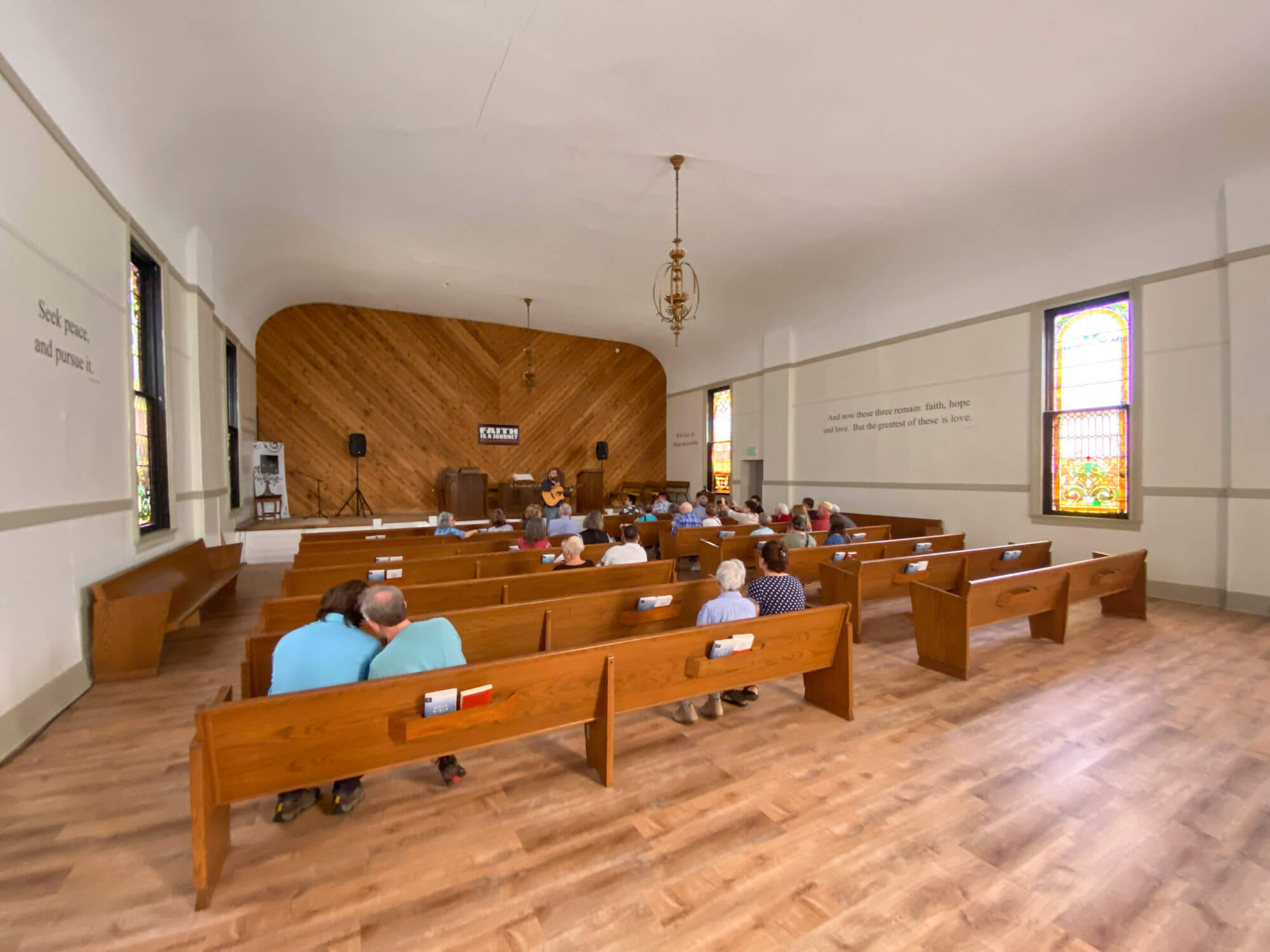
Where adaptive reuse has worked, she said, is when buildings function as active community centers rather than static exhibits. In Terre Haute, a former synagogue now operates as the Wabash Activity Center, hosting senior programs and public events. In Evansville, a community center incorporates the surviving tower of a burned synagogue into its campus — even using it in the organization’s logo.
“If it’s just a museum, it likely won’t work,” Soltz said of the Lafayette project. “But if there are aspects serving the community, that has proven staying power.”
With Indiana synagogues, not every rescue looks the same. Sometimes preservation takes surprising forms.
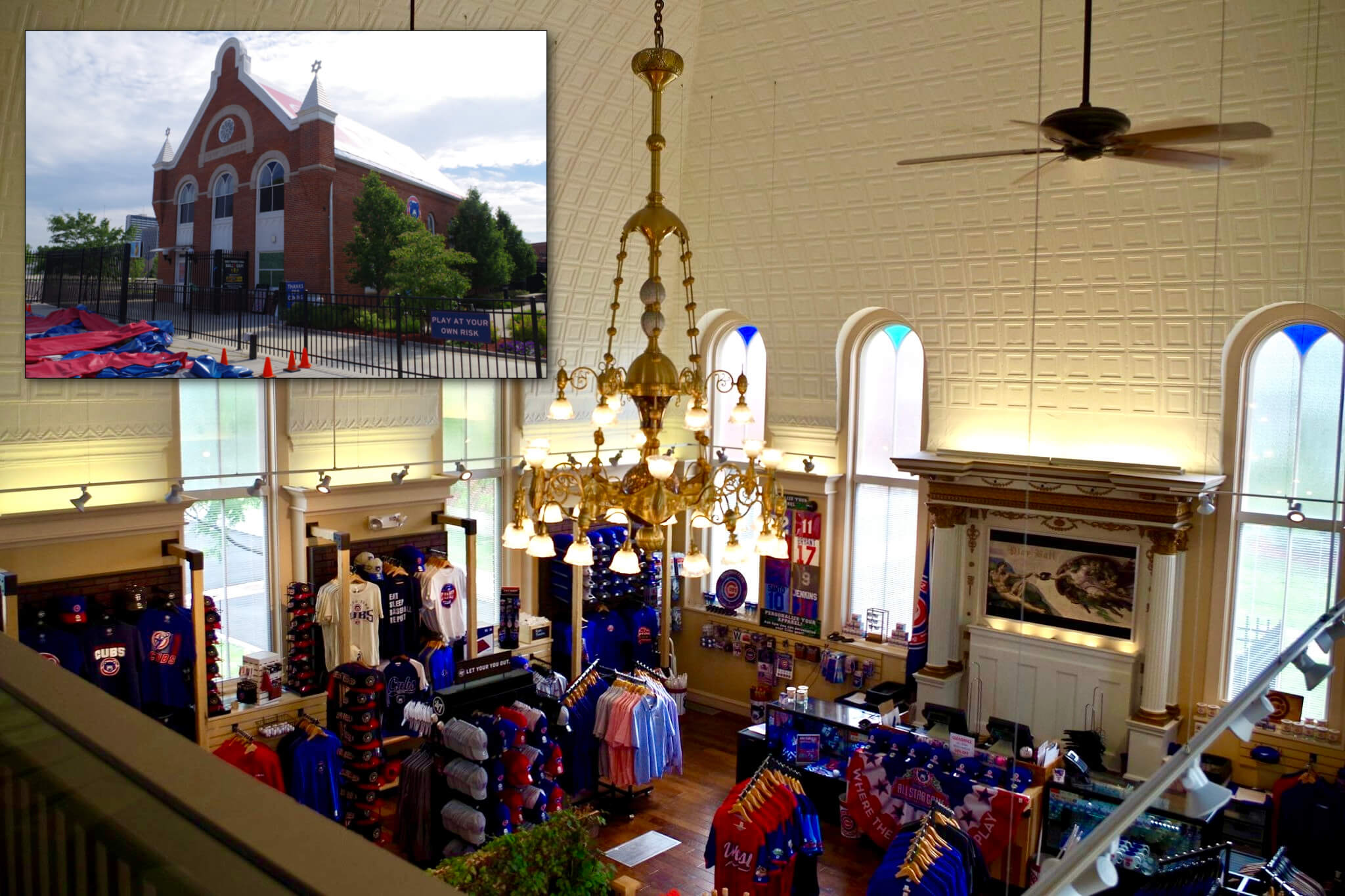
When a new baseball stadium was built in 2012 in South Bend, the team owner had to figure out what to do with a 1901 Romanesque Revival–style synagogue on the property that was listed on the National Register of Historic Places. The team spent $1 million restoring the building. It’s now where the gift shop is located. A mural on the wall of what’s now known as the Ballpark Synagogue riffs on the Sistine Chapel, depicting God passing a baseball to Adam along with words “Play Ball.”
Continuing a legacy
In 2024, during Temple Israel’s 175th anniversary, Rabbi Adam Bellows led congregants back into the old sanctuary for a commemorative tour.
“One of the highlights of my rabbinical career,” he said, was reciting the Shehecheyanu blessing there. Standing in the space, he felt connected “to all the past congregants and past rabbis and past prayer leaders.”
Bellows, the current rabbi of Temple Israel, is not formally involved in the buyback effort. But he supports it.
“I don’t think it’s counterproductive,” he said, even though his synagogue has room for events. He envisions the building as a monument to the long Jewish legacy in the region — a place for education and community gathering, even if regular worship remains across town.
“It’s a little bit of an underdog story,” he said. “But I believe in miracles.”
This is a moment of great uncertainty. Here’s what you can do about it.
We hope you appreciated this article. Before you go, we’d like to ask you to please support the Forward’s independent Jewish news this Passover. All donations are being matched by the Forward Board - up to $100,000.
This is a moment of great uncertainty for the news media, for the Jewish people, and for our sacred democracy. It is a time of confusion and declining trust in public institutions. An era in which we need humans to report facts, conduct investigations that hold power to account, tell stories that matter and share honest discourse on all that divides us.
With no paywall or subscriptions, the Forward is entirely supported by readers like you. Every dollar you give this Passover is invested in the future of the Forward — and telling the American Jewish story fully and fairly.
The Forward doesn’t rely on funding from institutions like governments or your local Jewish federation. There are thousands of readers like you who give us $18 or $36 or $100 each month or year.
Support our mission to tell the Jewish story fully and fairly.