Amid revolt against ‘Israel lobby,’ J Street seeks elusive middle ground in primaries
Unlike AIPAC, the progressive group funds Israel’s critics in Congress — but president Jeremy Ben-Ami is firm that candidates who don’t recognize Israel as the Jewish homeland won’t get his support
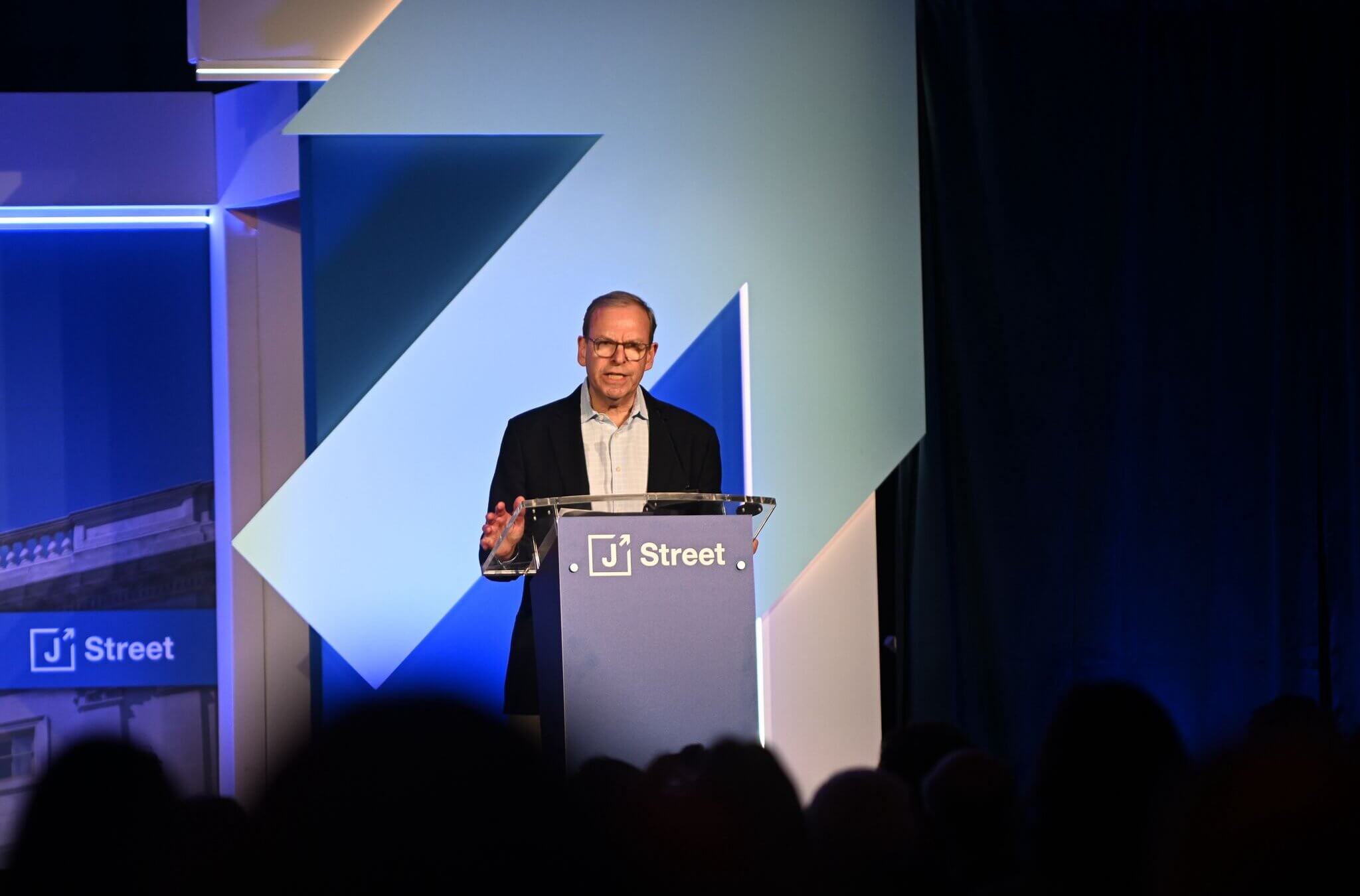
Jeremy Ben-Ami, president of J Street, on March 01. Photo by Gili Getz

By Jacob Kornbluh March 13, 2026
A website and social media posts from “Track AIPAC,” associated with a group called Citizens Against AIPAC Corruption, is targeting members of Congress it hopes to unseat in the upcoming primary season with large dollar figures alongside their photos, declaring them captive of the “pro-Israel lobby.”
Such posts give the impression that the candidates have received significant financial support from the American Israel Public Affairs Committee, the largest group working to elect candidates who support Israel uncritically — which has made clear this election year that it will not provide support to candidates who even mention conditioning U.S. aid to Israel.
But the Track AIPAC dollar figures in many cases also include contributions from other fundraising committees whose aims are at odds with AIPAC’s, such as J Street, a progressive group that is trying to push Israel to change direction as it carries out a new war alongside the U.S.
It’s just one attempt to lump together all campaign funding groups that recognize Israel’s right to exist and the candidates they support as targets for defeat in this year’s primary elections, no matter how critical they have been of the Israeli government. The tactic is aimed at voters in a party where support for Israel has collapsed, and risks obscuring where candidates stand on crucial questions as voters head to the polls.
Against that backdrop, J Street is holding its line while focusing on its lane in 2026: Endorse only candidates committed to Israel as a Jewish state, but who also advocate changes for the direction of Israel’s government.
“The minimum is the recognition that there must be, and there is, an Israel that is the national homeland of the Jewish people,” Jeremy Ben-Ami, J Street’s president, said in a recent interview. “If you don’t want to say that out loud publicly, you won’t be on our list.”
Ben-Ami himself has shifted his position on Israel in recent years. Last August, Ben-Ami wrote that he was “persuaded” by the claim that Israel was committing genocide in Gaza, after rejecting the term throughout most of the nearly two-year military campaign. Earlier in the war, he had described the military’s conduct as a “moral stain on the State of Israel.”
J Street also supported the pair of resolutions introduced by Sen. Bernie Sanders, the Jewish Vermont independent and longtime critic of U.S. aid to Israel, to block weapons transfers to Israel. A record 27 Senate Democrats — a majority of the caucus — voted in favor. And even before that, J Street urged oversight of U.S. military assistance to Israel.
Where J Street fits in
Founded in 2007, the organization describes itself as a pro-Israel, pro-peace and pro-democracy group that supports a two-state solution and diplomacy to resolve the Israeli-Palestinian conflict. Its federal political action committee, launched in 2009, has gradually expanded its list of endorsees as it seeks to position itself as a bridge between pro-Israel voices and the party’s progressive wing.
This cycle, J Street PAC is backing 133 House and Senate incumbents as well as Democratic challengers running against Republican incumbents. The group has also approved several candidates competing in open Democratic primaries, allowing its donor network to support their campaigns. In one New York race, J Street endorsed the incumbent, Rep. Dan Goldman, and also “approved” his challenger, former New York City Comptroller Brad Lander.
Even the minimal recognition of Israel and support for U.S. defense aid to the Jewish state have increasingly become a political flashpoint in Democratic primaries.
In some competitive races, progressive candidates critical of the U.S.-Israel alliance have gained traction, benefiting from crowded fields or backlash to heavy outside spending. That dynamic has been visible in contests such as the New Jersey special election for a House seat, where progressive candidate Analilia Mejia prevailed after an AIPAC-associated super PAC spent more than $2 million targeting former Democratic Rep. Tom Malinowski, a J Street–approved candidate.
Ahead of next Tuesday’s Illinois primary, another super PAC aligned with AIPAC, Elect Chicago Women, has targeted the frontrunner, Daniel Biss, contributing to the rise in polling of a younger Palestinian American candidate, Kat Abughazaleh. J Street is backing Biss.
AIPAC has become increasingly controversial among mainstream Democrats for backing pro-Israel Republicans who joined President Donald Trump’s crusade to question the 2020 election results. That opposition deepened during the Gaza war as Democratic voters became more polarized over U.S. policy on Israel. Many congressional candidates, including some Jewish Democrats, have promised not to take contributions from AIPAC. The group has also drawn attacks from white nationalists and some leaders of the MAGA movement.
The test: A future for Israel
Amid the larger conflict, J Street is trying to define a middle ground.
Ben-Ami outlined the organization’s red lines for endorsements during J Street’s annual conference in Washington, D.C., earlier this month, saying the group looks for candidates who acknowledge Israel’s legitimate security needs while avoiding unconditional support for its government. “If you’re in favor of a complete arms embargo against Israel, and you don’t recognize that Israel should be the national homeland of the Jewish people, you won’t come anywhere near our list,” Ben-Ami said.
The strategy reflects a broader shift in progressive politics, where Israel policy and Palestinian rights — once a marginal issue in most congressional races — have become a litmus test for progressive candidates seeking to define themselves against establishment Democrats. Recent polls showed the wider tensions within the Democratic Party, which loomed large in the 2024 presidential election in the wake of the Gaza war — and now opposition to the war in Iran — are likely to shape the midterm elections.
Gallup, which has tracked Americans’ views of Israel for more than two decades, found that sympathy for Palestinians in the decades-long Middle East conflict has jumped 22 percentage points over the past two years. Only 17% of Democrats now sympathize more with Israel.
J Street’s leaders reject that characterization. Ben-Ami said polling on Israel shouldn’t be a zero-sum choice. He faulted some established pro-Israel organizations for pushing a binary framework that pressures people to pick one side or the other, which he sees as a “self-defeating approach” that has backfired politically. J Street, he said, tries to create space for candidates who acknowledge both the trauma of the Oct. 7, 2023, attacks in Israel and the humanitarian toll of the war in Gaza. Ben-Ami added that many voters hold both views at once and are looking for leaders with clarity on the issue.
For some progressive activists, however, the distinction is: any organization that defends Israel as a Jewish state is increasingly treated as part of the same establishment.
Massively outspent
Also looming over J Street as it tries to reach voters is AIPAC’s vastly bigger bank account.
AIPAC’s super PAC, United Democracy Project, spent $28 million in high-stakes Democratic primaries in 2024. The group has already invested more than $7.3 million of the $78 million it raised in the 2026 election cycle, and its affiliated Illinois group, Elect Chicago Women, has to date spent an additional $5.7 million to defeat Biss in the March 17 primary for the open seat in Illinois’ 9th District.
J Street hasn’t been able to match that scale, even as it has framed its efforts as a counterweight to AIPAC spending. J Street raised $3 million for the J Street Action Fund super PAC for spending in competitive House and Senate races.
Ben-Ami said J Street plans to be “very targeted” in deploying its resources to influence key races, particularly contests that could determine control of Congress or where candidates aligned with its positions are facing attacks backed by AIPAC spending.
The Institute for Middle East Understanding Policy Project, a progressive research group, said it plans to spend $2 million in ads this cycle, targeting Republicans over their support for Israel and backing Democrats in favor of blocking weapons to Israel.
Democratic Majority for Israel, a mainstream Democratic-affiliated political action committee, said its budget for the midterms exceeds “seven figures.” Brian Romick, DMFI’s president, said in an interview that his group’s “number one goal” will be to help Democrats take back the House “with a pro-Israel majority.” Its primary spending, he said, will support candidates who would increase the odds of a Democrat winning the seat.