A government takeover could save a struggling Brooklyn hospital — while unsettling the Orthodox Jewish community it serves
NYC Health + Hospitals is poised to assume control of Maimonides Medical Center, over the objections of some in the Borough Park community that founded it
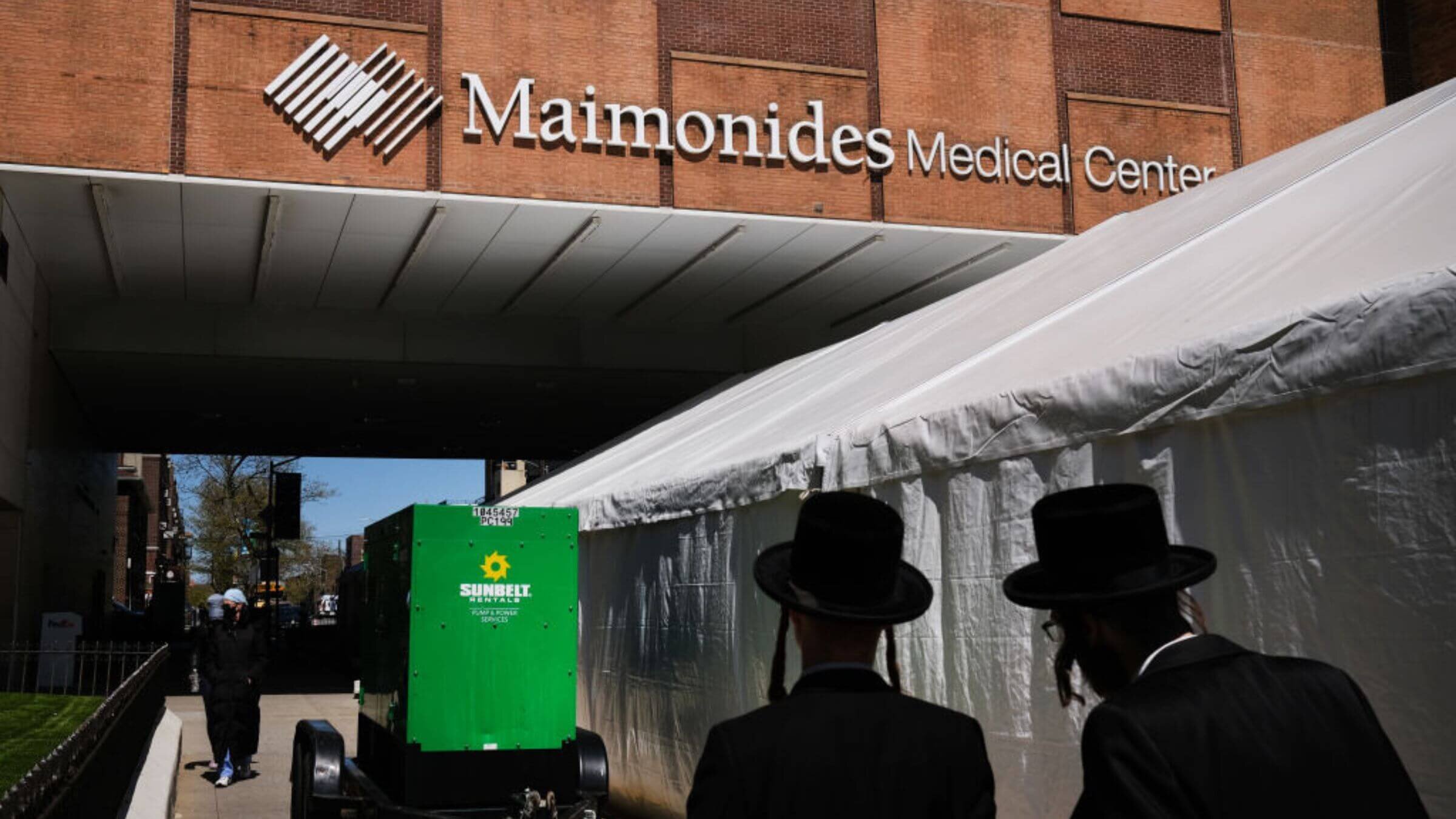
People walk by a special COVID-19 intake area at Maimonides Medical Center in April 2020. Photo by Spencer Platt/Getty Images

By Hannah Feuer March 17, 2026
As New York City moves to assume control of a financially distressed hospital that serves Brooklyn’s Orthodox Jewish community, some local players are pushing back, filing lawsuits in hopes of stopping the imminent merger with the city’s public hospital system.
Many Hasidic patients rely on Maimonides Medical Center, an independent nonprofit in Borough Park, as their local hospital. Even in a city where hospitals typically offer kosher food and are sensitive to Jewish patients’ needs, Maimonides stands out, with Shabbat elevators that stop on every floor, Yiddish-speaking staff and an on-site synagogue in the main lobby that hosts daily afternoon prayer.
New York City Health and Hospitals CEO Dr. Mitchell Katz has promised to retain those religious accommodations at Maimonides under the merger, noting in court documents that the merger agreement between Maimonides and the city requires preservation of existing religious and cultural practices at the hospital for at least 30 years.
“We certainly have heard concerns at community settings from the Orthodox Jewish community who are concerned about whether or not the hospital will still respect their cultural traditions,” Katz said at a New York City Council hearing earlier this month about the proposed merger. “And we’ve explained, ‘Absolutely.’” But, he said, “Change makes people worried.”
Such reassurances, however, have done little to assuage the plaintiffs in the pair of lawsuits seeking to block the merger, who include trustees of the hospital who disagreed with the decision to go public; Orthodox Jewish patient advocacy groups; and local Bobov, Satmar and Belz Hasidic congregations.
Their cases, filed against Maimonides Medical Center, the New York State Department of Health, and New York City Health and Hospitals, argue that relinquishing local control to the city hospital system jeopardizes the hospital’s Jewish character, conflicts with the nonprofit’s local mission, and threatens to deteriorate its quality of care.
The lawsuits have set up a clash between two groups who each argue they have the hospital’s best interest at heart: a city that says it wants to rescue a hospital on the brink of financial collapse, and Jewish leaders wary of public institutions, who prefer to keep the hospital’s management within the community it serves.
“Maybe at first you won’t see such a change in the culture, but over time, it’s inevitable that it’s just going to become a city-run hospital, like all the other city-run hospitals,” Martin Bienstock, a lawyer for the plaintiffs suing to block the merger, told the Forward. “If people lose trust in the hospital, because they lose that sense of affiliation, you’re going to get poorer health quality outcomes.”
The merger is set to be finalized on April 1, but could be disrupted by a judge’s pending decision on a request for a preliminary injunction blocking the transaction. The next hearing is scheduled for March 27.
A financial lifeline
Maimonides Medical Center, named for the 12th-century Jewish scholar, was founded over a century ago by a group of Jewish women as a philanthropic effort to serve the poor. It has long served a diverse, largely low-income population that includes many immigrant communities, in addition to the Brooklyn neighborhood’s longstanding Jewish population.
Even as other independent hospitals shut down or merged with big medical systems, Maimonides held out. But recent years have brought mounting financial strain, exacerbated by the COVID-19 pandemic.
Last December, those financial troubles led the city to step in. Former Mayor Eric Adams, with just three days left in office, announced a plan to merge Maimonides Medical Center with the city’s public hospital system. Gov. Kathy Hochul endorsed the deal, backing it with a $2.2 billion grant as part of her broader push to stabilize New York’s struggling safety-net hospitals, which serve patients who can’t afford to pay for their care.
New York City’s public hospital system receives a higher Medicaid reimbursement rate than independent hospitals do — a potential lifeline for Maimonides, which receives 70% of its patient revenue from Medicare and Medicaid, according to the Healthcare Association of New York State.
The deal is poised to infuse Maimonides with more than $2 billion over five years, according to city hospital spokesperson Christopher Miller. The money will be used “for many important upgrades,” Miller said, including adopting electronic health records and renovating the hospital’s maternity ward, where more than 6,000 women give birth each year — more babies than any other hospital in Brooklyn.
Advocates of the merger say that cash is urgently needed. Maimonides lost more than $165 million at its peak deficit in 2021 and has continued to operate tens of millions of dollars in the red in the years since, according to tax filings. A 2024 audit expressed “substantial doubt” about the organization’s ability to continue operating.
Those suing to block the transaction do not dispute that Maimonides’ finances are dire. But they argue that the hospital’s board did not adequately consider alternative options that could have allowed Maimonides to maintain its status as a private nonprofit, according to court documents that claim the hospital had snubbed potential partnerships with Touro University or Westchester Medical Center.
(The hospital’s CEO said in a court filing that he was not aware of any viable partners for Maimonides other than the city.)
Bienstock contends the merger will place Maimonides in the hands of an unwieldy government-sponsored bureaucracy — and under the political whims of New York City’s mayor, currently Zohran Mamdani, who oversees the city hospital system and proposes its budget.
“Any promises that they make, they’re always subject to later decisions by the Health and Hospitals board and mayor,” Bienstock said. “Ultimately, they’re going to be running the show.”
‘Grave concern’
It’s not the first time the hospital has had strained relations with the Orthodox community. During the pandemic, patients alleged that the hospital had removed patients from ventilators in ways that conflicted with Jewish values protecting the sanctity of life. Meanwhile, a campaign called “Save Maimonides,” led by local Orthodox Jewish leaders at odds with the leadership of CEO Ken Gibbs, alleged substandard patient care at the hospital and financial mismanagement.
Among the concerns was Maimonides Medical Center’s purchase of the naming rights to a minor league baseball stadium in Coney Island in 2021, and ballooning executive compensation even as the hospital lost millions. Gibbs’ salary was $3.2 million in 2020, up from $1.3 million the year prior, a payout hospital officials told The City was deferred compensation Gibbs had been slated to receive after five years of work. Gibbs has earned roughly $1.8 million each year since.
In a statement to the Forward, Maimonides spokesperson Sam Miller said the hospital has won national recognition for “outstanding care across several clinical areas,” including top rank for its children’s hospital.
Asked about executive compensation and spending on the minor league baseball stadium, Miller said, “Our financial management is sound.”
Mendy Reiner, co-chair of “Save Maimonides” and founder of a nonprofit that connects patients with kidney donors, told the Forward he sees the proposed merger as yet another sign of the hospital’s decline. In his experience, locals who can afford to pay often travel across the river to Manhattan for what he described as superior care. U.S. News and World Report currently ranks Maimonides 19th in the New York metro area, a market that includes some of the top-ranked academic hospitals in the nation.
“City hospitals are a failure across the board,” Reiner said. “And if we thought that Maimonides could go bad from bad to worse, here it is.”
In a statement, Miller said both Maimonides and NYC Health and Hospitals “run facilities that deliver high-quality care for their patients,” citing awards that include U.S. News & World Report putting all 11 of the system’s hospitals on its “Best Hospitals 2025-2026” list.
Katz, the H+H CEO, defended the public hospital system in court filings, arguing that the plaintiffs had made “inaccurate and baseless claims” about the quality of care and had “offensively” justified those allegations by pointing to the system’s large number of Medicaid patients.
Still, the proposed merger came as a shock to local state Assembly Member Simcha Eichenstein, who said he had been working with hospital leadership for years to come up with an alternative solution. In an October 2025 video address, he said the city’s proposal for Maimonides was “being shoved down our throats.”
“Let me be clear. This is a shortsighted, quick fix made without the slightest understanding of our local diverse neighborhoods,” Eichenstein said. “This is not collaboration. This is coercion.”
Hatzalah, the Jewish volunteer emergency medical service organization that partners with Maimonides, issued a letter last October “strongly” opposing the potential takeover as “not in the best interest of our community.” Hatzalah coordinators serving four heavily Orthodox Brooklyn neighborhoods — Borough Park, Crown Heights, Flatbush and Mill Basin — signed onto the letter “with grave concern.”
Since then, more Jewish institutions have joined the fight against the merger. Four Hasidic congregations — Congregation Khal Shaarei Zion Bobov, Congregation Kehilas Belz, Congregation Yetev Lev D’Satmar, and Khal Bobov 45 Inc. — signed onto the lawsuit filed against the hospital and state earlier this month, saying their congregants regularly rely on Maimonides for medical care. Other plaintiffs include Borough Park residents Chaim Beigel and Israel Minkoff, as well as the Orthodox Jewish patient advocacy groups Refuah Helpline and Chaim Medical Resource.
Miriam Knoll, CEO of the Jewish Orthodox Women’s Medical Association, said public hospitals can and do offer religious accommodations for Jewish patients. Still, she said, any new leadership must prioritize outreach to the local Jewish community to build trust.
For Knoll, the issue is close to home: She and all of her siblings were born at Maimonides, and her parents, both physicians, completed their medical residencies there.
“Maimonides is a deeply personal and important institution to the Jewish community in Brooklyn,” Knoll told the Forward. “And I think it’s very important that it continues to be a place that provides culturally sensitive care.”
This is a moment of great uncertainty. Here’s what you can do about it.
We hope you appreciated this article. Before you go, we’d like to ask you to please support the Forward’s independent Jewish news this Passover. All donations are being matched by the Forward Board - up to $100,000.
This is a moment of great uncertainty for the news media, for the Jewish people, and for our sacred democracy. It is a time of confusion and declining trust in public institutions. An era in which we need humans to report facts, conduct investigations that hold power to account, tell stories that matter and share honest discourse on all that divides us.
With no paywall or subscriptions, the Forward is entirely supported by readers like you. Every dollar you give this Passover is invested in the future of the Forward — and telling the American Jewish story fully and fairly.
The Forward doesn’t rely on funding from institutions like governments or your local Jewish federation. There are thousands of readers like you who give us $18 or $36 or $100 each month or year.
Support our mission to tell the Jewish story fully and fairly.