Gaza protest slogans amounted to ‘racial slurs’ toward Jews, Trump administration alleges in new Harvard lawsuit
The case filed Friday calls phrases like ‘from the river to the sea’ discriminatory — an argument that some courts have rejected
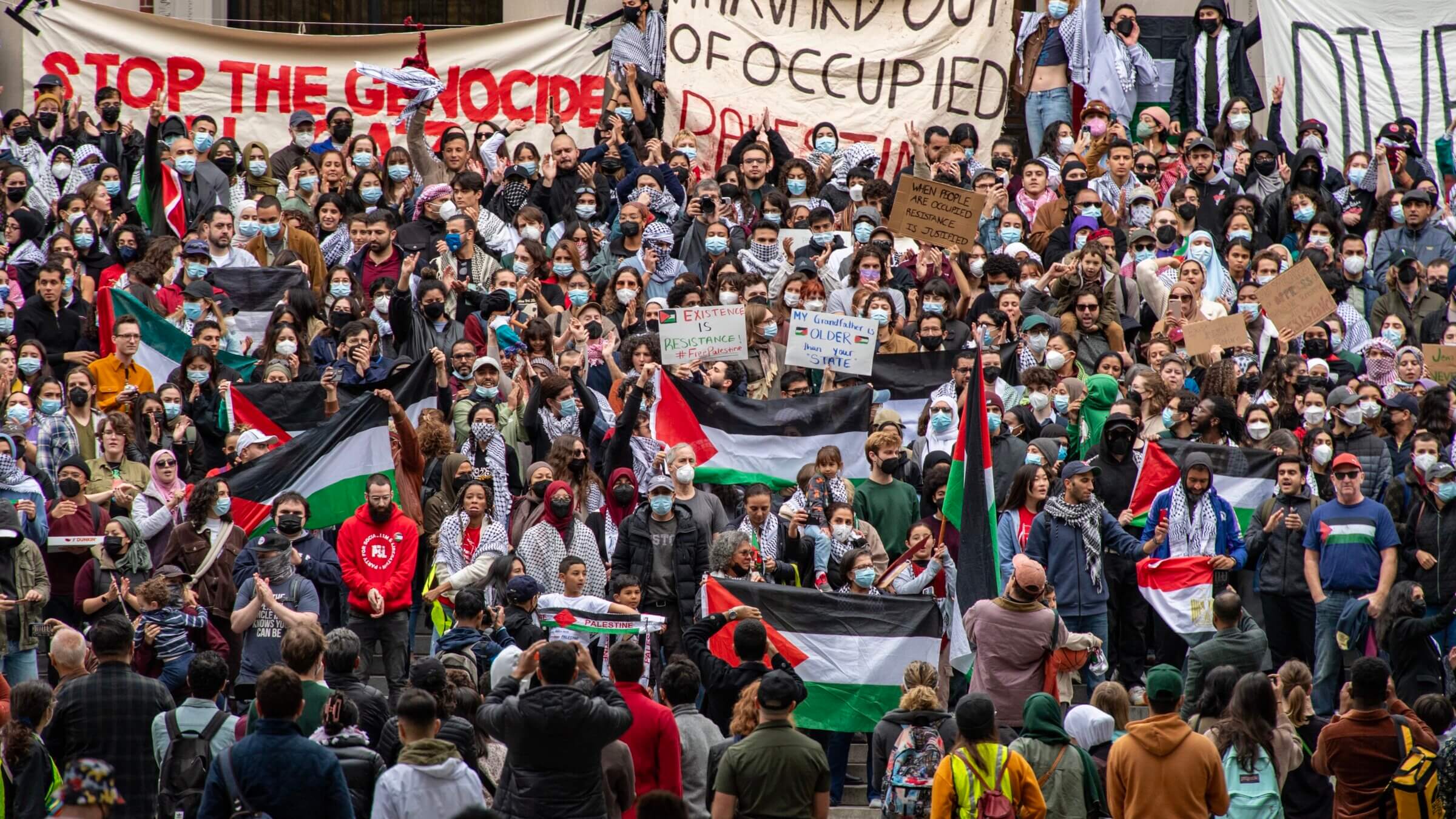
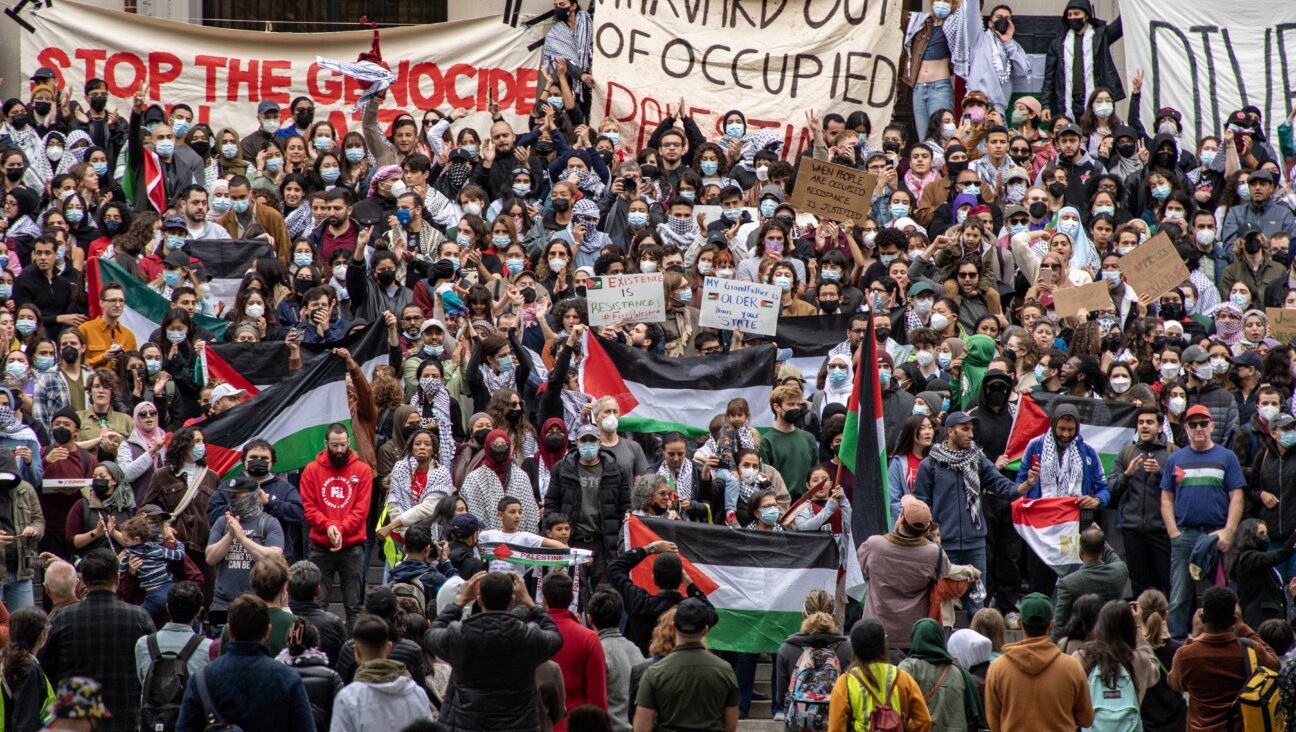
Supporters of Palestine gather at Harvard University to show their support for Palestinians in Gaza at a rally in Cambridge, Massachusetts, on October 14, 2023. Photo by Joseph Prezioso/AFP via Getty Images

By Arno Rosenfeld March 20, 2026
In the Trump administration’s year-long battle with Harvard University threatening federal funding over alleged antisemitism, its precise concerns have emerged in fuzzy and piecemeal fashion — in comments from White House officials, administrative agency findings and letters to the university as a pressure campaign and negotiations dragged on.
That changed Friday with a lawsuit filed by the Department of Justice under Title VI of the Civil Rights Act of 1964, which levels specific allegations of how the government contends Harvard violated the rights of Jewish and Israeli students.
The government claims in its federal court complaint that these students had been “harassed, physically assaulted, stalked, and spat upon,” and relies heavily on the report produced by Harvard’s own antisemitism task force, which found many Jewish students had experienced painful social isolation but stopped short of alleging that the university itself had engaged in antisemitism.
The lawsuit goes further, though, presenting its specific allegations alongside strident arguments popular with political opponents of the campus demonstrations that swept Harvard and other higher education institutions across the country after Oct. 7.
Harvard was not only too lenient toward protesters who violated school rules, but the protests themselves sought to intimidate and threaten violence toward Jewish students — the lawsuit claims — through the use of particular language.
Offensive terms
In laying out their case that students’ civil rights have been violated, lawyers for the federal government detailed offenses that Harvard allegedly permitted or allowed against Jewish students, and cited testimony from students who told the antisemitism task force that they had been assaulted and were afraid to display wear Jewish symbols on campus.
The complaint also provides examples of Harvard responding to claims of bias and discrimination lodged by other minority groups, that it says were not taken when community members raised concerns around antisemitism.
While stating that “peaceful protests that annoy Jewish and Israeli students” are not the target, the DOJ goes on to detail demonstrations that it asserts crossed a line, using slogans such as “from the river to the sea, Palestine will be free,” “globalize the intifada,” and “there is only one solution, intifada revolution.”
The DOJ stated: “to a Jewish or Israeli ear, these chants are racial slurs.”
After summarizing the Hamas attack against Israel — including a graphic allegation that Hamas terrorists cut open a pregnant woman’s womb and stabbed her fetus — the lawsuit said that the violence was “representative of what is meant by ‘intifada.’”
And the complaint also stated: “‘Intifada’ was the name given to a pair of wars waged by Palestinian groups against Israeli civilians” and that the only “reasonable” way to interpret the terms used by protesters was “as calls to kill Jews, rather than metaphors expressing political opposition to Israel.”
Prevailing on this point won’t necessarily be easy.
“Intifada,” in the context of the Israeli-Palestinian conflict, refers to two periods of political unrest that combined widespread protests against Israeli military rule in the West Bank and Gaza with violent attacks on Israeli civilians. Palestinian militants killed around 1,000 Israelis during the second Intifada, which took place between 2000 and 2005, while Israeli soldiers killed an estimated 3,000 Palestinians.
“Globalize the intifada” has become an especially controversial slogan because it invokes this history of violence for many Jews.
But proponents of the slogans, including some Jews in the campus protest movement, have embraced them as an expression of solidarity with Palestinian resistance to Israeli occupation.
The lawsuit similarly states that “from the river to the sea” is similarly not a political slogan but a call to expel the Jewish population of Israel.
Potential precedent
Legal precedent on the slogans don’t work in Trump’s favor.
In October, a panel of the First Circuit Court of Appeals — which oversees the Massachusetts district court in which the government filed its lawsuit against Harvard — rejected
the argument by student plaintiffs and StandWithUs that protesters at MIT were engaged in antisemitic behavior when they used similar slogans.
“Plaintiffs say that we should construe chants of ‘from the river to the sea, Palestine will be free’ and ‘intifada revolution’ as calls to wipe out the Jewish people as such,” the judges wrote in their ruling. “But neither slogan says as much on its face, nor do plaintiffs allege facts suggesting that either chant was commonly so constructed by the protesters.”
Ken Marcus, who ran the Education Department’s civil rights division during the first Trump administration, acknowledged that ruling could create a “controlling precedent” compelling the judge assigned to the Department of Justice’s case against Harvard to reject claims that the slogans were de facto antisemitic.
But he said other judges in the district had rejected attempts by Harvard to dismiss on free speech grounds other lawsuits that claimed that the school tolerated an antisemitic environment for Jewish students.
And some courts elsewhere in the country have reached the conclusions the Trump administration seeks. A federal judge in Washington, D.C. ruled in August that stealing an Israeli flag could be a hate crime because “targeting the Star of David is as racially motivated as the highly offensive racial slur, ‘‘n—.’” And the judge overseeing a lawsuit against the University of California, Los Angeles, that was ultimately settled ruled that anti-Zionist demonstrations required Jewish students to “denounce their faith,” declaring this “unimaginable and so abhorrent to our constitutional guarantee of religious freedom.”
Marcus, who now runs the Brandeis Center for Human Rights Under Law, said he supported the government lawsuit and was not worried that an unfavorable ruling — in which a judge rejects the notion that the campus protests were inherently antisemitic — would make it more difficult to bring similar cases against other universities.
“Even if the Justice Department loses its case, other universities aren’t going to want to be dragged through this sort of process,” Marcus said. “It will be expensive, it will be time-consuming — it’s just not the sort of thing that other institutions would want to risk.”
Latest salvo
The lawsuit is only the latest chapter in a campaign against Harvard that began almost a year ago when three federal agencies threatened to suspend $9 billion in funding to the venerable Cambridge institution unless it made a wide range of changes ostensibly intended to address antisemitism, including changes to academic departments and campus protest policies.
When the government made good on its threat to cut funds, Harvard sued and won a series of legal victories starting in June. Those, culminated in the fall, when a federal judge in Boston ruled that the funding freeze was illegal and that the White House had used “antisemitism as a smokescreen for a targeted, ideologically-motivated assault on this country’s premier universities.”
The government is appealing that ruling. But where the initial funding freeze relied on an untested legal theory in which the government claimed it was allowed to suspend grants for violations of civil rights law without following the standard procedure, Friday’s lawsuit follows the more conventional path and asks for judicial approval to revoke federal funding for Harvard and clawback three years worth of grants.
“In theory this process is what they should have been doing all along,” said Katy Joseph, who served as an Education Department official during the Biden administration. “But I think the conflict between the federal government and Harvard has gone far beyond vindicating the rights of Jewish and Israeli students — it’s more about proving a point than ensuring all students can learn.”