Mamdani draws lines around how Jews should use ‘sacred spaces’
The incoming mayor of New York City entered the debate over when it’s acceptable to protest outside a synagogue following a demonstration at Park East
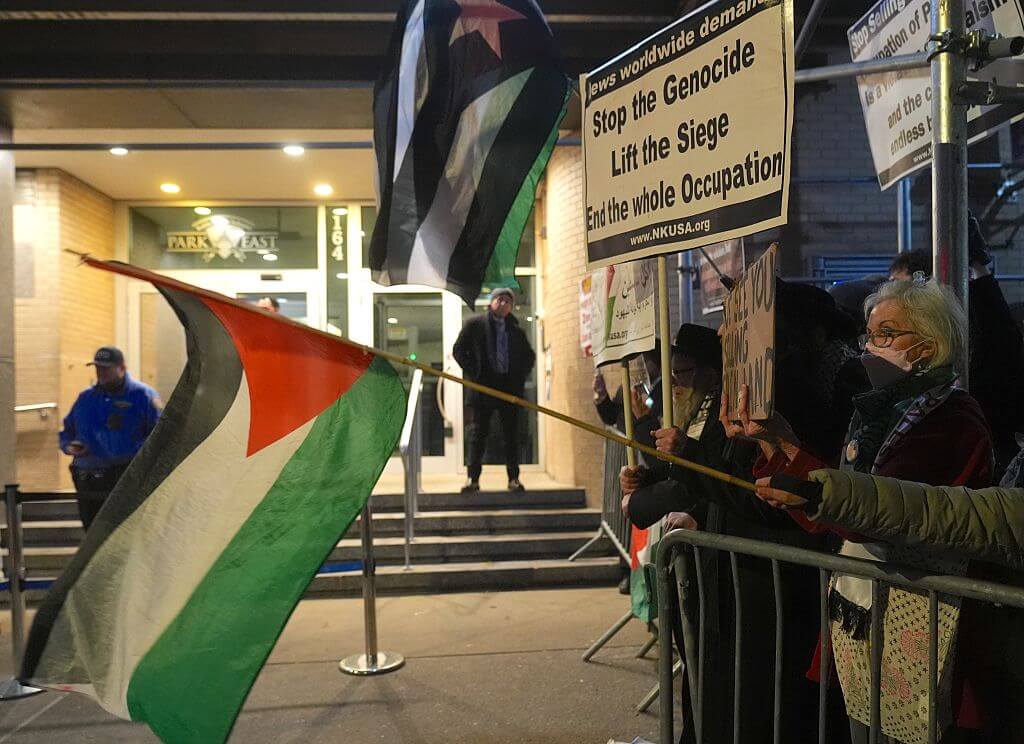
Demonstrators gather outside Park East Synagogue during an event promoting immigration to Israel hosted by Nefesh B’Nefesh on Nov. 19. Photo by Selçuk Acar/Anadolu via Getty Images
By Arno Rosenfeld December 3, 2025
Antisemitism Decoded is the Forward’s biweekly newsletter that helps you separate the signal from the noise and understand current debates over Jewish safety. Sign-up here.
After protesters hounded people entering an event promoting immigration to Israel at Park East Synagogue in Manhattan last month, Mayor-elect Zohran Mamdani condemned the demonstration — with a notable caveat.
“He believes every New Yorker should be free to enter a house of worship without intimidation,” Dora Pekec, Mamdani’s spokesperson, said in a statement. “And that these sacred spaces should not be used to promote activities in violation of international law.”
Mamdani may have had a previous news cycle in mind when he issued this response. Last year, protesters in New Jersey and California were accused of antisemitism for demonstrating outside several synagogues before the target of their ire — real estate seminars offering property in the Israeli-occupied West Bank — became clear and blunted some of the criticism.
But the event at Park East was more complicated than the real estate seminars, and Mamdani’s implicit condemnation of the synagogue for hosting it marked a messy entry into the fight over when Jews deserve protection, and when they don’t.
***
Protesters were targeting an event hosted by Nefesh B’Nefesh, an NGO sponsored by the Israeli government that serves as the primary clearinghouse for North American Jews who want to make aliyah, or immigrate to Israel under the Law of Return, regardless of their politics.
The argument that any synagogue that promotes aliyah is engaged in the violation of international law is so charged because almost every mainstream congregation in the United States supports Jews moving to Israel, at least implicitly. Aliyah is a core component of Zionism and rooted in the religious beliefs of many Jews. Nefesh B’Nefesh references a line from the Torah, “we shall surely ascend and inherit the Land,” in its promotional materials.
Mamdani’s office tried to clarify his statement following the initial uproar, and stated that he only objected to Nefesh B’Nefesh encouraging immigration to Jewish settlements in the Israeli-occupied West Bank, which are illegal under international law.
But here’s the rub: The Israeli government refuses to acknowledge any meaningful distinction between Jewish settlements in the West Bank and the rest of Israel — and, in fact, they often make distinguishing between the two illegal.
This came up in my reporting on Ben & Jerry’s unsuccessful attempt to stop doing business in Israeli settlements. Marc Stern, chief legal officer at the American Jewish Committee, explained to me that the Israeli government prohibits businesses from refusing to serve settlements. That means operating in Israel effectively requires operating in the West Bank, and boycotting Israeli settlements in the West Bank — a strategy once referred to as “Zionist B.D.S.” — effectively means boycotting the rest of Israel.
So it’s true that Nefesh B’Nefesh lists several Israeli settlements as potential destinations for American Jews. But as a quasi-state enterprise, the organization likely couldn’t exclude the settlements from its programming even if it wanted to.
***
The possibility that contemporary support for Israel may be inseparable, at least in practice, from supporting Israel’s occupation of the West Bank, has caused plenty of consternation among American Jews.
But it’s treacherous territory for Mamdani to enter because, as I’ve written before, failing to distinguish between Jewish leaders and organizations that are actively promoting and supporting a right-wing vision of Israel, and everyone else, risks declaring open season on the vast majority of American Jews.
And the protesters outside Park East certainly weren’t making careful distinctions about where, exactly, those in attendance were interested in moving.
Chants from demonstrators included “resistance, you make us proud, take another settler out,” reported Luke Tress in the Times of Israel, and “settlers, settlers, go back home, Palestine is ours alone,” celebrating violence against Israeli civilians and calling for the wholesale expulsion of Jews from Israel — both of which would be violation of international law in their own right.
Mamdani is clearly wary of playing into the hands of Jewish leaders who consider the vast majority of demonstrations against Israel to be antisemitic. But many synagogues display Israeli flags on the bimah, organize congregational trips to Israel and issue statements of solidarity with Israel during times of war.
The Park East incident was no doubt only a preview of things to come, and as Mamdani prepares to take office he’ll need to decide with much more precision what, exactly, he believes marks a synagogue as sacred or profane.
GO DEEPER:
- What does Mamdani’s response to synagogue protests mean for Jews? No one will like the answer.
- NYPD commissioner Jessica Tisch apologizes for allowing ‘turmoil’ outside synagogue
- Most American Jews believe Zohran Mamdani will make NYC Jews less safe, Israeli poll finds
- What the LA synagogue pro-Palestinian protest was really about