Will laying tefillin make a difference? A rabbi responds to his cousin’s murder in Australia attack
We must confront what faith can, and cannot, offer after terror
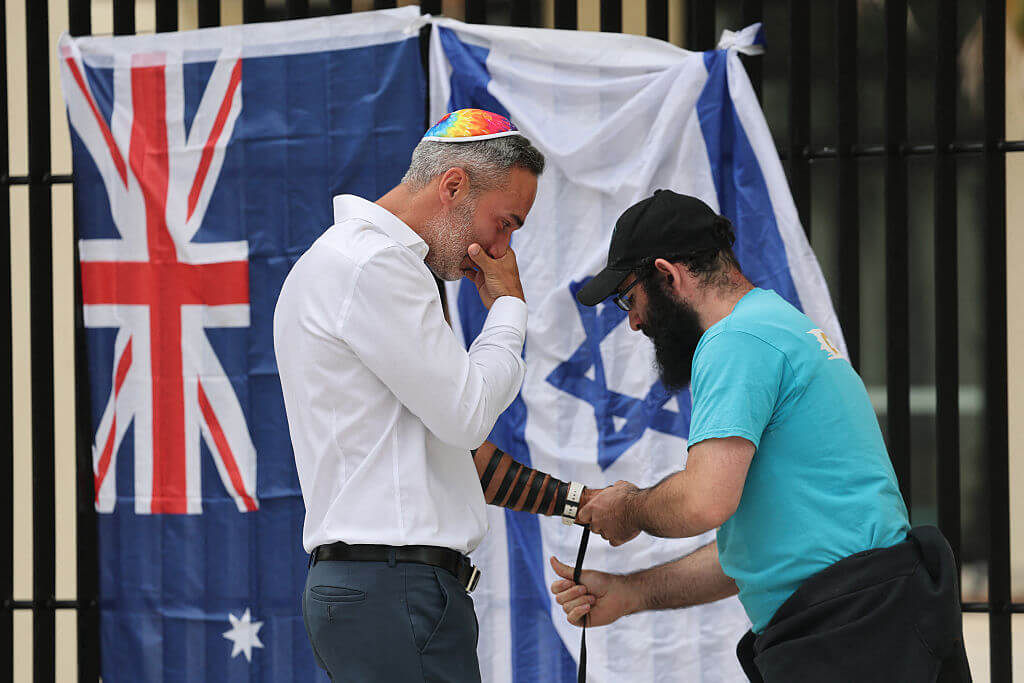
Co-CEO of the executive council of Australia Jewry Alex Ryvchin (L) prays with a rabbi as they stand outside the Bondi Pavilion, where an Australia and Israeli flag are displayed in memory of the victims of a shooting at Bondi Beach, in Sydney on December 15, 2025. Photo by David Gray/AFP via Getty Images

Editor-at-Large Robin Washington December 15, 2025
The first thing I did when I heard news of the attack at Bondi Beach — at what must have been midnight Australian time — was to call my dear friend Michelle.
No response, though that’s not atypical: an American expatriate who’s lived in Sydney for a generation, she usually doesn’t get back to me for a day or two. Then I worked social media, searching for her and anyone else I might be connected to via Jewish geography — which often means a friend-of-a-friend among Facebook users.
While searching, the enormity of the horror set in. Fifteen people dead, about 40 wounded, hundreds under fire on the beach where the Chabad of Bondi, near Sydney, held its “Chanukah by the Sea” event.
If there were people I knew — one survivor had previously written for the Forward — the names of those killed weren’t released yet, except for Rabbi Eli Schlanger, who organized the celebration. His death was confirmed by his cousin, Rabbi Zalman Lewis of Brighton, England.
“My dear cousin, Rabbi Eli Schlanger was murdered in today’s terrorist attack in Sydney. He leaves behind his wife & young children, as well as my uncle & aunt & siblings,” Lewis posted on Facebook.
Lewis turned quickly from his cousin – “More about Eli later in the week” – to what to do next.
“Do a Mitzvah today,” he wrote. “Send pictures wearing Tefillin, saying a prayer, giving extra charity, lighting Chanukah candles.”
The suggestion instantly reminded me of another by a Chabad rabbi, in answer to a question by CNN’s Jake Tapper two weeks after the Oct. 7 attack. In the face of Hamas’s evil, that rabbi said, “Every Jewish woman should please before the Sabbath and before sundown light the Shabbat candles.”
I recall seeing Tapper’s baffled expression. It’s similar to what I’m sure many who saw Rabbi Lewis’s message must be thinking: There’s a major attack on Jews and all you can say is put on tefillin? How about kill all the terrorists?
At the other extreme are those cheering on the attackers — including one friend-of-a-friend (Jewish, I’m all but certain) who posted, “At this point, these random attacks are the only way to stop Israel. It should’ve never gotten this far but unfortunately the Zionists have brought us all here.”
I have to believe — or hope — the latter is an extreme minority opinion, and I’ll spare the poster’s name lest it incite any reciprocal violent reaction.
As for the former, kill-them-all reactions immediately run into the reality that it isn’t so easy to do, illustrated disastrously by the Gaza war. Measured purely in casualties and carnage, it was a military victory. Politically and morally, it was a public-relations disaster for Israel.
That reality has led some Jews to question the wisdom of celebrating Hanukkah as a Maccabean victory. Instead, many are accentuating Gemara rabbis who argued the holiday is more about the miracle of the oil than military might.
That doesn’t mean their successors have evolved into pacifists, but Chabad rabbis are largely speaking to Jews, about being Jewish, and, as they see it, things Jews can do themselves to repair the world.
“Let’s flood the world with goodness. As Jews, we know, as difficult as it might seem, that light & good will always win,” Rabbi Lewis wrote.
You don’t have to walk into a Chabad house to hear that. My own Reconstructionist rabbi in Duluth, Minnesota, said essentially the same thing, writing to congregants on Sunday, “Let us not succumb to fear or despair but rather embrace our faith that much more resolutely.”
Maybe some prayers are answered. Hours after my calls and messages — but much sooner than her usual replies — Michelle finally responded.
“Physically, we’re fine,” she said.
So she is safe. But too many others were not. And if faith prevents a similar fate for even a single human being, pray away.
This is a moment of great uncertainty. Here’s what you can do about it.
We hope you appreciated this article. Before you go, we’d like to ask you to please support the Forward’s independent Jewish news this Passover. All donations are being matched by the Forward Board - up to $100,000.
This is a moment of great uncertainty for the news media, for the Jewish people, and for our sacred democracy. It is a time of confusion and declining trust in public institutions. An era in which we need humans to report facts, conduct investigations that hold power to account, tell stories that matter and share honest discourse on all that divides us.
With no paywall or subscriptions, the Forward is entirely supported by readers like you. Every dollar you give this Passover is invested in the future of the Forward — and telling the American Jewish story fully and fairly.
The Forward doesn’t rely on funding from institutions like governments or your local Jewish federation. There are thousands of readers like you who give us $18 or $36 or $100 each month or year.
Support our mission to tell the Jewish story fully and fairly.