A Jewish-American exile behind the Iron Curtain, he never lost his love for East Germany
An Army private named Stephen Wechsler reinvented himself as Victor Grossman, critic of capitalism
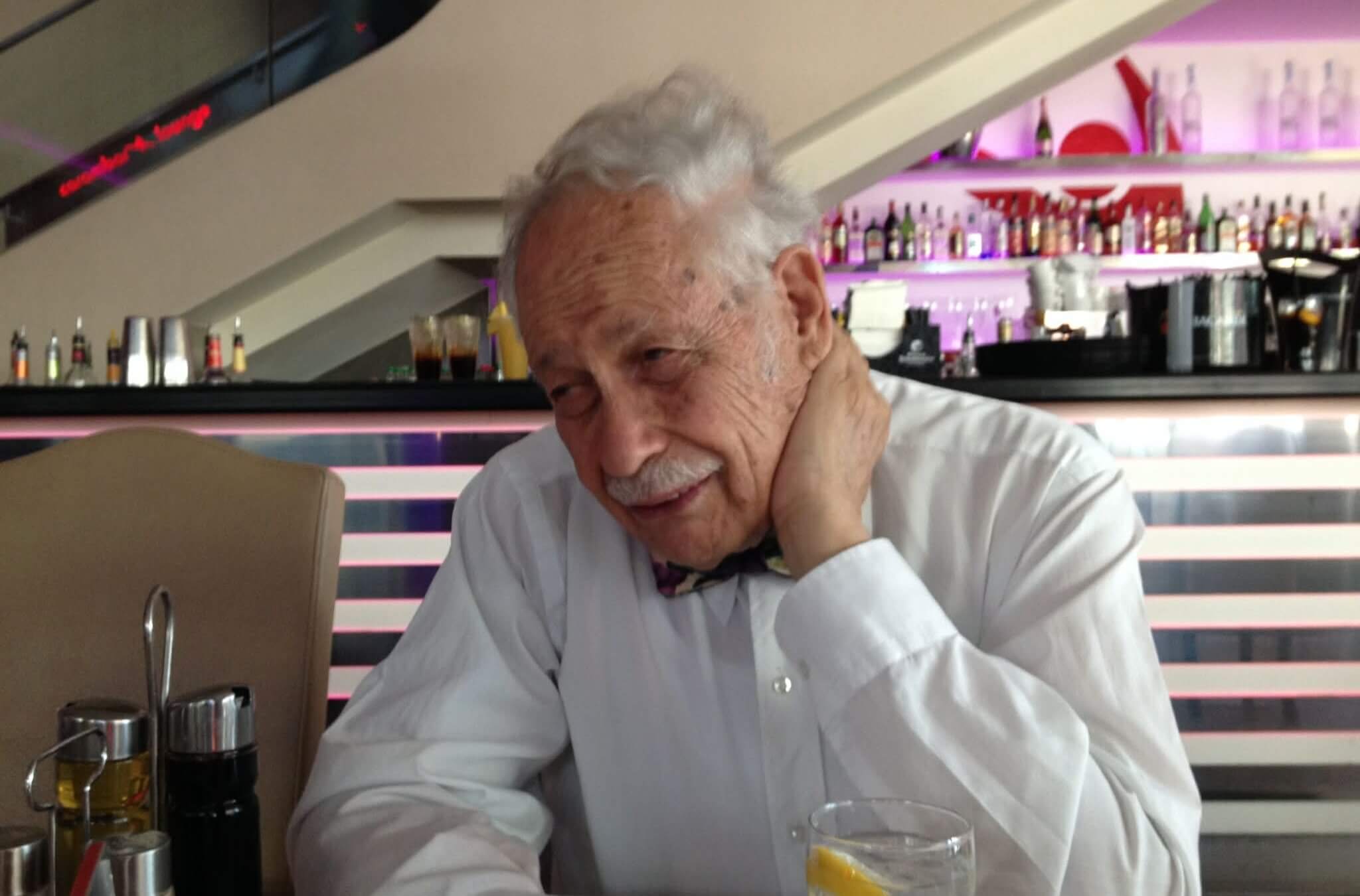
Born Stephen Wechsler, Victor Grossman wrote an online newsletter called Berlin Bulletin, warning about the threat to German democracy posed by the far-right Alternative for Germany, and to American democracy posed by Donald Trump. Courtesy of Amie Rose
Terrence Petty December 29, 2025
Three thousand miles from his New York City home, as the August dawn broke over the Austrian landscape, 24-year-old Army draftee Stephen Wechsler took off his shoes, waded into the Danube River, and began to swim. He struggled at first, then realized the current was carrying him toward his destination: the Soviet zone of occupied Austria.
Wechsler’s act of betrayal took place in 1952. The U.S. Army had discovered that the young Jewish private first class had lied on his induction papers, denying that he had ever belonged to the Communist Party or any affiliated organizations. In truth, he had belonged to several Communist groups, starting at age 14.
When a letter arrived ordering him to appear before a military judge in Nuremberg, it didn’t specify the charge. It didn’t need to. Wechsler understood immediately. And in his mind, there was only one path left: flee the American zone and seek refuge behind the Iron Curtain.
What followed is one of the more improbable personal odysseys of the Cold War. Starting a new life in Communist East Germany, Wechsler remade himself as Victor Grossman — establishing himself as a columnist, interpreter for visiting American leftists like Jane Fonda, defender of his adopted homeland, crusader against fascism, and sharp critic of American capitalism.
In his final years, Victor/Stephen wrote an online newsletter called Berlin Bulletin, warning about the threat to German democracy posed by the far-right Alternative for Germany, and to American democracy posed by Donald Trump.
Victor/Stephen died last week in Berlin at age 97, bringing to a close a 73-year exile.
I came to know him through a cousin of his in Portland, Oregon, where I live. I interviewed him by phone last year, reaching him at his apartment on Karl Marx Allee, in the formerly Communist half of Berlin. He had just turned 96. I call him Victor/Stephen because he was known as the former in Germany and the latter among his friends and relatives in the U.S.
Victor/Stephen’s story is as much about love as it is about betrayal — perhaps more so. It was love for Renate, the East German woman he married soon after his desertion, that anchored him.
“I was homesick. But I was very much in love, and that made up for it,” he told me about Renate, who died some years ago.
He sometimes wondered whether he was like Don Quixote, jousting with windmills. But his ideals were so deeply rooted that he fought for them until his final years, writing his Berlin Bulletin with the same passion he had carried since adolescence.
From his teen years through Harvard and in factory jobs after graduation, Stephen Wechsler had been deeply involved in Communist causes. In the infamous 1949 riot that disrupted a Paul Robeson concert in Peekskill, N.Y., young Wechsler was among the leftists on buses attacked by stone-throwing white mobs while police stood by and did nothing.
His activism was interrupted by the Korean War, when he was drafted into the Army. He was relieved to be sent to West Germany rather than to the front lines. But his radical past caught up with him. Facing a possible five-year sentence in a military prison for lying on his induction papers, he decided to desert.
After his swim across the Danube, Wechsler didn’t know what to expect from Austria’s Soviet occupiers. Would they suspect he was a spy? He soon found himself in Bautzen, East Germany, where the Soviets had established a kind of halfway house for Western deserters. He found work in a factory, joined the German-Soviet Friendship Society, and so impressed his hosts that they appointed him culture director of a clubhouse for foreign deserters — organizing dances, ping-pong tournaments, chess matches, billiards, and other diversions from the temptations of Bautzen’s bars.
He fell in love with Renate, enrolled in the journalism program at Karl Marx University in Leipzig, married her, and after graduation went to work for an East Berlin publishing company, as he later wrote in his autobiography Crossing the River: A Memoir of the American Left, the Cold War, and Life in East Germany. He and Renate started a family, raising two sons.
Victor/Stephen caught the attention of John Peet, a British expatriate who published the German Democratic Report, an English-language newsletter sent abroad from East Berlin to counter negative portrayals of the German Democratic Republic. He worked for Peet for four years, helping publish reports that embarrassed West Germany by using Nazi-era documents to reveal how deeply the Federal Republic’s judiciary and bureaucracy were staffed by former officials of the Third Reich
He next worked for East Germany’s state radio network. A unique opportunity arose when East Germany’s Academy of Arts asked him to create an archive dedicated to Paul Robeson. Freelance work followed: articles on U.S. affairs for fellow Karl Marx University graduates now in senior media positions, dubbing dialogue for East German films, writing English subtitles.
He began writing his own books, including a history of the United States that emphasized the roles of women, Black Americans, peace movements and unions — themes that aligned with the ideals of Communist East Germany, at least partly because of their propaganda value against the West.
The opening of the Berlin Wall tossed him into a predicament. While he welcomed the end of travel restrictions on East Germans, he feared it would lead to the demise of East Germany as an autonomous state. Of course, he was right.
When West Germany formally merged with East Germany on Oct. 3, 1990, it was a stab in the heart for him. His wish was not to see “little GDR,” as he called it, swallowed by the capitalist West, but to take a middle path — allowing political freedom to bloom while preserving socialism and what he saw as the virtues of the East German state.
“I had always made clear that I was against the boils and carbuncles,” he wrote of the GDR’s abuses, “but wanted to cure, not kill the patient.”
When I interviewed him last year, he spoke wistfully about the GDR: child care, university education, dental care, eyeglasses, and hospital stays were free; rents were cheap; there was virtually no joblessness, he said; crime was practically nonexistent. While East Germans couldn’t travel to the West, they enjoyed inexpensive vacations in Prague, Budapest, and other Eastern Bloc cities.
“Life was not what people in the West imagined,” he told me.
In his recent writings and interviews, Victor/Stephen argued that the East German state took better care of its citizens than the U.S. does of its own. In a 2019 interview with the socialist magazine Jacobin, he said, “I shine a light on issues that Americans face: evictions, homelessness, mass incarceration, food banks, and the lack of access to food, healthcare, education, maternity leave, and childcare. I draw on some truly ghastly yet upsettingly commonplace examples.”
Although Victor/Stephen could sound like an ideologue, from my phone and email communications with him I got the distinct impression that love was a factor in his decision not to move back to the States. It was love not just for Renate, but also for East Germany, for its people, and for a dream he pursued until his final days: of trying to improve the lot of all humankind.
In our times, with authoritarianism on the rise around the world, with human rights and social justice slipping away, who is to fault Victor/Stephen for never abandoning such a dream?
This is a moment of great uncertainty. Here’s what you can do about it.
We hope you appreciated this article. Before you go, we’d like to ask you to please support the Forward’s independent Jewish news this Passover. All donations are being matched by the Forward Board - up to $100,000.
This is a moment of great uncertainty for the news media, for the Jewish people, and for our sacred democracy. It is a time of confusion and declining trust in public institutions. An era in which we need humans to report facts, conduct investigations that hold power to account, tell stories that matter and share honest discourse on all that divides us.
With no paywall or subscriptions, the Forward is entirely supported by readers like you. Every dollar you give this Passover is invested in the future of the Forward — and telling the American Jewish story fully and fairly.
The Forward doesn’t rely on funding from institutions like governments or your local Jewish federation. There are thousands of readers like you who give us $18 or $36 or $100 each month or year.
Support our mission to tell the Jewish story fully and fairly.