Was Maduro’s abduction a ‘Zionist’ plot? The accusation is unfounded — and incredibly telling
Venezuela’s acting president suggested an Israeli influence in the shocking US operation that unseated her predecessor
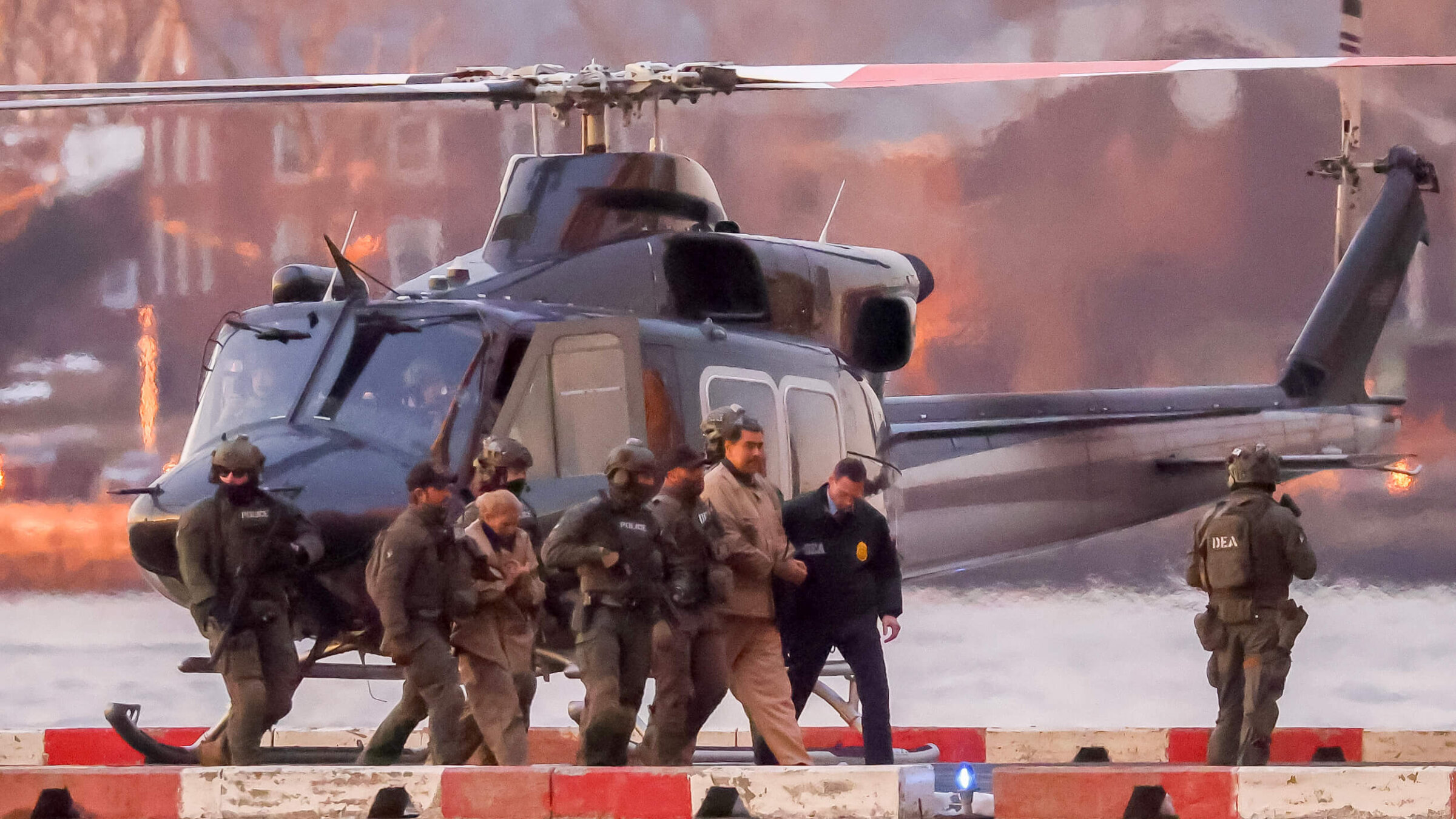
Ousted Venezuelan President Nicolas Maduro arrives at the Wall Street heliport ahead of his appearance in federal court in New York on Jan. 5. Photo by Michael Nagle/Bloomberg/Getty Images

Columnist Dan Perry January 5, 2026
In the cacophony following the United States’ extraordinary abduction of Venezuelan President Nicolás Maduro, one comment cut through the noise for many Jews. Delcy Rodríguez — a central figure in the Chavista hierarchy, and now Venezuela’s acting president — suggested that the drama had “Zionist undertones.”
The claim felt almost reflexive. When events anywhere in the world go sideways, it’s a good bet that somehow Israelis — or is it the Jews? — will be said to be behind it.
Rodríguez’s wearying words were a bit of familiar theater. But her instinct still matters, because it reveals how Israel, in the global imagination, has come to occupy a strange dual role: object of admiration for its undeniable strategic competence and, simultaneously, all-purpose bogeyman for the populist left.
How did that come to be?
Let’s begin with the obvious point. As Israeli Prime Minister Benjamin Netanyahu has openly aligned himself with far-right leaders around the world, he’s come to be seen by the left worldwide as a diabolical symbol of the populist right writ large. (Maduro is far-left — an authoritarian of a different variety.) To criticize Netanyahu, or Israel under him, is increasingly shorthand for criticism of the global right.
But there is a second, equally important truth: Israel in the past several years has demonstrated an astonishing level of military and intelligence competence — ironically, after the monumental failure on both fronts on Oct. 7, 2023. That too shapes how the country is perceived: sometimes in awe, sometimes in fear, always with the risk of sliding seamlessly into conspiracy.
Consider the record. Since Oct. 7, Israel has thrashed the Lebanese militia Hezbollah and killed its leader, Hassan Nasrallah; the exploding beepers episode at the height of that conflict was received, on the world stage, like a strategy straight out of James Bond films. Israel eliminated almost the entire top tier of Hamas’ military and political brain trust — including Ismail Haniyeh, in a dramatic assassination staged during a visit to Tehran. Plus, in the opening hours of last summer’s war with Iran, Israel was able to decimate significant portions of Iran’s military and scientific leadership and expose the brittleness of its air defenses, while also shooting down the vast majority of hundreds of Iranian missiles and drones launched in response.
These are extraordinary feats. They cultivate an aura of capability — and to some, of near-invincibility. Israel looks, to friend and foe alike, like a country that sees further, strikes deeper, and plays a longer game than its enemies expect.
U.S. President Donald Trump has added a crucial third element to the equation: He appears obsessed with keeping Netanyahu in power, going so far as to beg the Israeli president to give him a pardon in his corruption trial. The two leaders have held five meetings in the U.S. in the year since Trump’s return to office, most recently last week, and Netanyahu has addressed Congress to rounds of loud applause
To the global left, all of these factors make Israel seem almost like a co-author of Trumpism, one with exceptional military acumen. To the global right — or at least the part of it that has not fallen under the spell of an increasingly vocal antisemitic contingent led by those like Tucker Carlson — it makes Israel seem like an indispensable warrior in a civilizational struggle.
Both views are deeply flawed. And both are influential in inflating the sense that Israel is everywhere — guiding, enabling, manipulating. Even the country’s haters participate in its mythmaking.
Combine this ascendant sense with long-lived antisemitic tropes that portray Jews as omnipotent puppet masters, the hidden hand behind major world events, and it is not hard to see why the words “Zionist undertones” rolled so easily off Rodríguez’s tongue. Her words aren’t new in her milieu. The Latin American left has long embraced movements opposed to Western liberal capitalism. Many of those movements have centered “anti-Zionism”: see Jeremy Corbyn, the former leader of Britain’s Labour Party and a lodestar for much of the global left, who has openly cultivated sympathy for Hezbollah and Hamas and expressed warmth toward Cuba and Venezuela’s Chavismo.
This entire coterie — the global far left, the South American authoritarian left, and various Israel-hating jihadist groups — are unlikely bedfellows who are also longtime fellow travelers. There are real strategic threads connecting Venezuela, Iran, and groups sworn to Israel’s destruction. Hezbollah’s presence in Latin America — including in Venezuela — has been an open secret for years. Its networks in the tri-border area between Paraguay, Argentina and Brazil have been documented; its fundraising, smuggling, and occasionally operational footprints are not figments of imagination. The bombings of the Israeli Embassy and the Jewish community center in Buenos Aires in the 1990s were not myths; they were atrocities almost universally attributed to Iran and Hezbollah acting far from home.
And Venezuela’s Chavista governments have cultivated warm ties with Tehran for years. They have provided diplomatic cover, economic cooperation, and political solidarity. So the Venezuelan accusation does not emerge from a vacuum. It emerges from an arena in which opposition toward Israel is a potent political force, and a global political culture in which Israel is cast not as a small state in a dangerous region, but rather as a symbol of the entire global order the left wishes to dismantle.
But Rodríguez’s words add to that preexisting state of affairs by casting Israel as a stand-in for Trump himself. After all, it’s far easier to demonize a distant state with its own set of pressing geopolitical concerns than an American president who is powerful, vindictive and politically dangerous to cross.
This is a moment of great uncertainty. Here’s what you can do about it.
We hope you appreciated this article. Before you go, we’d like to ask you to please support the Forward’s independent Jewish news this Passover. All donations are being matched by the Forward Board - up to $100,000.
This is a moment of great uncertainty for the news media, for the Jewish people, and for our sacred democracy. It is a time of confusion and declining trust in public institutions. An era in which we need humans to report facts, conduct investigations that hold power to account, tell stories that matter and share honest discourse on all that divides us.
With no paywall or subscriptions, the Forward is entirely supported by readers like you. Every dollar you give this Passover is invested in the future of the Forward — and telling the American Jewish story fully and fairly.
The Forward doesn’t rely on funding from institutions like governments or your local Jewish federation. There are thousands of readers like you who give us $18 or $36 or $100 each month or year.
Support our mission to tell the Jewish story fully and fairly.