An arsonist torched a Mississippi synagogue. It feels hauntingly familiar.
The fire at Beth Israel echoes a long history of synagogue attacks, including the 1958 bombing of The Temple in Atlanta
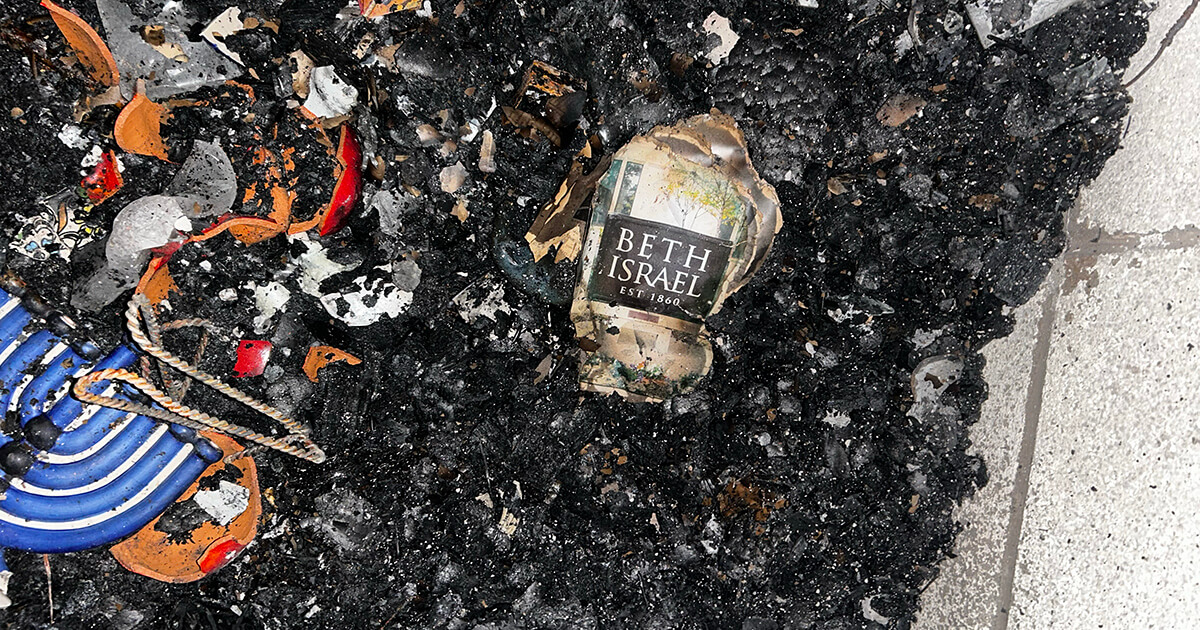
Soot and smoke damaged the entire building of Beth Israel Congregation in Jackson, Mississippi. Courtesy of Beth Israel Congregation

Rabbi Jeffrey K. Salkin January 11, 2026
A Mississippi synagogue has just been destroyed by hateful actors — and it is not the first time.
I am talking about what happened Saturday morning. An arsonist set fire to the historic Beth Israel Congregation in Jackson, Mississippi. By the time the flames were extinguished, much of the building was destroyed and rendered unusable.
According to reporting by Mississippi Today, the fire tore through parts of the building, damaging sacred objects, prayer books and decades of communal memory. Firefighters were able to prevent a total collapse, but the synagogue — founded in 1860 and one of the oldest Jewish congregations in the state — will not be able to function as a house of worship for the foreseeable future.
I am experiencing historical déjà vu. On Sept. 18, 1967, white supremacists bombed Beth Israel in retaliation for the civil rights activism of its rabbi, Perry Nussbaum. Nussbaum was a visible ally of Black leaders in Jackson, including Medgar Evers, and his moral courage made him a target. Shortly thereafter, they bombed Nussbaum’s home as well. He survived. The building was rebuilt.
Those attacks followed a grim and unmistakable American tradition. For several years, I served The Temple in Atlanta, and congregants still spoke in hushed tones about where they were on the morning of Oct. 12, 1958, when The Temple was bombed by white supremacists angered by Rabbi Jacob Rothschild’s outspoken support for civil rights. That bombing is often remembered by Southern Jews as the most infamous attack on a religious building in American history, but what many forget is that it did not stand alone. In the year leading up to it, synagogues in Miami, Nashville, Birmingham and Jacksonville were also bombed.
Synagogues have succumbed to flames throughout Jewish history. On Kristallnacht, Nov. 9-10, 1938, the Nazis and their collaborators burned or destroyed more than 1,400 synagogues across Germany and Austria. That night was not a spontaneous riot; it was a dress rehearsal for annihilation. And the line of fire stretches further back still, to the Roman destruction of the Second Temple in 70 C.E., and before that to the Babylonian destruction of the First Temple in 586 B.C.E.
Beth Israel is not just a building. It is a witness. It is a repository of Jewish persistence in a place where Jews have lived as a tiny minority for generations, carving out space for faith, community and civic engagement in the Deep South. To see it burned is to feel a familiar Jewish nausea, the sickening recognition that this story has been told before — far too many times.
Beth Israel in Jackson burned on Shabbat, coinciding with the Torah portion of Shemot, as we read in the book of Exodus about the burning bush — a bush that burns but is not consumed by flames. Such is Jewish history.
An American tradition?
What disturbs me most is not only the act itself, but its familiarity.
I mentioned my time in Atlanta. I also served as a rabbi in Columbus, Georgia. When I look back on my career, I realize that I have spent no fewer than 20 years serving Jewish communities in the South — and yes, I include South Florida in that number.
During those years, I learned a profound respect for Jews in small Southern communities who tenaciously maintain their synagogues in the face of demographic shrinkage, economic pressure, and cultural isolation. When those synagogues close, as too many do, the community must make sure that there are homes for their Torah scrolls and ritual objects. This is sacred labor, often carried out quietly and without recognition.
Most Americans do not realize that a surprisingly large percentage of Reform synagogues in this country look far more like Beth Israel in Jackson than like the caricature of the large, affluent suburban congregation. The heart of Reform Judaism beats in small, struggling, historic communities. That is why the fire in Jackson sears the Jewish soul. It could be any synagogue. And in my darkest fears, I believe there will be more.
Right about now, some of you are saying, “Well, what did you expect? Look at what has happened in Gaza, and the Palestinians, and Netanyahu…”
If you are saying this, your foolishness betrays you. No one should ever suggest that victims of violent bigotry are responsible for the hatred directed at them. We would never say this about any other group. We must not say it about Jews.
The raw truth is what historian Pamela Nadell names so clearly in her indispensable new book, Antisemitism: An American Tradition.
Pamela does not only name and record the incidents of antisemitism that have occurred over the years. She shows that antisemitism is, in fact, an American tradition. It has always been with us, sometimes polite, sometimes lethal, often lying dormant like an autoimmune disease, flaring up when fear, desperation and social change demand a scapegoat.
An issue for all faiths
Antisemitism flares up not only because of what has happened, but because of what I fear will follow — not only imitation, but silence. As I write these words, I do not know whether this arson will merit national attention, whether it will appear in The New York Times or vanish into the vast archive of shrugged-off hate. I hope my fears are wrong.
I also wonder who will speak. Will our most trusted chroniclers of American moral life take notice? I admire historian Heather Cox Richardson deeply, and I hope she will address antisemitism with the same moral clarity she brings to other threats to democracy. Because it cannot be that even in the warmest of hearts there is a cold spot for the Jews.
I often think of an artifact I have seen at the United States Holocaust Memorial Museum in Washington, D.C. It is a Torah ark ripped from the wall of a synagogue in Essen, Germany, hurled into the street. Carved into it are the words, “Know before whom you stand.” But those words were deliberately chiseled away by a vandal, as if to declare that there is no one before whom we stand, no God whose presence must be reckoned with — because we are destroying the place where that God so often comes to dwell.
That is why I am turning now to my readers who are not Jewish. I am calling on Christian pastors, Muslim imams, and religious leaders of every tradition to denounce what happened in Jackson this coming weekend. Because just as we rightly said when Black churches were burned, any attack on a house of worship is not only an attack on one community. It is an assault on the very idea that holiness has a place in public life.
And that, ultimately, is an attack on God.
Correction, Jan. 12: A previous version of this story claimed that Russian Orthodox churches have not been vandalized in response to Russian President Vladimir Putin’s actions. In fact, there are multiple accounts of Russian Orthodox churches being vandalized in the wake of Russia’s invasion of Ukraine in 2022.
The story was also updated to clarify that it is Southern Jews who often remember the 1958 bombing of The Temple as the most infamous attack on a religious building in American history. Among the general population, the 16th Street Baptist Church bombing is more widely known.
This is a moment of great uncertainty. Here’s what you can do about it.
We hope you appreciated this article. Before you go, we’d like to ask you to please support the Forward’s independent Jewish news this Passover. All donations are being matched by the Forward Board - up to $100,000.
This is a moment of great uncertainty for the news media, for the Jewish people, and for our sacred democracy. It is a time of confusion and declining trust in public institutions. An era in which we need humans to report facts, conduct investigations that hold power to account, tell stories that matter and share honest discourse on all that divides us.
With no paywall or subscriptions, the Forward is entirely supported by readers like you. Every dollar you give this Passover is invested in the future of the Forward — and telling the American Jewish story fully and fairly.
The Forward doesn’t rely on funding from institutions like governments or your local Jewish federation. There are thousands of readers like you who give us $18 or $36 or $100 each month or year.
Support our mission to tell the Jewish story fully and fairly.