For southern Jews, the Mississippi synagogue firebombing rekindles memories of exile and endurance
The specter of violence seems to be haunting Jews everywhere we live
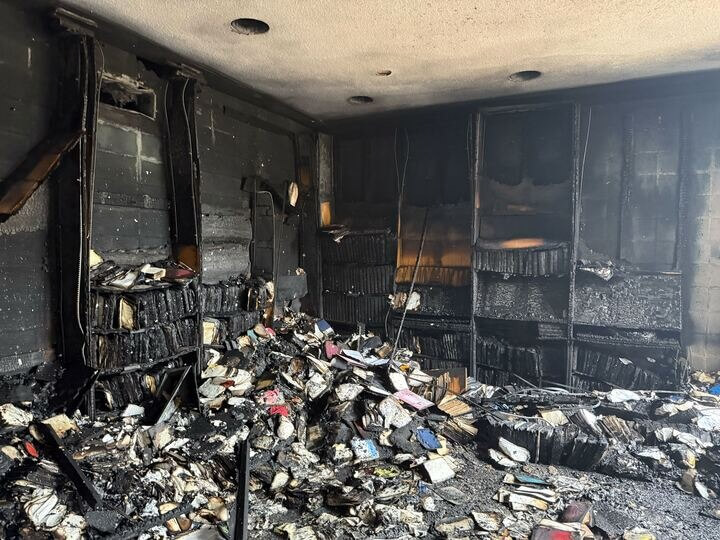
A fire damaged the library at Beth Israel Congregation in Jackson, Mississippi, on Jan. 10. Courtesy of Beth Israel Congregation
As I read a Facebook post from a childhood friend about the Jan. 10 firebombing of Beth Israel, Mississippi’s oldest and largest synagogue, the words of one of Mississippi’s greatest authors, William Faulkner, haunted me: “The past is never dead. It’s not even past.”
Beth Israel’s library and administrative offices were reduced to “charred ruins,” according to Mississippi Today. Two Torahs were destroyed and five more damaged. By the end of Saturday, the Jackson Fire Department, the FBI, and the federal Bureau of Alcohol, Tobacco, Firearms and Explosives had arrested a suspect for arson.
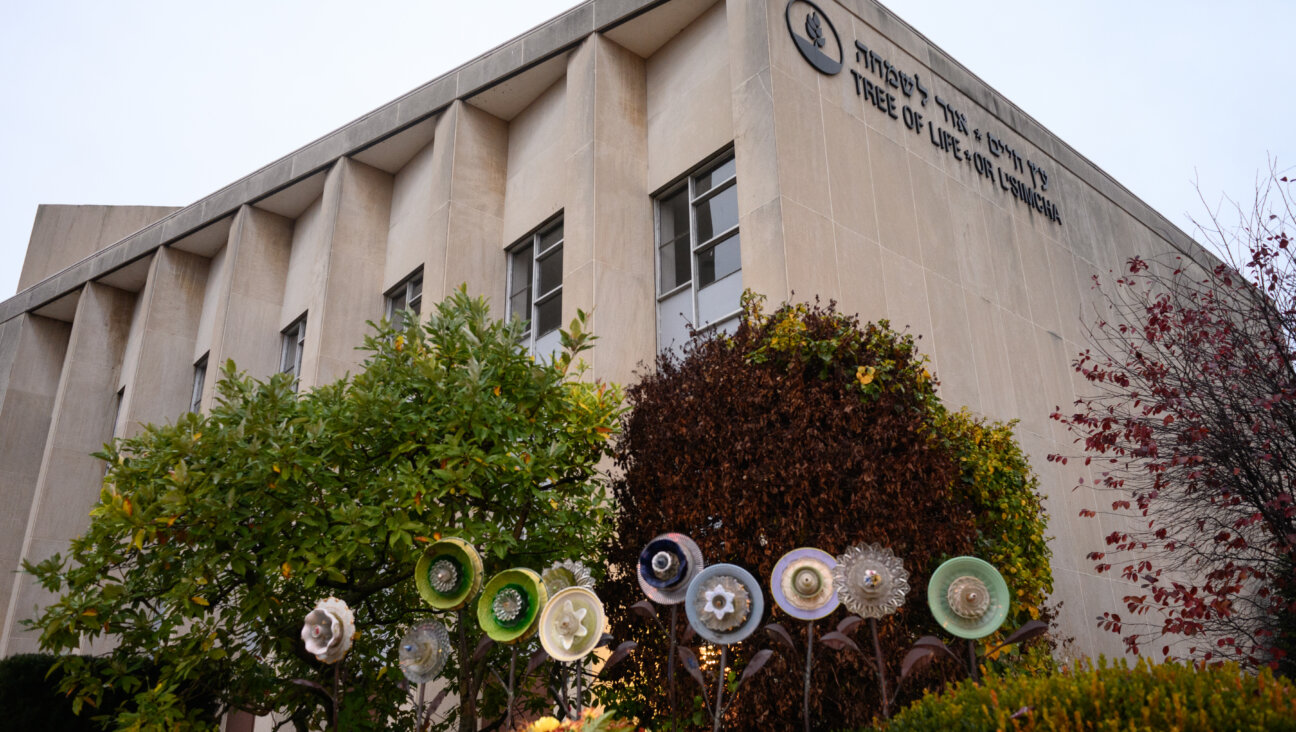
It is too soon to know the precise motives of the arsonist. But the echoes of history are deafening. This was not the first time someone had set fire to this very synagogue. Ku Klux Klan members firebombed it in 1967, because of the support of the rabbi, Perry Nussbaum, for desegregation. They firebombed Nussbaum’s house, too.
This is a desecration. The devastation spreads out in ripples, from the community itself, to those who have a personal connection to the place, to every Jew near and far who feels both empathetic and afraid when they hear of yet another attack like this.
I’m in the second ring. When I was growing up in Louisiana, this congregation was part of my broader Jewish community. Henry S. Jacobs Camp, the Reform summer camp I attended and worked at, is located in the small town of Utica, 30 miles southwest of Jackson.
In fall 1992, I sat in Beth Israel’s sanctuary for a camp friend’s bat mitzvah. In high school I visited for Shabbaton with my regional youth group, which brought together teenagers from Louisiana, Mississippi, Arkansas and western Tennessee. There might have been fewer of us across four states than in a single city like LA, Chicago or Miami, and it felt like we were one big extended family.
Roberta Berner, my friend’s mother, used to volunteer running Beth Israel’s gift shop. She has warm memories of raising her two kids in the Jewish community in Mississippi.
“One real difference in Mississippi versus New England, where we live now, is that down there everyone affiliated with the synagogue,” she told me. In a predominantly Southern Baptist town, there was safety and belonging within the synagogue walls. “You want to feel like you’re in a comfortable group, and you don’t have to explain yourself,” she added.
Many Jews don’t realize that the American South was settled as far back as the 1700s in part by Jewish peddlers from Germany, Alsace-Lorraine and then Poland. Beth Israel first opened its doors just before the Civil War. As children, we learned this history at camp, because longtime camp director Macy B. Hart started collecting and displaying sacred objects gathered up from scattered places where Jews could no longer make a minyan. Today, thanks to that preservation work, there is a Museum of the Southern Jewish Experience in New Orleans, and an Institute for Southern Jewish Life that had its offices at Beth Israel in Jackson.
We Jews are a small tribe, barely 16 million people worldwide. And we tend to cluster in places where we can form a critical mass. Those of us who, by choice or circumstance, come from places where we’re scattered more thinly, are used to feeling as if we’re on the fringes, both of the community we live in and of the broader Jewish community. It’s a kind of double galut (exile). Maybe that’s why we so fiercely claim our history and each other.
Growing up in the South, I wager I experienced more antisemitism than many Jews of my generation, especially those like myself who aren’t visibly observant. I was mocked by Christian classmates and told I was going to hell. The year before I attended that bat mitzvah in my sailor dress and pearl necklace, I was bullied by a classmate in a black trenchcoat who brandished a copy of Mein Kampf and used antisemitic slurs in threatening late-night calls to my house.
At the very same time, 1991, David Duke was running for governor of Louisiana. As an avowed neo-Nazi and grand wizard of the Ku Klux Klan, his presence on the mainstream political scene was terrifying, bewildering. If you pointed out he was a Nazi, it was such an outlandish thing to say that you sounded hysterical. My parents, as part of a Jewish and Black coalition, were active against Duke, and he was ultimately defeated, aided by the best unofficial political slogan of modern times: “Vote for the crook. It’s important.” (The victor, Edwin Edwards, eventually served time in federal prison for racketeering.)
Marked by those experiences, I grew up dreaming not only of a mythical Yerushalayim but of a mythical New York City, a place I watched on Seinfeld and visited with my Sunday School class: where Jewish shrugs and cadences were the norm, where real-life Hasidim spoke Yiddish, where billboards on the Lower East Side advertised Passover wine. I firmly believed I would grow up, move out of the South, and leave behind Confederate flags and ugly antisemitic rhetoric for good.
I made it to New York City, but the antisemites aren’t history anymore. At this moment, violence and prejudice against Jews certainly feel like they’re accelerating. At Jacobs Camp, we used to joyfully sing a song that went, “Wherever you go, there’s always someone Jewish.” Now that sentiment makes me feel less powerful and more vulnerable, because whether it’s in Bondi Beach, Manchester, Boulder, or Jackson, Mississippi, members of my extended family are coming under attack.
But my visceral response to yet another incident like this isn’t only to be afraid and draw closer to fellow members of the tribe. I think about the reason that Nussbaum and his congregation were attacked 59 years ago. It’s because they embraced pluralism and coexistence. Because they loved justice and refused to back down to terrorists. Because they raised money for Black churches that were set on fire. They were on the side of the poor and the less powerful — the right side of history. That’s the kind of proud Southern Jew I want to be.
This is a moment of great uncertainty. Here’s what you can do about it.
We hope you appreciated this article. Before you go, we’d like to ask you to please support the Forward’s independent Jewish news this Passover. All donations are being matched by the Forward Board - up to $100,000.
This is a moment of great uncertainty for the news media, for the Jewish people, and for our sacred democracy. It is a time of confusion and declining trust in public institutions. An era in which we need humans to report facts, conduct investigations that hold power to account, tell stories that matter and share honest discourse on all that divides us.
With no paywall or subscriptions, the Forward is entirely supported by readers like you. Every dollar you give this Passover is invested in the future of the Forward — and telling the American Jewish story fully and fairly.
The Forward doesn’t rely on funding from institutions like governments or your local Jewish federation. There are thousands of readers like you who give us $18 or $36 or $100 each month or year.
Support our mission to tell the Jewish story fully and fairly.