Trump says Republicans ‘don’t like’ antisemites. Don’t trust him
The president’s words don’t reflect the reality of a party that has grown more welcoming toward open antisemitism
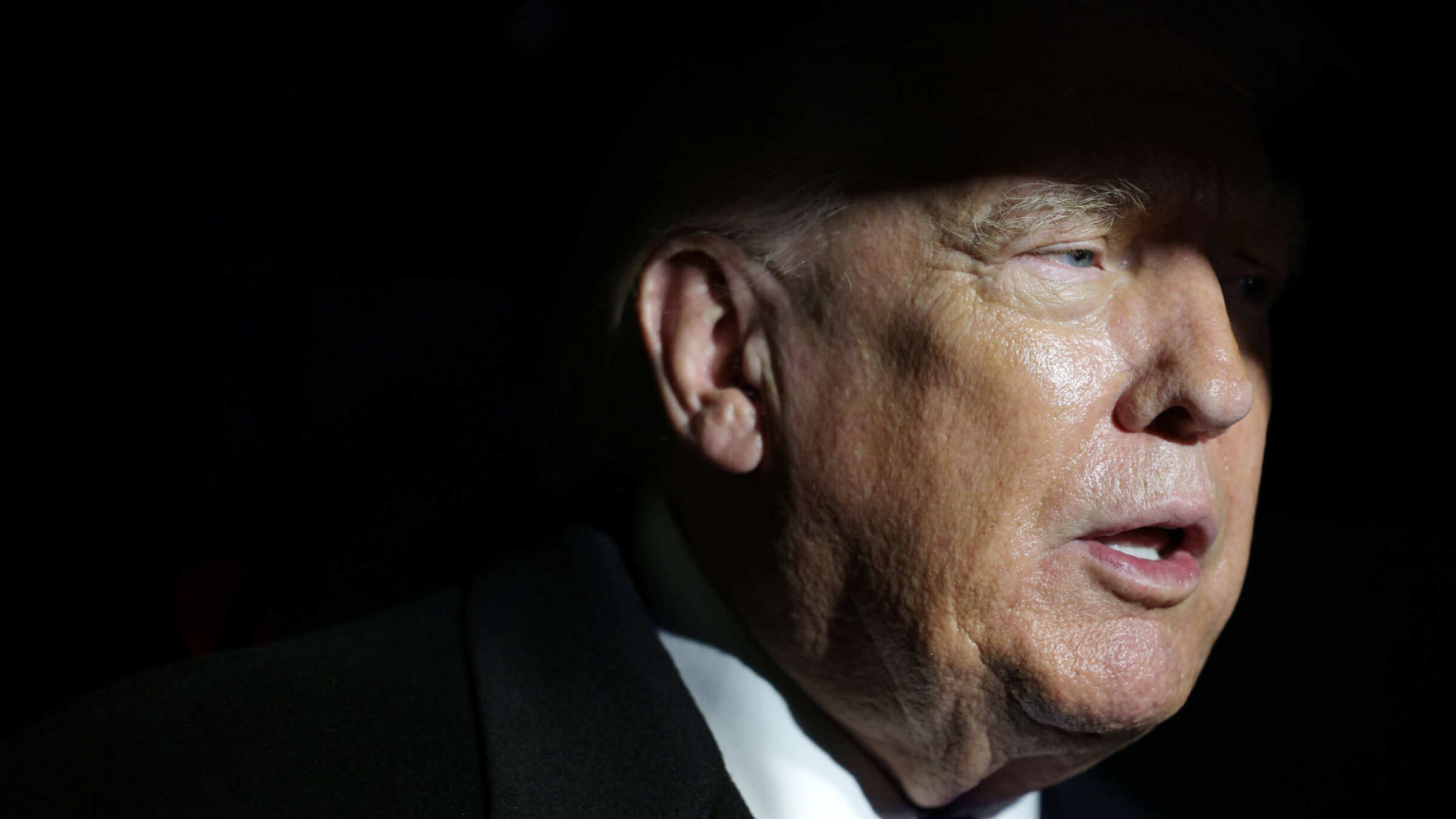
President Donald Trump on Jan. 9. Photo by Alex Wong/Getty Images

Contributing Columnist Sruli Fruchter January 12, 2026
President Donald Trump claims to be “the least antisemitic person” in the world, and, in a new interview with The New York Times, insisted that antisemites have no home in the Republican Party.
But with antisemitism erupting in right-wing circles, the narrative of Trump and the Republican Party as the Jewish people’s sole defenders is crumbling. And so is a form of Jewish politics that has catastrophically failed American Jews.
In response to the surge of left-wing antisemitism after Hamas’ massacre on Oct. 7, 2023, many American Jewish communities and institutions adopted a realpolitik approach for survival: support whichever candidates fight most fiercely in defense of Israel, and against campus antisemitism. That often meant standing behind Trump and his “Make America Great Again” base.
But staying in Trump’s good graces came with the condition of unequivocal loyalty. Questioning Trump, or the movements that backed his return to power, would be considered the epitome of disloyalty. Which meant that, in order to ensure the administration’s continued support for Jewish interests, Jewish groups working with Trump needed to disregard Republican antisemitism — see the widespread refusal to decry Elon Musk’s apparent Nazi salute after Trump’s inauguration.
That trade-off is no longer working.
Amid the growing popularity and influence of antisemites like Tucker Carlson, Candace Owens and Nick Fuentes — whom Trump, in the Times interview, claimed not to know, despite the two’s infamous 2022 dinner — Trump and his right-wing allies have failed to meaningfully act.
Which means that Jews who have partnered with Trump, or hoped his second presidency would prove to be good for our people, need to start considering a new form of Jewish politics – one in which supporting Israel and paying lip service to combating antisemitism are not the only meaningful yardsticks.
Supporting liberal democratic values — equality, civil discourse and political order — must matter, too. Because when illiberalism thrives, Jewish communities are always endangered.
Authoritarianism, the journalist Anne Applebaum explained in her 2020 book Twilight of Democracy: The Seductive Lure of Authoritarianism, stands against complexity, debate, and the political norms that make democracies thrive. This breeding ground is ripe for conspiratorial thinking, which is almost always a pretext to antisemitism.
Applebaum saw that process unfold after the election of Poland’s Law and Justice party in 2016, when some of her acquaintances drifted from embracing illiberalism to becoming propagandists advancing age-old antisemitic conspiracy theories.
Disregarding facts, spreading conspiracies and refusing accountability are the playbook of Trump’s presidency. And that’s exactly the playbook that figures like Carlson, Owens and Fuentes follow — no matter how much Trump disowns the connection.
Carlson, who was fired from Fox News more than two years ago, has since used his extraordinarily successful podcast to platform Holocaust deniers and spread conspiracy theories about Jews and Israel. And Trump defended Carlson’s 2025 interview with Fuentes, an openly antisemitic far-right agitator who has rapidly gained influence in the wake of his fellow far-right activist Charlie Kirk’s murder.
It was up to listeners “to decide” for themselves about Fuentes’ antisemitic views, Trump insisted.
Vice President JD Vance similarly refused to condemn Carlson, who served as an influential surrogate for Trump’s reelection campaign.
Owens, who hosts one of the world’s most popular podcasts, has also been defended by the more mainstream right. Megyn Kelly, a former Fox host with 4 million YouTube subscribers, has repeatedly refused to condemn the absurd antisemitic conspiracy theories Owens has spread — whether they involve Jewish pedophile rings, Israel being responsible for Charlie Kirk’s assassination, or Jewish money controlling the United States.
So despite Trump’s weak condemnation of antisemites — “I think we don’t like them,” he told the Times — his actions, and those of his allies and defenders, send a contrary message.
That must push American Jews to ask: What went wrong in the calculus? How could once avowedly proud defenders of Jews and Israel backtrack like this?
For starters, we must acknowledge that this change is not sudden. Rampant antisemitism in Trump’s administration has rarely received serious attention from his Jewish supporters. During his first term, and since his second inauguration last January, high-ranking officials under his watch have promoted the antisemitic great replacement theory; mocked the Holocaust; and maintained ties to antisemites. The response from too many mainstream Jewish groups has been, effectively, a shrug.
They may have thought that ignoring that culture was part of the bargain needed to secure Trump’s allyship. Instead, it should have been a warning sign that Trump cared about antisemitism and Israel only so long as doing so served him — not because it was right to do so.
Taking that bargain was an aberration from the Jewish norm, and a damaging one.
“Given the realities of history,” Jonathan A. Jacobs, director of the Institute for Criminal Justice Ethics at John Jay College, has written, “Jews are fully alert to the ways that serious deficits of civility can be as menacing and lethal as discriminatory laws.”
There is a reason why American Jews have traditionally held a deep affinity for democratic societies: They have understood the role that true democratic governance, and the values of liberal democracy, have played in their safety.
History reminds us that whether in 20th-century Europe or today’s Middle East, systematic anti-democratic behaviors are a warning sign for Jews.
At the same time, this does not mean that democratic societies are the only consideration for Jewish safety.
The Australia Institute describes Australia’s democracy as “thriving,” yet only weeks ago, 15 people were killed at a Hanukkah celebration in Sydney, which came in the context of escalating antisemitism across the country — arsonist attacks on synagogues, calls for destroying Israel and isolation of Jewish communities.
That means democracy may not be enough to guarantee Jewish safety. But neither can it be disregarded.
The lesson for Jewish communities and institutions is that we must find leaders and politicians who will protect Jews in the short and long term. We must support a healthy democracy, and also fight for it to combat hate as effectively as possible.
That means backing politicians whose policies are not only favorable to Jewish safety and supporting Israel, but also toward democracy.
“Anyone who buys into the conspiracy myth that is the foundation stone of antisemitism,” Deborah Lipstadt, the former special envoy to combat and monitor antisemitism, said in 2024, “has given up on democracy.”
If there is any lesson from the unmasking of right-wing antisemites, it is this: If Jews want lasting safety, they cannot secure it through transactional loyalty or selective outrage. The task is not to choose between fighting against antisemitism and for democratic values, but rather to insist upon both.
This is a moment of great uncertainty. Here’s what you can do about it.
We hope you appreciated this article. Before you go, we’d like to ask you to please support the Forward’s independent Jewish news this Passover. All donations are being matched by the Forward Board - up to $100,000.
This is a moment of great uncertainty for the news media, for the Jewish people, and for our sacred democracy. It is a time of confusion and declining trust in public institutions. An era in which we need humans to report facts, conduct investigations that hold power to account, tell stories that matter and share honest discourse on all that divides us.
With no paywall or subscriptions, the Forward is entirely supported by readers like you. Every dollar you give this Passover is invested in the future of the Forward — and telling the American Jewish story fully and fairly.
The Forward doesn’t rely on funding from institutions like governments or your local Jewish federation. There are thousands of readers like you who give us $18 or $36 or $100 each month or year.
Support our mission to tell the Jewish story fully and fairly.