American Jews can’t agree about anything — except Iran
American Jews have rallied behind Iranian protesters in a rare show of solidarity, anti-Zionists and Israel hawks alike
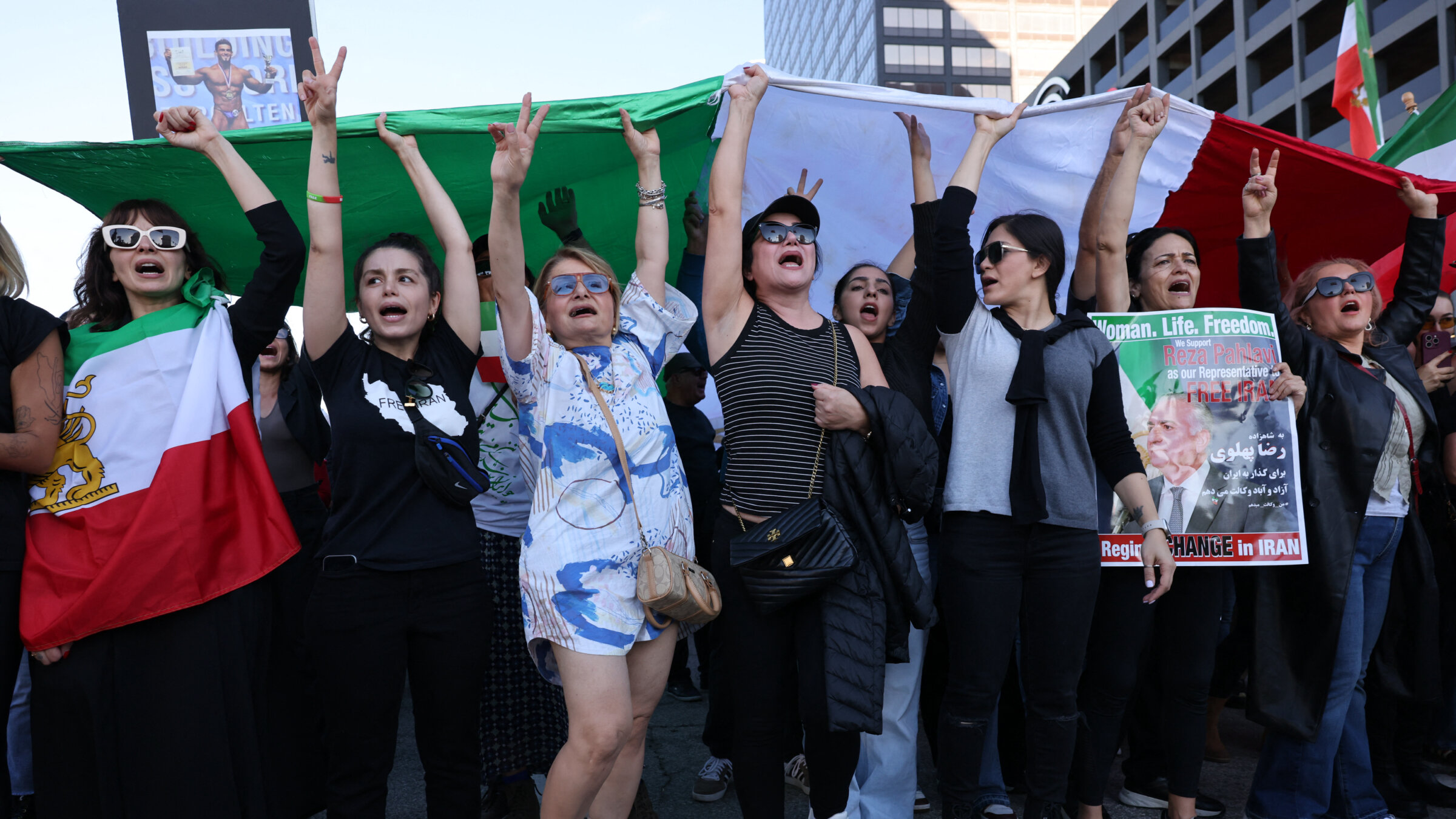
People take part in a Jan. 11 ‘Free Iran’ rally in Los Angeles, home to a large Iranian Jewish community. Photo by Jonathan Alcorn / AFP via Getty Images

Senior Columnist Rob Eshman January 14, 2026
Jews around the world have set aside their deep differences and come together in support of the protests in Iran.
“This never happens,” Rachel Sumekh, an Iranian-American nonprofit consultant in Los Angeles, told me. “You never had a coalition this diverse, because people get so stuck in politics.”
It’s easy to see why the protests — which began in response to a plunge in the value of Iran’s currency, and have ballooned into a widespread outpouring of rage at the Iranian regime — have drawn together all parts of the Jewish world. For the left, it’s a human rights struggle; for the right, it’s a chance for the regional balance to reset in favor of Israel.
But it’s difficult to say with certainty that unity between left and right, Zionist and anti-Zionist, will survive the tough decisions the protests will demand.
‘Progressives should care about human rights’
Since the 1979 revolution that brought the religious Islamic mullahs into power, Iranians have seen their rights and freedoms stripped away.
Millions took to the streets in the 2009 Green Movement to dispute a rigged election. Regime forces killed at least 550 protesters during the 2022 “Women, Life, Freedom” marches for women’s rights.
The brutality of the new crackdown has been on full display during the new protests; thousands are feared dead, with accounts of many killed by direct shots to the head. Amid that environment of fear and violence, protesters “deserve the support of progressives,” wrote Peter Beinart, an outspoken anti-Zionist, in his Substack newsletter, “because progressives should care about human rights.”
Many on the left are leery of supporting a cause that may lead to U.S. military intervention — or one they see as covertly backing Israel’s interests.
That may explain the silence of many so-called human rights activists who have stayed mum. But Jews are bucking that trend. “I have anti-Zionist Jewish friends who are posting in support of Iran, even though they know the base doesn’t like it,” said Sumekh.
Beinart, who has written that he “no longer believes in a Jewish state,” reminded his hundreds of thousands of followers of something that, well, should be pretty obvious.
“It’s as wrong to give countries a pass when they brutally violate human rights because they’re anti-American,” he said in a posted video, “as it is to give them a pass when they brutally violate human rights, because they’re pro-American.”
Not ‘death to Israel,’ but ‘long live Iran’
For many Jews, any revolt against Iran’s theocratic government is personal. The majority of the 60,000-odd Jews who lived in Iran at the time of the 1979 revolution fled, settling mostly in Israel and the United States. In both countries, those exiles have become integral to the Jewish community.
Some have family still in Iran, where about 15,000 Jews remain. In sharing their culture, stories and concerns, they have made Iranian freedom a tangible and pressing Jewish cause.
Plus, an overthrow of the regime could be a reason for relief in the Jewish state. The Iranian opposition, said policy analyst Karim Sadjadpour on the Call Me Back podcast, “is trying to replace, ‘Death to America’ and ‘Death to Israel’ with ‘Long Live Iran.”
The human rights issue matters to the right as well. But Israel’s staunchest supporters are also hoping for the downfall of a regime that has sworn to achieve Israel’s destruction.
Iran has funded the terror groups Hezbollah and Hamas and pursued a missile and nuclear weapons program that threatened and attacked Israel — even at the cost of crippling Iran’s own economy. The regime also funneled funds to Bashar al-Assad’s authoritarian government in Syria, which served as a conduit to supply weapons to Hezbollah.
Republican Jews are saying a successful regime overthrow would expiate the original sin made by Democratic President Jimmy Carter, whom they blame for not supporting the Shah of Iran during the 1979 revolution, which swept the mullahs into power.
President Donald Trump, to them, is the anti-Carter. Trump has publicly supported the protesters, and threatened to use American power to protect them. Trump has not ordered any military intervention, but on Tuesday he posted a message on his Truth Social platform, “KEEP PROTESTING! TAKE OVER YOUR INSTITUTIONS!”
As Ellie Cohanim, Trump’s former deputy envoy to combat antisemitism, said on Fox News, Trump is the first president to threaten the Iranian regime that if they kill protesters, “we’re going to hit you hard and we’ll hit you where it hurts.”
‘We actually have the same enemy’
If the U.S. does intervene militarily, the Jewish response is likely to be less unified.
We have been bitterly divided over Iran policy in the past. Slightly more than 60% of American Jews supported the 2015 agreement then-President Barack Obama spearheaded to limit Iran’s nuclear development, but the opposition was organized and vocal, leading to deep fissures in the community.
Those cracks may reappear if America intervenes militarily.
“When the United States gives itself the right to intervene militarily in the internal affairs of another country,” Beinart cautioned, “that emboldens other powers, China and Russia in particular, to do exactly the same thing.”
Yet many liberal American Jews backed Trump’s decision to strike Iranian nuclear facilities in June 2025. Those strikes made “Israel, the Jewish people and the world safer, ”Rabbi Rick Jacobs, the president of the Union for Reform Judaism, told the Forward at the time.
What will decide the extent to which Jews agree on the wisdom of intervention? Probably the duration of any operation; a long-term involvement in Iran would likely be much more controversial than any quick, one-time strike.
A worse outcome, said Sumekh, would be for Trump to attempt to negotiate with the regime, ultimately leaving it in place. The mullahs would likely use negotiations as a way to buy time and reassert control, making waste of the rare opportunity for real change.
It is too early to tell if the courageous Iranians facing bullets and batons will bring down their repressive regime. And should that happy day come to pass, we will surely find ways to argue over who should get credit, who should get blame, and how we can best help a free Iran repair its economy and find stability.
But for now, Jews know that overthrowing the regime is the most important goal. Iranians deserve liberation, and that freedom will be beneficial for the entire Middle East, if not the world.
“Through what’s happening right now, people can finally understand and see the connection between the Iranian people and the Jewish people and the people of Israel,” Natalie Sanandaji, an Iranian-Israeli survivor of the Nova massacre, said in a video posted to X, “They can see that not only are we not enemies, but we actually have the same enemy, the Islamic regime of Iran.”
This is a moment of great uncertainty. Here’s what you can do about it.
We hope you appreciated this article. Before you go, we’d like to ask you to please support the Forward’s independent Jewish news this Passover. All donations are being matched by the Forward Board - up to $100,000.
This is a moment of great uncertainty for the news media, for the Jewish people, and for our sacred democracy. It is a time of confusion and declining trust in public institutions. An era in which we need humans to report facts, conduct investigations that hold power to account, tell stories that matter and share honest discourse on all that divides us.
With no paywall or subscriptions, the Forward is entirely supported by readers like you. Every dollar you give this Passover is invested in the future of the Forward — and telling the American Jewish story fully and fairly.
The Forward doesn’t rely on funding from institutions like governments or your local Jewish federation. There are thousands of readers like you who give us $18 or $36 or $100 each month or year.
Support our mission to tell the Jewish story fully and fairly.