What Jackson, Mississippi’s only synagogue means to its city — in the wake of arson, and beyond
The history of Beth Israel is marked by violence, and by profound communal efforts at repair
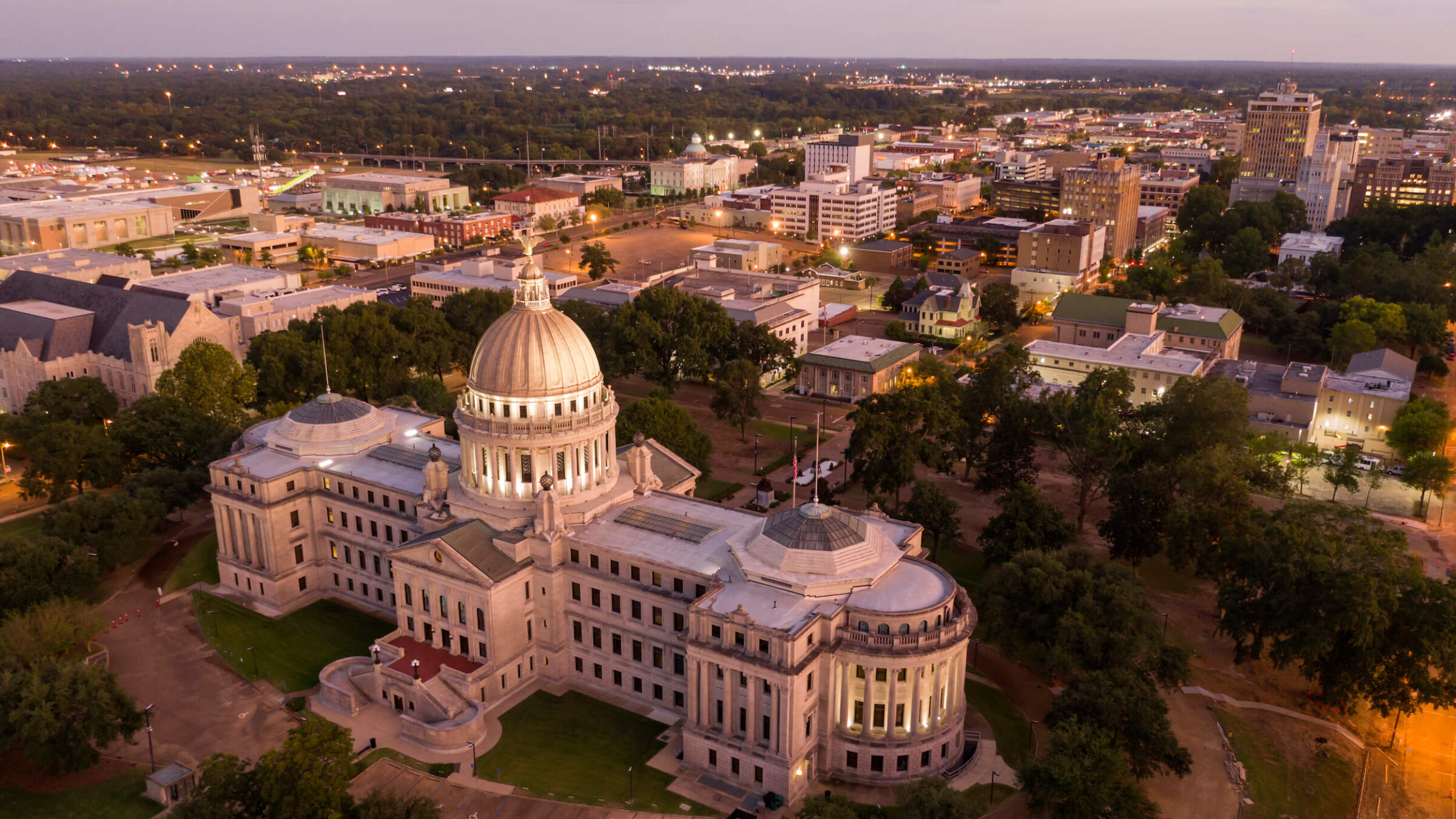
Jackson, Mississippi. Photo by Chris Boswell/iStock by Getty Images
Austin Albanese January 15, 2026
When Beth Israel Congregation was dedicated in Jackson, Mississippi, in the summer of 1875, the occasion was marked with a procession that began in front of City Hall.
A local paper reported that the synagogue was so crowded that many were unable to gain admission. Visitors had come from all over the South: Vicksburg, Canton, New Orleans, Memphis, and beyond. Christians were present and explicitly welcomed. The service concluded with an elegant supper and a ball at Angelo’s Hall on Capitol Street, a venue that could comfortably accommodate 400 people. Much of the crowd remained out celebrating until dawn.
This was a city witnessing Jewish life in public and welcoming it, even though the congregation numbered only about 80 souls. And it was also a city reckoning with the aftermath of hate: The ceremony marked the opening of a rebuilt synagogue, after an earlier Beth Israel building had been destroyed by “an incendiary” the year before.
This history matters now. Jackson has long known a double inheritance: the reality of antisemitism, and the presence of neighbors who showed up to support the Jewish community.
After an antisemitic arson attack on Saturday severely damaged Beth Israel — which was rebuilt after being bombed by the Ku Klux Klan in 1967 — national coverage moved quickly to frame the event as confirmation of a familiar story about Mississippi. One outlet led with the phrase “Mississippi Goddam,” invoking the title of Nina Simone’s civil rights protest anthem as a shorthand for moral condemnation.
Outrage in the face of antisemitic violence is justified. But framing Jackson primarily as a home to deeply rooted hatreds obscures the local reality: a synagogue that has long benefited from relationships with churches and civic partners, and a city where Jewish life has persisted through cooperation, not isolation. When that context disappears, so do the stories of neighbors who still live there, and who will be working to rebuild long after the headlines fade.
Months before the fire, I wrote for a local Jackson publication about Beth Israel’s history as a civic and interfaith institution in the city. My reporting traced how the synagogue’s 19th-century dedication unfolded as a public event, with Christian leaders in attendance and the building treated as a point of local pride.
And it showed me how significant a source of pride Beth Israel has been to its hometown — one of the truths lost, after the arson, in a rush to define Mississippi as a one-dimensional home of bigotry.
The 1875 reports on the synagogue’s opening lingered on details that newspapers of the time reserved for buildings that were points of civic pride, dwelling on the height of the sanctuary, the carved woodwork of the altar, the light from arched windows, and the number of people the pews could seat. One paper ventured that no small congregation “in the entire South, if indeed the whole country,” possessed as fine a place of worship as Beth Israel in Jackson.
That pride is still evident today, particularly in the swell of interfaith support that followed Sunday’s fire.
As the president of Beth Israel Congregation told the Forward, multiple churches reached out in the days following the arson, offering their sanctuaries as temporary worship space for the congregation while repairs are underway.
Rebuilding, he noted, could take up to a year. In the meantime, Jewish life in Jackson would continue.
That gesture may have been quiet, but it is not small. It means Christian congregations opening their doors not just for a one-night vigil or brief program, but for the long, ordinary work of sustaining religious life: making space for Shabbat services, holidays, study and gathering.
This history is not new. After the 1874 arson, local papers reported that a subscription had been started to rebuild the synagogue and predicted that the call would be “generously responded to.” A year later, the congregation, described as “Spartan-like,” rebuilt, assisted by friends in the wider Jackson community.
When Beth Israel dedicated a new synagogue in 1942, amid World War II, the ceremony again unfolded as a civic occasion. The governor of Mississippi sent greetings, the mayor spoke on behalf of the city, and representatives of Catholic and Protestant churches were present.
In his dedication sermon, Rabbi Julian Feibelman urged that the synagogue be consecrated “to everything that is true and that is blessed in the teachings of our faith,” and called it a house meant for “intercommunication and society — the ethical in life.”
When we treat a place as defined by inevitable hatred, we suggest that the people who actually live there are incapable of building a stronger and more welcoming communal life — people like Feibelman, who, in that 1942 sermon, said the synagogue aimed to be “a perpetual lamp” within the community. We treat antisemitism as something to fear from a distance, rather than something neighbors can confront together.
That kind of framing leaves out the work that follows violence. Jewish life in Jackson is not something to be guarded from afar. It is sustained locally, as an integral part of the city it has helped shape.
This is a moment of great uncertainty. Here’s what you can do about it.
We hope you appreciated this article. Before you go, we’d like to ask you to please support the Forward’s independent Jewish news this Passover. All donations are being matched by the Forward Board - up to $100,000.
This is a moment of great uncertainty for the news media, for the Jewish people, and for our sacred democracy. It is a time of confusion and declining trust in public institutions. An era in which we need humans to report facts, conduct investigations that hold power to account, tell stories that matter and share honest discourse on all that divides us.
With no paywall or subscriptions, the Forward is entirely supported by readers like you. Every dollar you give this Passover is invested in the future of the Forward — and telling the American Jewish story fully and fairly.
The Forward doesn’t rely on funding from institutions like governments or your local Jewish federation. There are thousands of readers like you who give us $18 or $36 or $100 each month or year.
Support our mission to tell the Jewish story fully and fairly.