Hannah Arendt could have anticipated the Trump administration’s lies in Minnesota — and elsewhere
The Jewish philosopher’s essay on ‘Lying in Politics’ applies as much to current politics as it did to Vietnam
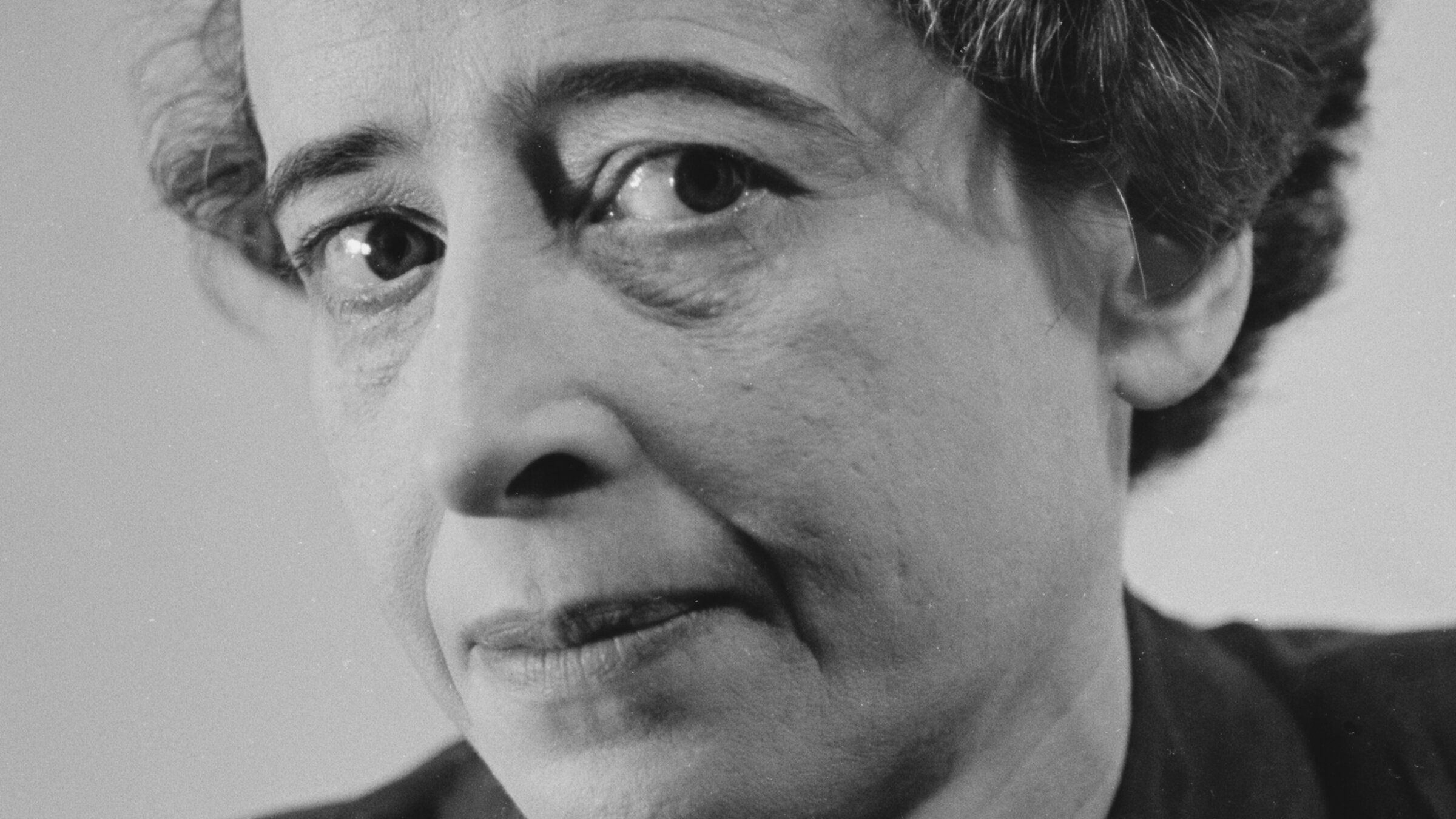
Portrait of German-born American political theorist and author Hannah Arendt, 1949. Photo by Fred Stein Archive/Archive Photos/Getty Images
Robert Zaretsky February 2, 2026
During the last half-dozen years of Hannah Arendt’s life, the celebrated political and moral philosopher, who died in 1975, was shaken by a series of personal and political crises. Not only was she still dealing with the fallout from her book Eichmann in Jerusalem: A Study in the Banality of Evil, but Arendt lost two of her closest friends: her husband Heinrich Blücher and her mentor Karl Jaspers. Moreover, she was increasingly alarmed by the assassinations of Bobby Kennedy and Martin Luther King, the churn of student antiwar protests, and mounting police violence.
“For the first time,” Arendt told her friend, the novelist Mary McCarthy, in 1968, “I meet middle-aged, native-born Americans (colleagues, quite respectable) who think of emigration.”
One affair during this period that struck Arendt with great force was the New York Times publication of the Pentagon Papers in June 1971. These papers, commissioned by former Secretary of Defense Robert McNamara, documented in despairing detail America’s deepening involvement in Vietnam from 1945 to 1967. Leaked to the Times by the RAND Corporation analyst Daniel Ellsberg, the papers quickly led to a series of crises — constitutional, political, nearly existential — that led both to the landmark decision by the Supreme Court to allow their publication and, of course, Richard Nixon’s decision to draft a team of plumbers to burglarize the office of Ellsberg’s psychiatrist.
Arendt was of course shocked by the blood-soaked futility and consequences, for civilians no less than soldiers, of American military strategy. But she was also staggered by how successive governments packaged this deadly madness for public consumption. It was nothing less, she declared in her essay “Lying in Politics,” a “quicksand of lying statements of all sorts, deceptions as well as self-deceptions,” one which will engulf any reader intent on making sense of our government’s actions.
First published in the New York Review of Books more than a half-century ago — and subsequently included in Arendt’s collection of essays Crises of the Republic — the piece is hauntingly prophetic, anticipating the salvo of crises now roiling our country. These dangers most often issue from a single source — namely, the embattled status of what Arendt calls our “common world,” one structured by the existence of truth and fact. Were we to undermine these, we would undo that very same world.
The history of political lying is, in a sense, little more than a series of footnotes to Plato’s notion of the “noble lie” — lies the powerful tell the weak in their quest for power and, if they succeed, hold on to it.
“Truthfulness,” Arendt drily notes, “has never been counted among the political virtues, and lies have always been regarded as justifiable tools in political dealings.”
But there is lying and lying. For a prince or president to maintain power, Machiavelli famously declared, “it is necessary to know how to do wrong.” While the use of deception and deceit is among these necessary wrongs, it is important for the ruler to use them sparingly and surgically. Yet this was hardly the case for the succession of presidents who presided over the military and moral debacle in Vietnam. Instead, they and their officials lied with great but also systematic abandon over the reasons for the war — which evolved over time — as well as its human cost and progress. That these lies, Arendt writes, “became the chief issues of the Pentagon Papers, rather than the illusion, error, miscalculation, and the like, is mainly due to the strange fact that the mistaken decisions and lying statements consistently violated the astoundingly accurate factual reports of the intelligence community.”
This deliberate dissonance between facts and claims, in turn, feeds a kind of rot that eats away at the epistemological and ethical foundations of our world and lives. And this is no small matter, for it goes to the heart of Arendt’s analysis of totalitarianism. She argues that factual truths, unlike rational truths, are never compellingly true. That 2+2 will always equal 4 needs no witnesses; that a violent mob stormed out Capitol on Jan. 6, 2020 does, however, require witnesses and factual evidence.
“Facts need testimony to be remembered and trustworthy witnesses to be established in order to find a secure dwelling place in the domain of human affairs,” she wrote. This web of truths is as intricate and fragile as a spider’s web; just as a swat of a stick can collapse the latter, so too can the constant swatting of lies by groups or peoples destroy the former.
The path to the Nazi destruction of European Jewry was paved by the deconstruction of factual truth, the obliteration of moral judgment, and the contagion of state lies. This was no less the case with those Arendt called the “problem-solvers” at RAND — the club of the best and brightest which Ellsberg decided to quit — than with the architects of the Final Solution. In both instances, Arendt writes, “defactualization and problem-solving were welcomed because disregard of reality was inherent in the policies and goals themselves.”
But the rot runs broader and deeper. Eventually, it destroys not just common sense and a common past, but the world we hold in common. If everybody always lies to you, Arendt observes, the consequence is that you will no longer believe anything at all. The next step, quite simply, is the unmaking of reality.
As Arendt wrote in “Truth and Politics,” a companion piece to “Lying in Politics,” the “result of a consistent and total substitution of lies for factual truth is not that the lies will now be accepted as truth, and the truth be defamed as lies, but that the sense by which we take our bearings in the world is being destroyed.”
Of course, this is the existential threat posed by our nation’s current management, one dedicated to the destruction of factual truth and the world it undergirds. Yet the still provisional success of the citizens of Minneapolis who, in their relentless attention to factual truths — truths they have witnessed and share not only amongst themselves but also the world beyond their city — reminds us that this enterprise in nihilism is hardly predestined.
Arendt would not have been surprised, I believe, by this insurgency on behalf of not just factual but also moral truth in our glacial Midwest. Yet another reason, as this new chapter to the crises of the republic unfolds, Arendt shall remain our indispensable guide.
This is a moment of great uncertainty. Here’s what you can do about it.
We hope you appreciated this article. Before you go, we’d like to ask you to please support the Forward’s independent Jewish news this Passover. All donations are being matched by the Forward Board - up to $100,000.
This is a moment of great uncertainty for the news media, for the Jewish people, and for our sacred democracy. It is a time of confusion and declining trust in public institutions. An era in which we need humans to report facts, conduct investigations that hold power to account, tell stories that matter and share honest discourse on all that divides us.
With no paywall or subscriptions, the Forward is entirely supported by readers like you. Every dollar you give this Passover is invested in the future of the Forward — and telling the American Jewish story fully and fairly.
The Forward doesn’t rely on funding from institutions like governments or your local Jewish federation. There are thousands of readers like you who give us $18 or $36 or $100 each month or year.
Support our mission to tell the Jewish story fully and fairly.