Amid standoff with US, would Iran really attack Israel?
There’s a strong regional precedent for such a move — and serious dangers attached to doing so
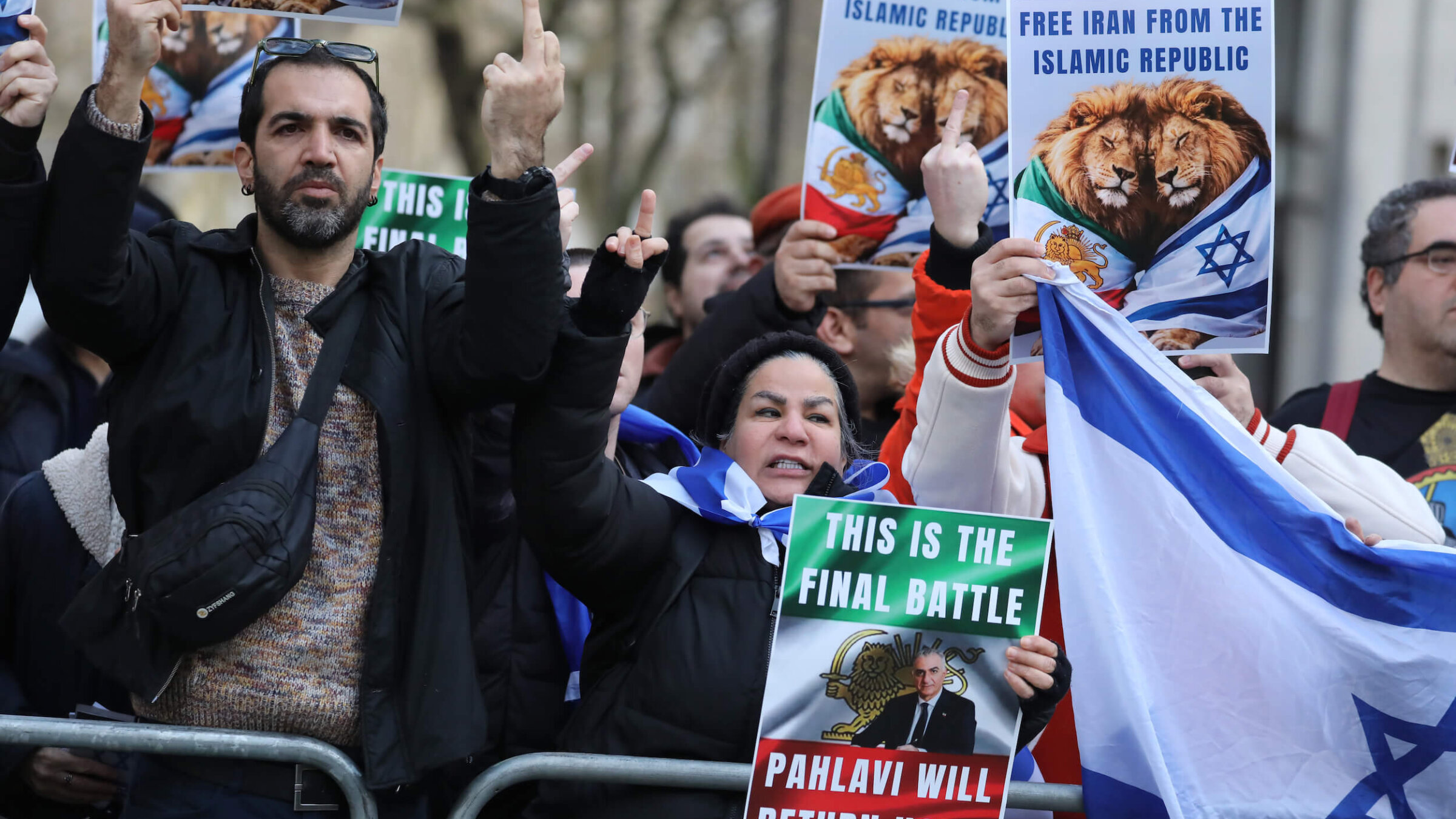
Protesters display Israeli flags along with placards stating “Free Iran from the Islamic Republic” in London on Jan. 31. Photo by Alishia Abodunde/Getty Images

Columnist Dan Perry February 2, 2026
As President Donald Trump weighs ordering military action against Iran — with officials from both sides scheduled to meet Friday to pursue a diplomatic resolution —Tehran has issued a familiar warning: Attack us, and we will strike Israel.
The threat makes little sense. Israel is responsible neither for Iranians’ miseries, which led to major protests last month, nor for any possible attack by the United States. Yet the cynical logic behind the warning is credible. Turning any confrontation with the U.S. into an Arab-Israeli one might change the dynamics by fracturing any regional coalition backing Washington, shifting the narrative to one of resistance.
Former Iraqi dictator Saddam Hussein attempted exactly this in 1991, during the first Gulf War. Facing a broad U.S.-led coalition that included Arab states, he fired Scud missiles at Israel. If Israel had retaliated, those Arab partners would have been forced to choose between coalition discipline and domestic outrage. The alliance might have collapsed.
Israel, urged by the U.S., showed extraordinary restraint: It absorbed the attacks and did not respond. Saddam’s gambit failed, and he was expelled from Kuwait. That precedent may no longer apply. Israel is angrier now, and its accounts with Iran — even after last summer’s brief war — remain overdue.
Those truths, combined with Trump’s rash approach to conflict, could make for a dangerous combination.
From Tehran’s perspective, it is critical that Trump has no apparent appetite for long wars. He wants moments that can be spun as achievements, not long and costly campaigns. And he is generally impatient. After the 12-day war in June, the Iranian regime was badly exposed, and serious analysts were calling for real surrender terms: an end to enrichment, abandonment of ballistic missiles, and the dismantling of proxy militias, including Hezbollah and the Houthis.
Trump instead rushed to declare that everything had been “obliterated” and mused publicly that a deal might no longer be necessary at all, turning his sights elsewhere.
That short attention span creates room for Iranian calculation — in which Israel is apparently factoring.
It is possible that the Iranians are bluffing about attacking Israel. But they may also be threatening to do so as part of a certain logic, which might look like this: As last summer’s war showed, an American strike targeting the nuclear system — which has clearly become Trump’s focus, despite the fact that his initial threats came in response to Iran’s violent crackdown on protesters — is survivable. As a form of symbolic punishment, it can be absorbed. Limited concessions — caps on enrichment, revived nuclear negotiations, even the quiet removal of expendable officials — might preserve the system itself.
But since Trump is unpredictable, and may get carried away, the threat to strike Israel could serve as a way of cautioning Trump to not take things too far. It could be seen as warning that, should he not stick to the script, Iran has the ability to potentially mire him in a far more drawn-out and costly conflict.
If this is the case, the Iranian regime should tread very carefully indeed. That’s because Israel’s interests in this situation diverge fundamentally from those of the U.S. And actually making good on the threats, and handing Israel an excuse to pursue them, might spectacularly backfire.
Trump may want a quick win for his hubristic claims of unparalleled greatness. But for Israel, regime change in Iran is a very serious, real and rational goal. The Islamic Republic is explicitly committed to Israel’s destruction and has spent decades constructing a “ring of fire” around it — Hezbollah in Lebanon, Hamas in Gaza, militias in Syria and Iraq, precision-guided munitions aimed at Israeli cities.
The benefit of a post-theocratic Iran — one no longer devoted to Israel’s annihilation — would be transformative, not only for Israel but for the Middle East itself.
Yet despite Trump’s initial passion for protecting the Iranian protesters agitating toward regime change, all signs suggest that he is unlikely to really pursue a democratizing project. To do so would go against his own political philosophy, which is centered on his admiration for authoritarians. His real interest is in being seen to have achieved something — even a item much smaller than regime change — which he might argue his predecessors could not.
That is bad news for those who want to see a democratic Iran, and with it, a more stable Middle East with improved prospects for regional peace. Israel is far from alone in that wish.
Across the Arab world, a quiet realignment is underway. Saudi Arabia, the Gulf states, and even parts of the broader Sunni establishment increasingly view Iran — not Israel — as the primary source of regional instability. Normalization with Israel is no longer taboo.
So whereas Iran’s playbook assumes Arab outrage will constrain Israeli action, that logic is eroding — giving Israel its own potential ace in the hole.
Moreover, Israelis genuinely yearn for peace with Iran, and they believe that feeling is at least partly reciprocated. Israeli singers performing in Farsi have followings in Iran. The occasional Iranian dissident has visited Israel to much acclaim. The Crown Prince in exile, Reza Pahlavi, has called for a democratic Iran at peace with Israel and the West. There are also more than 200,000 Iranian Jews in Israel; they remember a different Iran, and consider that its rebirth should be no fantasy.
Israel, in short, is more focused than the U.S., potentially more ruthless where necessary, possibly more patient where required, and far more invested in the outcome with Iran than Trump is ever likely to be. So, counterintuitive as it may seem, provoking the U.S. may be survivable. Provoking Israel would be far more dangerous. Israel’s air force is far larger than the number of attack jets the U.S. has moved into the region. And that air force, backed by stellar intelligence, made mincemeat of Iran’s air defenses just last June.
If Tehran is thinking clearly, it may conclude that its safest move is not escalation. Then again, desperate dictators can do very stupid things.
This is a moment of great uncertainty. Here’s what you can do about it.
We hope you appreciated this article. Before you go, we’d like to ask you to please support the Forward’s independent Jewish news this Passover. All donations are being matched by the Forward Board - up to $100,000.
This is a moment of great uncertainty for the news media, for the Jewish people, and for our sacred democracy. It is a time of confusion and declining trust in public institutions. An era in which we need humans to report facts, conduct investigations that hold power to account, tell stories that matter and share honest discourse on all that divides us.
With no paywall or subscriptions, the Forward is entirely supported by readers like you. Every dollar you give this Passover is invested in the future of the Forward — and telling the American Jewish story fully and fairly.
The Forward doesn’t rely on funding from institutions like governments or your local Jewish federation. There are thousands of readers like you who give us $18 or $36 or $100 each month or year.
Support our mission to tell the Jewish story fully and fairly.