A death knell for the American Jewish dream of a melting pot — in the 1920s, and today
With the closure of HIAS’ Vienna office, we’re repeating the mistakes of a century ago
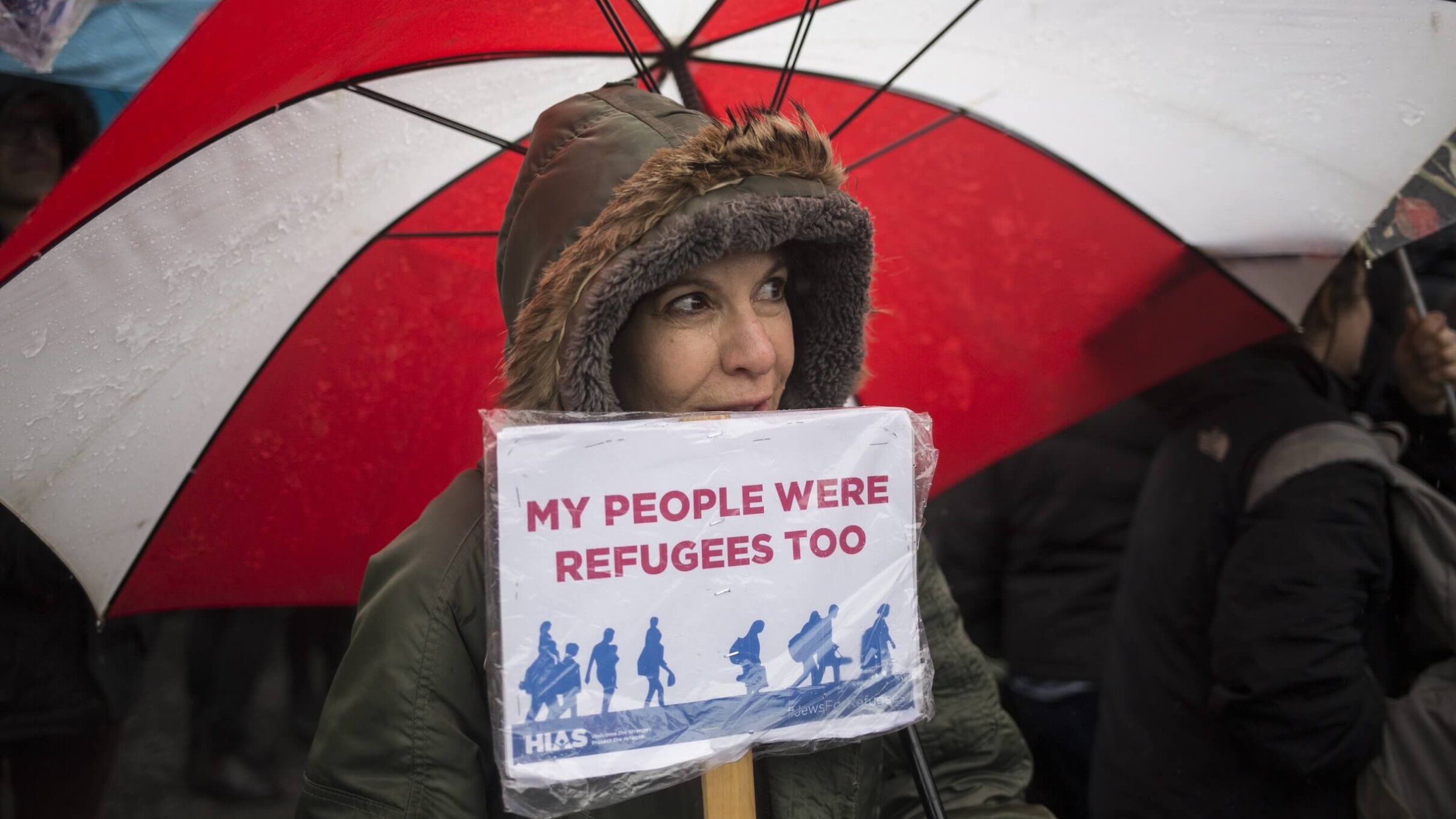
A February 2017 rally organized by HIAS, the global Jewish nonprofit that protects refugees, against President Donald Trump’s immigration ban. Photo by Alex Wroblewski/Getty Images

Contributing Columnist Emily Tamkin February 4, 2026
“You are declaring the incapacity of America to Americanize.”
So said Rabbi Stephen S. Wise before the House immigration committee in January 1924. Wise, whose family immigrated to the United States from Budapest in his infancy, was one of several Jewish leaders to appear in front of the committee to argue against restrictive limits on immigration from southern and eastern Europe.
Imposing these quotas — which had a particularly deleterious effect on Eastern European Jews seeking a life of greater opportunity and less antisemitism in the U.S. — showed “a want of faith in America,” he said.
I thought about Wise’s charge to this country’s leaders while reading about the Hebrew Immigrant Aid Society shuttering its operations in Vienna this week. That closure is just one more consequence of President Donald Trump’s halting of the U.S. refugee program — which he suspended on the first day of his second term, and which remains in limbo one year later — and termination of the grant that funded HIAS’ Resettlement Support Center in Austria.
According to HIAS, the decision will leave more than 14,000 religious minorities in Iran who have already been vetted and approved for resettlement, including hundreds of Jews, in immigration purgatory.
I thought of Wise and how lazily history is repeating itself. The arguments that fueled Trump’s decision to end refugee entry to the U.S. — we can only let in those who can assimilate; it’s a matter of national security to do otherwise — could have been copied from the headlines of a century ago.
Why is the United States doing this, once again?
Because now, as before, our leaders don’t actually want America to Americanize. They want us to believe this country can’t survive taking in people who will both change and be changed by it. And they still fail to see the wisdom in Wise’s vision of a country that becomes more itself with every immigrant — a vision that many Jews still believe in, even as a very prominent Jewish man in the Trump administration strives to snuff it out.
When Wise spoke to Congress, the language of assimilation and national security was, like today, being used to obscure racism. In 1922, the eugenicist American educator Harry Laughlin presented a report to the House Immigration Committee in which he asserted that “the recent immigrants, as a whole, present a higher percentage of inborn socially inadequate qualities than do the older stocks.”
That report, as Jia Lynn Yang recounts in One Mighty and Irresistible Tide: The Epic Struggle Over American Immigration, was quoted in papers across the country. One, the Saturday Evening Post, elaborated on Laughlin’s analysis: “If the farmer doesn’t keep out the weeds by his own toil, his crops will be choked and stunted,” a lead story in that publication read. “If America doesn’t keep out the queer, alien, mongrelized people of Southeastern Europe, her crop of citizens will eventually be dwarfed and mongrelized in turn.”
The banging of the drum against Italian and Jewish immigrants in particular had been crescendoing for years.
In 1911, Charles Davenport wrote that Jews from eastern Europe had “intense individualism and ideals of gain at the cost of any interest,” and that if allowed to mix in the U.S., they and Italians would make Americans “darker in pigmentation, smaller in stature, more mercurial… more given to crimes of larceny, kidnapping, assault, murder, rape, and sex-immorality.”
The ability to assimilate was then, and is still, held up as some immutable, objective good, and failure to fully do so as dangerous. It is no accident that Trump has framed his immigration crackdown — which has involved the arrest of some 75,000 people with no criminal record — as ridding the streets of “killers, rapists, and drug dealers.”
There are clear costs to the belief that our national security is so fragile that an Italian or Iranian family could be fatal to it.
The Jews who could not come here for a better, safer life a century ago because of the immigration restrictions against which Wise protested remained in Europe. Many of them died there during the Holocaust, precisely because they could not come here.
The U.S. tried to make belated amends after World War II, welcoming hundreds of Holocaust survivors. The same HIAS office in Vienna that closed this week helped in that effort, resettling around 150,000 Holocaust survivors in the U.S. and elsewhere. It did the same for hundreds of thousands of Jews from the former Soviet Union, then for tens of thousands of religious minorities from Iran over the past two decades.
If, in the future, this country has the chance to once again make amends for closing in on itself, who will be left to do the same?
This is a moment of great uncertainty. Here’s what you can do about it.
We hope you appreciated this article. Before you go, we’d like to ask you to please support the Forward’s independent Jewish news this Passover. All donations are being matched by the Forward Board - up to $100,000.
This is a moment of great uncertainty for the news media, for the Jewish people, and for our sacred democracy. It is a time of confusion and declining trust in public institutions. An era in which we need humans to report facts, conduct investigations that hold power to account, tell stories that matter and share honest discourse on all that divides us.
With no paywall or subscriptions, the Forward is entirely supported by readers like you. Every dollar you give this Passover is invested in the future of the Forward — and telling the American Jewish story fully and fairly.
The Forward doesn’t rely on funding from institutions like governments or your local Jewish federation. There are thousands of readers like you who give us $18 or $36 or $100 each month or year.
Support our mission to tell the Jewish story fully and fairly.