The left won’t let Iranians be grateful for the end of Khamenei’s reign
Doing nothing about a brutal regime is its own kind of choice
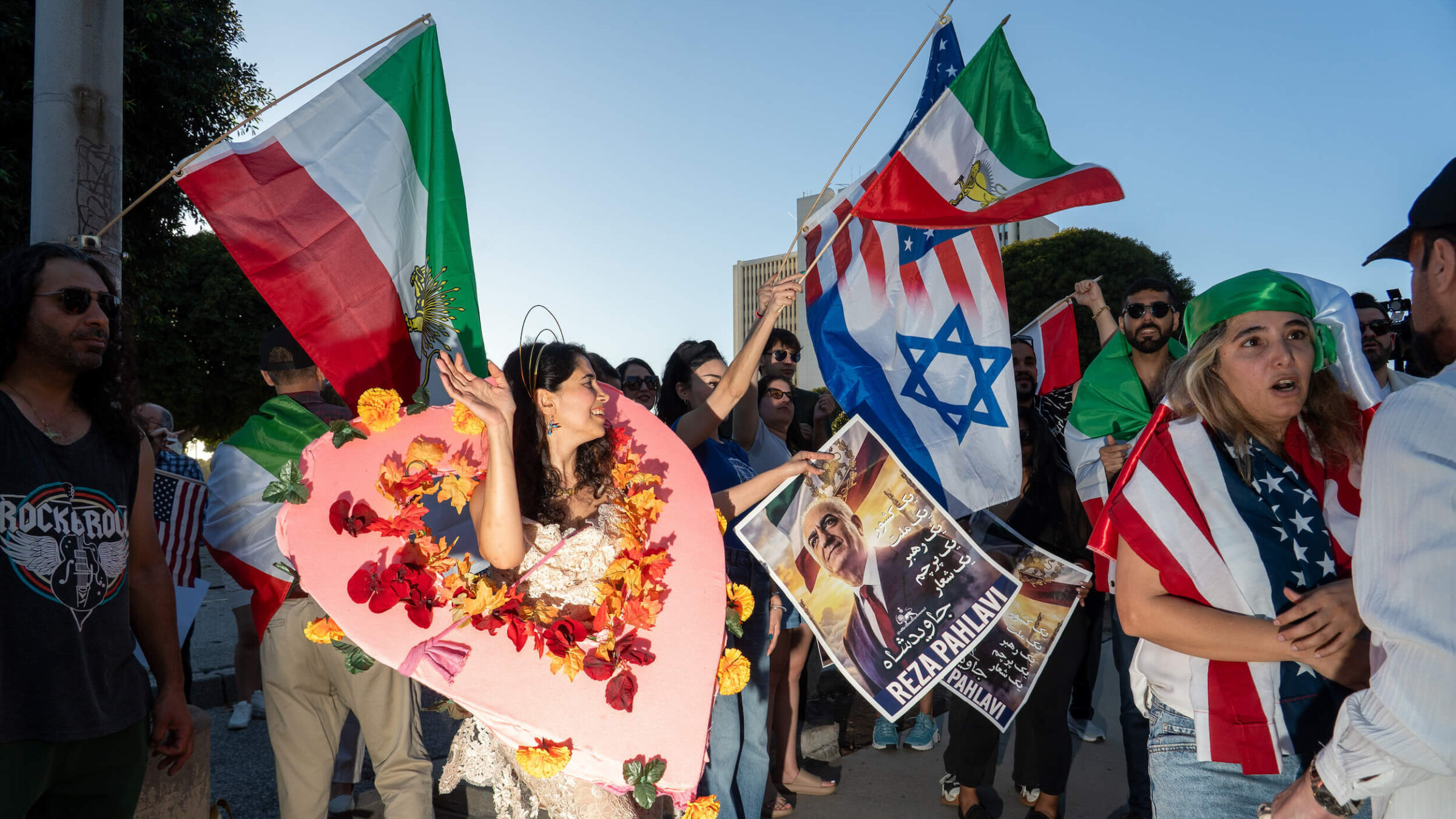
Demonstrators in support of a war in Iran at City Hall in Los Angeles, California, US, on Feb. 28. Photo by Kyle Grillot/Bloomberg
When my Iranian girlfriend and I started dating in 2020, some of her family were skeptical of what it meant for her to be with an Israeli man. But after a United States and Israeli military campaign killed Supreme Leader Ali Khamenei this weekend, we watched Iranian and Israeli flags fly alongside one another during celebrations in the streets of Los Angeles.
Families took their kids out for ice cream. Cars and motorcycles streamed down Westwood Boulevard: flags flying, horns blaring, drivers flashing victory signs.
At the same time, activists claiming solidarity with the people of Iran demanded an end to strikes. The Democratic Socialists of America decried “an attack on an entire people and region of the world.” The Party for Socialism and Liberation called the U.S.-Israeli campaign “a war for empire.” Some Democratic lawmakers came close to echoing that framing.
When leftists and progressives frame this as a war against the Iranian people, while Iranians who lived under Khamenei dance in the streets, the message to Iranians is that they are wrong about their own oppression.
The celebrations I saw in Los Angeles were not an anomaly. Euphoria bubbled up in London, Berlin, Paris, Sydney, Toronto and Seoul. Inside Iran, verified celebration footage emerged from all over the country. One woman in Isfahan told Reuters she began crying from a mix of joy and disbelief upon hearing the news, and joined others dancing in the street. In southern Iran, citizens toppled a monument to Ayatollah Ruhollah Khomeini, the founder of the Islamic Republic.
One man could be heard exclaiming, “Am I dreaming? Hello to the new world!” A doctor in Rasht said it was one of the best nights of his life.
The catharsis runs deep for good reason.
Khamenei presided over decades of theocratic rule, first as president and then as supreme leader, a position he assumed in 1989. Under his command, Iran maintained the highest execution rate per capita in the world. Khamenei crushed the 2009 Green Movement, killing dozens and imprisoning hundreds. He met the 2022 Women, Life, Freedom movement with mass arrests, torture and executions. He destroyed the Iranian economy to fund a proxy network spanning Hezbollah, the Houthis, Hamas and Shia militias across the Middle East. He repressed tens of millions of women. And in January 2026, his security forces murdered thousands of citizens protesting the regime, with some estimating the death toll at more than 30,000.
This last entry on Khamenei’s ledger is especially telling.
When millions of Iranians took to the streets in a rush of anti-regime sentiment, they were met with brutal force and massacred in the thousands. This violence decisively eliminated any remaining possibility that Iran’s government could be remade without foreign intervention or mass death.
Yet that change is one that public opinion data strongly suggests an overwhelming majority of Iranians want.
When protesters hold signs saying “Hands off Iran!” or commentators like Peter Beinart denounce violations of Iran’s “national sovereignty,” the sovereignty they are defending is that of the ayatollahs; of a government that has stolen the lives, livelihoods and joy of its people for 47 years. When the DSA calls strikes “an attack on an entire people” or Rep. Rashida Tlaib says that “you cannot ‘free’ people by killing them and destroying their country,” it collapses the distinction between the state and its subjects, a distinction Iranian people have been literally dying to make clear.
Yes, there are good reasons to be concerned about U.S. military engagement in the Middle East. Long wars in Iraq and Afghanistan left a trail of destruction with little tangible reward.
But while a dark history of imperialism has led many on the left to be skeptical of any military action by the West, the legacy of Western non-intervention is also worth consulting.
In Rwanda, up to a million people died in 100 days in a genocide in 1994; former President Bill Clinton has since said that failing to intervene early was one of his greatest regrets, and estimated that such intervention might have drastically reduced the death toll. The West watched Cambodia’s killing fields claim well over a million lives, murder which only ended when Vietnam invaded. In a similar contortion of the concept of sovereignty, U.S. officials actually condemned the Vietnamese for cross-border aggression, describing it as a violation of international law.
Democrats are right to ask tough questions about war powers — Trump decided to attack without seeking congressional approval — and what the plan for the “day after” looks like. But they should also recognize that the status quo is not neutrality. It is a choice to accept the suffering of oppressed people. In the case of Iran, the status quo is a 47-year theocratic dictatorship that represses millions and massacres thousands of its own people in the streets.
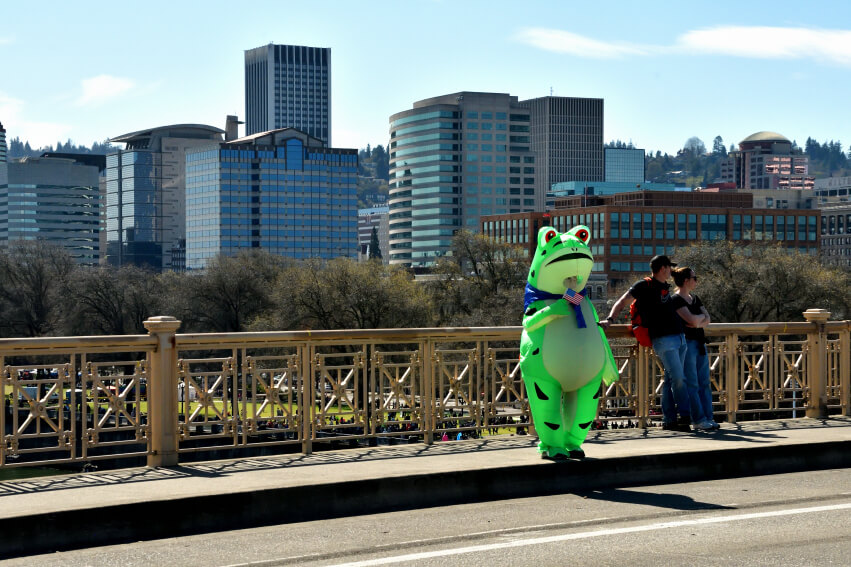
When Iranians greet strikes with such joy, the least the American left can do is ask why. The answer is clear. As an engineer in Amsterdam explained, “It may sound strange that we are celebrating the killing of our dictator by the United States and Israel during this war, but the fact is that he was responsible for the deaths of thousands of civilians.” Or, as one Portland State University professor told a crowd, “I hope you never know the sheer desperation of a people praying to be bombed only to be free.”
Khamenei’s death is only an opening move in what will inevitably be a tough path to Iranian democratization. But the outpouring of joy by Iranians worldwide tells us this moment is far more complicated than the chants of those protesting the war would have it. American activists castigating the strikes Iranians are celebrating are not standing with the Iranian people. They are standing with the regime that brutalizes them.
This is a moment of great uncertainty. Here’s what you can do about it.
We hope you appreciated this article. Before you go, we’d like to ask you to please support the Forward’s independent Jewish news this Passover. All donations are being matched by the Forward Board - up to $100,000.
This is a moment of great uncertainty for the news media, for the Jewish people, and for our sacred democracy. It is a time of confusion and declining trust in public institutions. An era in which we need humans to report facts, conduct investigations that hold power to account, tell stories that matter and share honest discourse on all that divides us.
With no paywall or subscriptions, the Forward is entirely supported by readers like you. Every dollar you give this Passover is invested in the future of the Forward — and telling the American Jewish story fully and fairly.
The Forward doesn’t rely on funding from institutions like governments or your local Jewish federation. There are thousands of readers like you who give us $18 or $36 or $100 each month or year.
Support our mission to tell the Jewish story fully and fairly.