The digitized ‘Yosl and Chana Mlotek Yiddish Song Collection’ is now live
The site provides lyrics, translation, songsheets and historical context for songs on many themes, including love, holidays and the labor struggle.
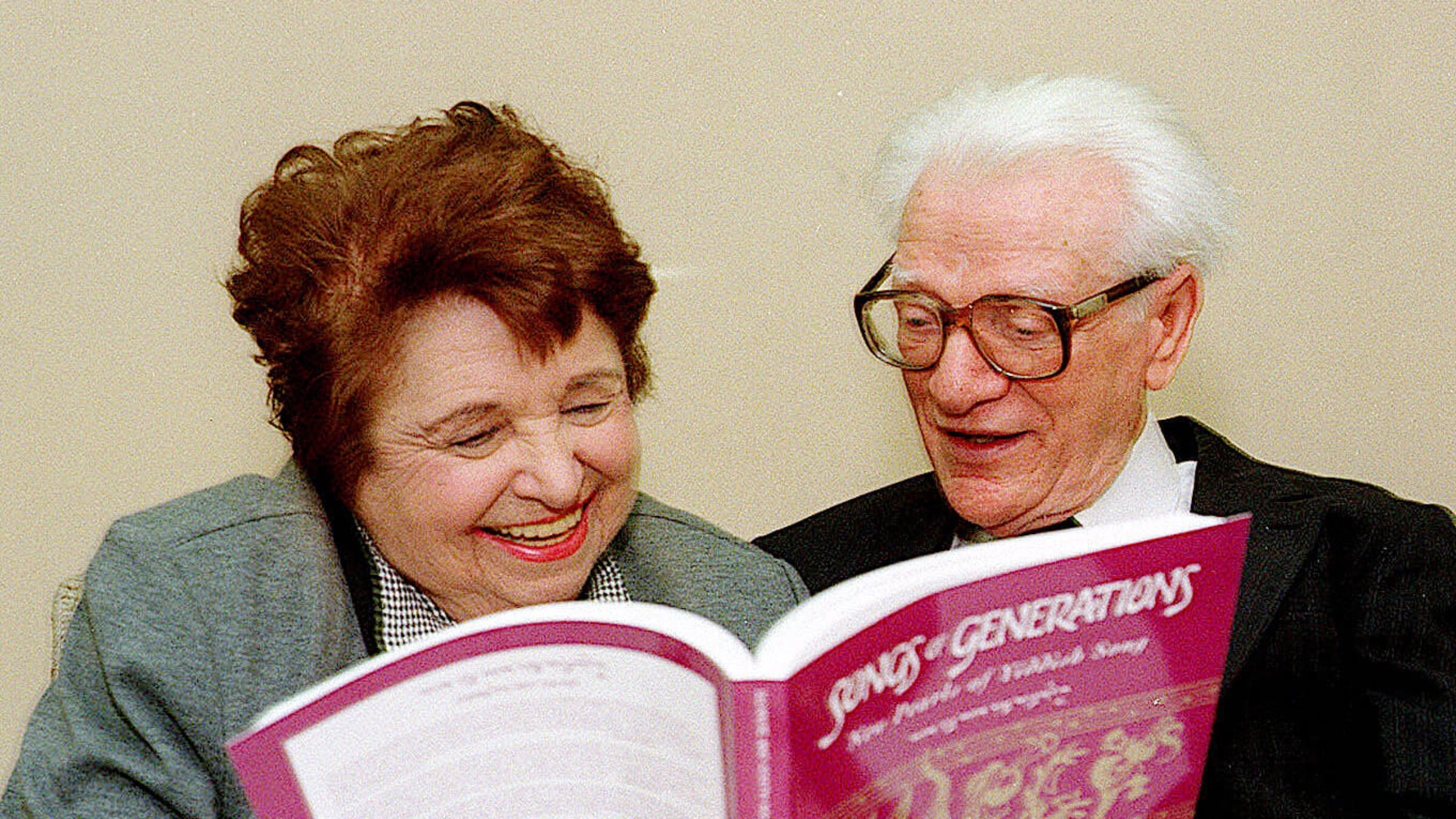
Chana and Yosl Mlotek with one of their signature Yiddish songbooks, “Songs of Generations” Courtesy of the Mlotek Family
The Workers Circle has unveiled a long anticipated website: the digitization of 400 Yiddish songs, based on the popular out-of-print songbook series, Pearls of Yiddish Song, compiled and written by the late Yiddishist couple, Yosl and Chana Mlotek.
The new site, called “The Yosl and Chana Mlotek Yiddish Song Collection at the Workers Circle,” was celebrated on March 20 in a 40-minute Zoom presentation.
The Zoom event featured Moish Mlotek — the younger son of Chana and Yosl Mlotek — and Elisha Mlotek, the couple’s grandson. Moish Mlotek funded the website and Elisha helped design it.
“It’s been an honor building the song collection and preserving the legacy of my grandparents,” Elisha said. “I love my bubbe with all my heart and when I sing songs, I imagine her in the audience with her wide smile and loving eyes shepping infinite naches.”
The grandson provided a tour of the new site, demonstrating how to access its sheet music, translations and transliterations, as well as audio and video files of the Yiddish songs. One demo that drew laughter was a video of the Montreal-based hip hop artist Josh Dolgin, who performs as Socalled, playing keyboards as a puppet named Tina sang in Yiddish.
Daniel Kahn, an American klezmer musician now based in Germany, appeared in a pre-recorded video. “If you want to have anything to do with Yiddish song, you go to these books,” he said.
Visitors to the website can now stream videos of Yiddish songs performed by a variety of singers, including Paul Robeson, Pete Seeger, Leonard Cohen and The Klezmatics. They can use either Yiddish or English in the search engine to look for love songs, children’s songs, holiday songs, theater songs, Holocaust songs and labor songs.
One participant at the Zoom launch event asked if there was a section of the website where Bundist Yiddish songs could be found. Moish Mlotek responded that the Bundist songs are “all over the place.”
The Mlotek collection is not the only source of Yiddish music available to the public. YIVO’s music archive, which includes the “Ruth Rubin Legacy” and Yiddish folklore scholar Barbara Kirshenblatt’s collection, consists of more than 4,000 songs. Song collector and scholar Itzik Gottesman’s blog Yiddish Song of the Week has about 300 Yiddish folk songs in its collection, which is being preserved at the University of Texas.
Linda Gritz, who grew up in the same Bronx neighborhood as the Mloteks and had Chana Mlotek as a music teacher at the Yiddish shule she attended as a girl, was online for the launch event. Gritz is active in the monthly Yiddish Sing at the Worker’s Circle in Brookline, Massachusetts, which met online during the pandemic.
“These invaluable songbooks have now been ‘fartaytsht un farbesert’ (translated and improved) on yiddishsongs.org,” she wrote in an email. ‘With easy access, more complete translations, and fine recordings of many of the songs, we look forward to using the songs from this website this Thursday at our monthly online Yiddish Sing.”
Website visitors can also print sheet music of the songs out after entering their names and email addresses.
This is a moment of great uncertainty. Here’s what you can do about it.
We hope you appreciated this article. Before you go, we’d like to ask you to please support the Forward’s independent Jewish news this Passover.
This is a moment of great uncertainty for the news media, for the Jewish people, and for our sacred democracy. It is a time of confusion and declining trust in public institutions. An era in which we need humans to report facts, conduct investigations that hold power to account, tell stories that matter and share honest discourse on all that divides us.
With no paywall or subscriptions, the Forward is entirely supported by readers like you. Every dollar you give this Passover is invested in the future of the Forward — and telling the American Jewish story fully and fairly.
The Forward doesn’t rely on funding from institutions like governments or your local Jewish federation. There are thousands of readers like you who give us $18 or $36 or $100 each month or year.
Support our mission to tell the Jewish story fully and fairly.