Yiddish culture shared mainstream racist stereotypes of the 1920s, new book shows
Even progressive Yiddish journalists and activists who protested anti-Black violence in the South used racist stereotypes
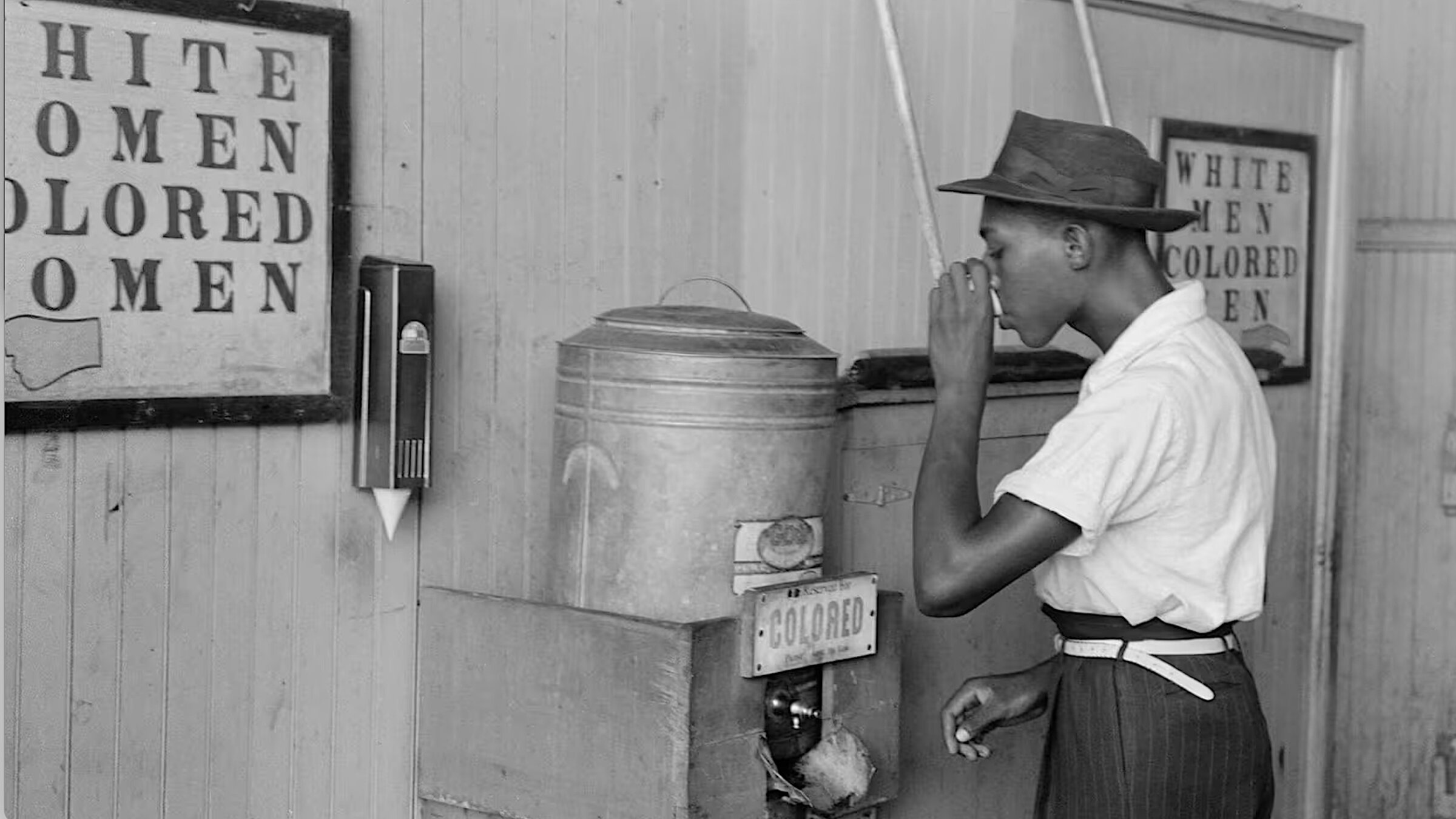
A man outside a segregated bathroom, 2018 Photo by Universal History Archive/Universal Images Group via Getty Images

By Mikhail Krutikov December 3, 2025
This article initially appeared in Yiddish and can be read here.
America held many surprises for Jewish immigrants arriving at its shores over 150 years ago but one of the most significant was meeting African Americans, something that was very unfamiliar, even alien to them.
Sholem Aleichem conveyed this feeling in his series of stories Motl, Pesye the Cantor’s Son. In one memorable episode, its protagonist Motl, aged about nine, gets on the New York subway for the first time and sees a Black couple on the train. Stunned, he describes them in terms that would shock today’s readers: “Crude creatures. Horribly thick lips. Large white teeth and white nails.”
Critics would naturally focus on the racist stereotypes in this passage. But who’s to blame here: the author or the character?
In his latest book, Gil Ribak (University of Arizona) tackles this very question, putting Motl’s words right in the title: “Crude Creatures: Confronting Representations of Black People in Yiddish Culture.” Hillel Halkin’s English translation of these Sholem Aleichem stories, Ribak notes, omits the phrase, in a sign of modern discomfort around racist language.
Ribak isn’t the first scholar to take on this complicated, sensitive topic. However, until recently, scholars tended to tread carefully around attitudes toward African Americans as reflected in Yiddish literature; positive stories were amplified, and any negative elements kept quiet. Racist stereotypes didn’t figure in conversation, although they had existed all along. Even the Yiddish leftist literati, who openly sympathized with the hardships of Black people, made use of such expressions.
And as Ribak argues in his thoroughly researched study, we must keep in mind that the terms and images that sound so offensive today didn’t have the same meaning for readers a hundred years ago.
The stereotype of Black people as “wild animals” emerged in Hebrew and Yiddish when Ashkenazi Jews were still living in Eastern Europe, where most people had never seen an African person. European culture in general played a major role in transmitting this image, but it also reached Jewish communities through traditional Yiddish books. One example: The popular Yiddish Bible adaptation, Tsenerene, explains that the children of Noah’s son Ham, as punishment for their father’s sin, would be made “dark” and “black.”
When American Yiddish journalists set out to explain the American race problem to their readers, they viewed the South through an Eastern European lens, likening the African Americans to Russian peasants. Yiddish socialists claimed that the bitter experiences of slavery had made both the African Americans and the Russian peasants “slow,” “coarse” and “lazy.” The comparison was bolstered by the fact that Russian serfs and African American slaves had both been emancipated around the same time, in the 1860s.
In the United States, Ribak notes, the African American became a kind of Russian peasant incarnate in the American Jewish imagination. Ab Cahan, the editor-in-chief of the Forverts, drew a parallel for his readers between the Southern whites in America and Polish nobles back in Eastern Europe: hospitable and civil with their own, but when it came to those they considered their inferiors — the slave and the serf — they treated them as less than human.
Even as they protested anti-Black violence in the South, progressive Yiddish journalists and activists like Baruch Vladek and Ab Cahan still used racist stereotypes. Reporting for the Forverts on the Leo Frank trial in Atlanta in 1914, Cahan observed that “the streets were full of Negroes, mostly filthy and ragged.” To see how widespread these stereotypes were, one need look no further than the numerous caricatures by Jewish cartoonists that appeared in the popular satirical weekly Der Groyser Kundes (The Big Prankster).
Sometimes Jews and African Americans found themselves residing side by side in America’s urban centers. As Ribak notes, in Harlem, New York, in the early 20th century, Jews were practically the only white residents living among the majority Black population. But the two groups didn’t mix much, and by 1930, nearly all the Jews had left the neighborhood.
To be sure, Yiddish socialists upheld racial equality as an important principle, recognizing that Black people were the victims of discrimination and oppression. In practice, however, they had little direct contact with African Americans and often perceived them as “weaker and younger brothers.”
This ambivalence also plays out in the works of other American Yiddish writers like Sholem Asch, Joseph Opatoshu and Boruch Glazman. They all opposed racism, but their fictional portrayals of African Americans consistently drew on racist stereotypes, most visibly so in their descriptions of Black physicality, of faces and gestures. Opatoshu’s well-known story, A Lynching, is a telling example.
Ribak concludes that the authors’ negative, aesthetic representations in these literary works were at odds with their progressive, ethical worldviews. In other words, these writers were internally conflicted by their own diametrically opposed attitudes.
Ribak’s book is packed with vivid details from thousands of Yiddish, Hebrew and English sources. Unlike most Yiddish scholars today, he doesn’t limit his analysis to well-worn samplings of “high” culture and progressive journalism, but also cites examples in low-brow Yiddish popular culture.
Ribak’s wide-ranging approach allows him to reveal a series of complicated and sometimes contradictory positions that Eastern European immigrants held on the American race issue in the first othree decades of the twentieth century.
The many examples in this book support Ribak’s argument that Jewish immigrants were far from bias-free when it came to race. There’s a bit of implicit polemic here, too, against the tendency in the field of Yiddish Studies today, to focus exclusively on the progressive, anti-racist elements of American Yiddish culture.
It’s fair to say that by appropriating racist clichés, Jewish immigrants were hoping to take one step further on the path toward Americanization. It made them feel like truly “white” Americans, a very real matter at a time when American society was intensely xenophobic and antisemitic. But things would change. By the 1930s, leftist Jews began to see Black people as potential partners in the struggle for social and economic justice.
This is a moment of great uncertainty. Here’s what you can do about it.
We hope you appreciated this article. Before you go, we’d like to ask you to please support the Forward’s independent Jewish news this Passover. All donations are being matched by the Forward Board - up to $100,000.
This is a moment of great uncertainty for the news media, for the Jewish people, and for our sacred democracy. It is a time of confusion and declining trust in public institutions. An era in which we need humans to report facts, conduct investigations that hold power to account, tell stories that matter and share honest discourse on all that divides us.
With no paywall or subscriptions, the Forward is entirely supported by readers like you. Every dollar you give this Passover is invested in the future of the Forward — and telling the American Jewish story fully and fairly.
The Forward doesn’t rely on funding from institutions like governments or your local Jewish federation. There are thousands of readers like you who give us $18 or $36 or $100 each month or year.
Support our mission to tell the Jewish story fully and fairly.