A podcast about disappearance – and Yiddish life
Born in a Yiddish cultural space, “I Think I Saw You” asks intimate questions about visibility, loss and freedom

Photo by pexels.com
Elena remembers a moment when she fully disappeared. She describes it as “emerging into a wall or a transparent substance without any borders.” Adah feels she has disappeared from certain places and people when moving to a new place. Others, like Adi, wish to have more of a chance to disappear: to be less visible and to go about their daily life without anyone paying them much attention. And still others, like Moishy, have experienced disappearance through a moment of unconsciousness.
These are some of the voices you hear in the podcast “I Think I Saw You (Right When You Disappeared),” which explores individual experiences of disappearance. Launched in April 2025, the podcast releases one episode per week, each one based on an interview with one person.
This first season of “I Think I Saw You” features interviews with participants of the Yiddish youth camp Generation J, which took place in Germany in 2022. Generation J – which will have its next edition in April 2026 in Paris and Weimar – is a program that brings together young people from many different backgrounds to dive deeper into Yiddish language, culture and art. So, given the context in which these interviews took place, it’s not surprising that the podcast touches upon several topics connected to the Yiddish world.
One episode, for instance, addresses the history of Yiddish language and culture through the lens of disappearance: the ways in which Yiddish has disappeared in many places in Europe through destruction, most notably in the Holocaust and under the Soviet regime, but also through Jewish assimilation across time and countries, and the dominance of modern Hebrew in Israel.
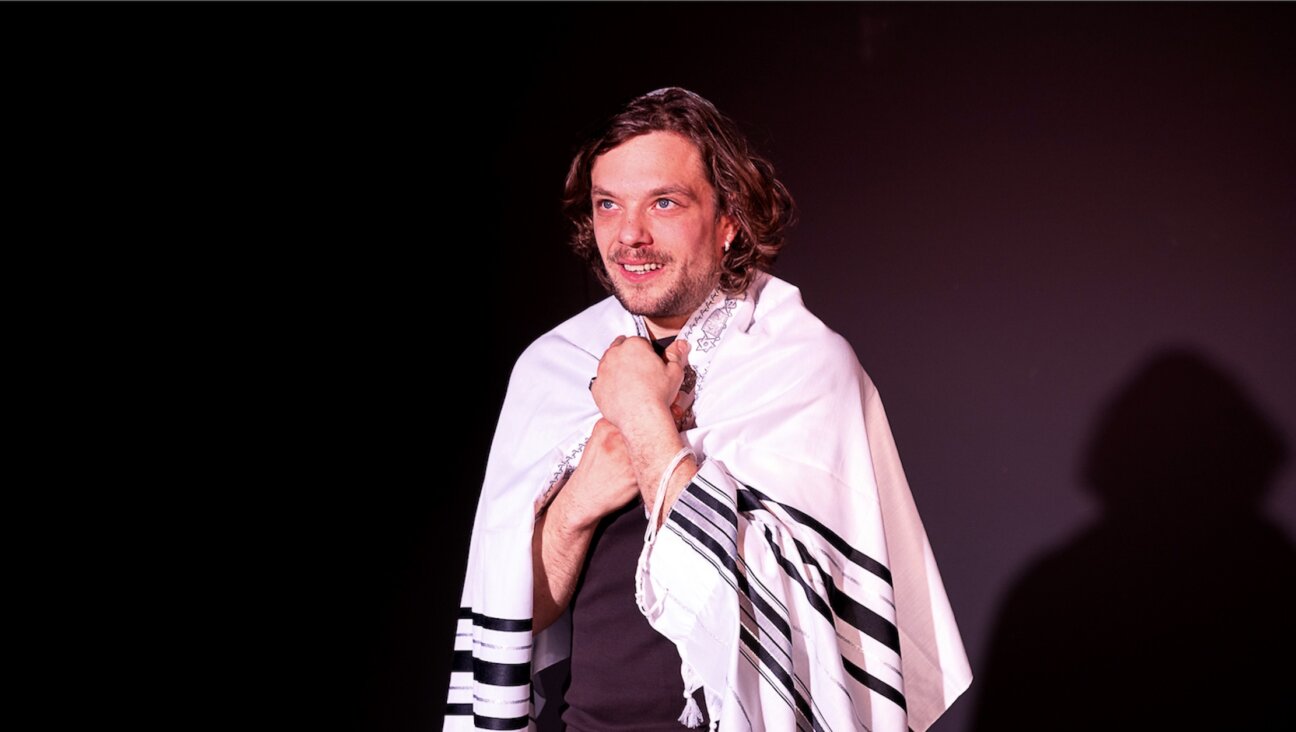
At the same time, the episode stresses the continuation of Yiddish as well as its revival movement and resistance to disappearance. “The fact that Yiddish still exists is a constant proof of its dis-disappearance,” noted the podcast’s creator, designer and producer, Berlin-based interdisciplinary artist Eyal Davidovitch. Davidovitch was a member of Generation J’s teaching staff when he was inspired to create the podcast. The idea of engaging with the metaphor of disappearance had stayed with him ever since film school.
Another episode includes a reference to a different Yiddish-speaking community, when Yisroel, who comes from a Chassidic community, remembers his first solo backpacking trip as an act of both disappearance and liberation: “For those few weeks, I was nobody. I was free. No one knew me.” He partly traces this experience back to his community of origin, where “someone always sees you,” understanding his disappearance as “disappearing from my act of who I am.”
Some of the interviewees are Yiddish native speakers, like Yisroel and Moishy; others are prominent figures in the contemporary Yiddish cultural scene, like Yiddish dance instructor Avia Moore; fiddler-composer Craig Judelman, and Yiddish singer Sasha Lurje.
In her interview, Lurje says that she never feels she disappears in a crowd, which she chalks up to her longstanding experience with Yiddish cultural practice: she sees immersion in a community and “being with the space and being with the rhythm of what’s happening,” but at the same time “being a strong individual and representing what you are in this particular moment,” as an important aspect of Yiddish music and dancing, as well as of davening (Jewish prayer).
“I Think I Saw You,” which is funded by listeners’ donations as well as by Paideia, the European Institute for Jewish Studies in Sweden, has so far been downloaded more than 13,000 times – a strikingly high number for a non-sponsored, self-published debut podcast. Apple recently featured the podcast on its Apple Podcasts app for users in the U.S.
Although it’s hard to say how many people have actually listened to the podcast, statistics show that it has listeners in the U.S., Germany and other countries in Europe; even in Saudi Arabia and Iraq.
“Most of the reactions I heard were how the podcast touches in such a gentle and unique way philosophical and psychological questions alongside complex topics, and how it creates a space where listeners are invited to constantly reflect on or rethink their own feeling of disappearance,” Davidovitch recounted.
Unlike other recent podcasts that feature Yiddish — for example, the language learning podcast “Proste Yiddish;” the feminist Yiddish podcast “Vaybertaytsh” that ran from 2016-2021 and the Forward’s recent “Yiddish with Rukhl,” “I Think I Saw You” is not branded as a Yiddish podcast. In a world where Davidovitch feels Jews are often narrowed down to their Jewish identity, it was important for him that the podcast deals with Yiddish and Jewishness without limiting it to these labels.
Instead, he aims to introduce Yiddish culture as well as Jewish and non-Jewish voices as part of a mixed cultural space through the universal theme of disappearance. “It cannot be put into one box. In the end, it’s a podcast about life!” he said.
Nevertheless, Davidovitch said that the podcast has “nothing and everything to do with Yiddish.” He explained that the diversity of Yiddish cultural spaces – and especially of the Generation J community – facilitated his ideas for the podcast. As he puts it: “There is something about Yiddish that invites this energy.”
This is a moment of great uncertainty. Here’s what you can do about it.
We hope you appreciated this article. Before you go, we’d like to ask you to please support the Forward’s independent Jewish news this Passover.
This is a moment of great uncertainty for the news media, for the Jewish people, and for our sacred democracy. It is a time of confusion and declining trust in public institutions. An era in which we need humans to report facts, conduct investigations that hold power to account, tell stories that matter and share honest discourse on all that divides us.
With no paywall or subscriptions, the Forward is entirely supported by readers like you. Every dollar you give this Passover is invested in the future of the Forward — and telling the American Jewish story fully and fairly.
The Forward doesn’t rely on funding from institutions like governments or your local Jewish federation. There are thousands of readers like you who give us $18 or $36 or $100 each month or year.
Support our mission to tell the Jewish story fully and fairly.