Confronting art and love as the Nazis close in
In the play ‘Beneath the Ice of the Vistula,’ a Jewish composer refuses to flee before finishing his master work.
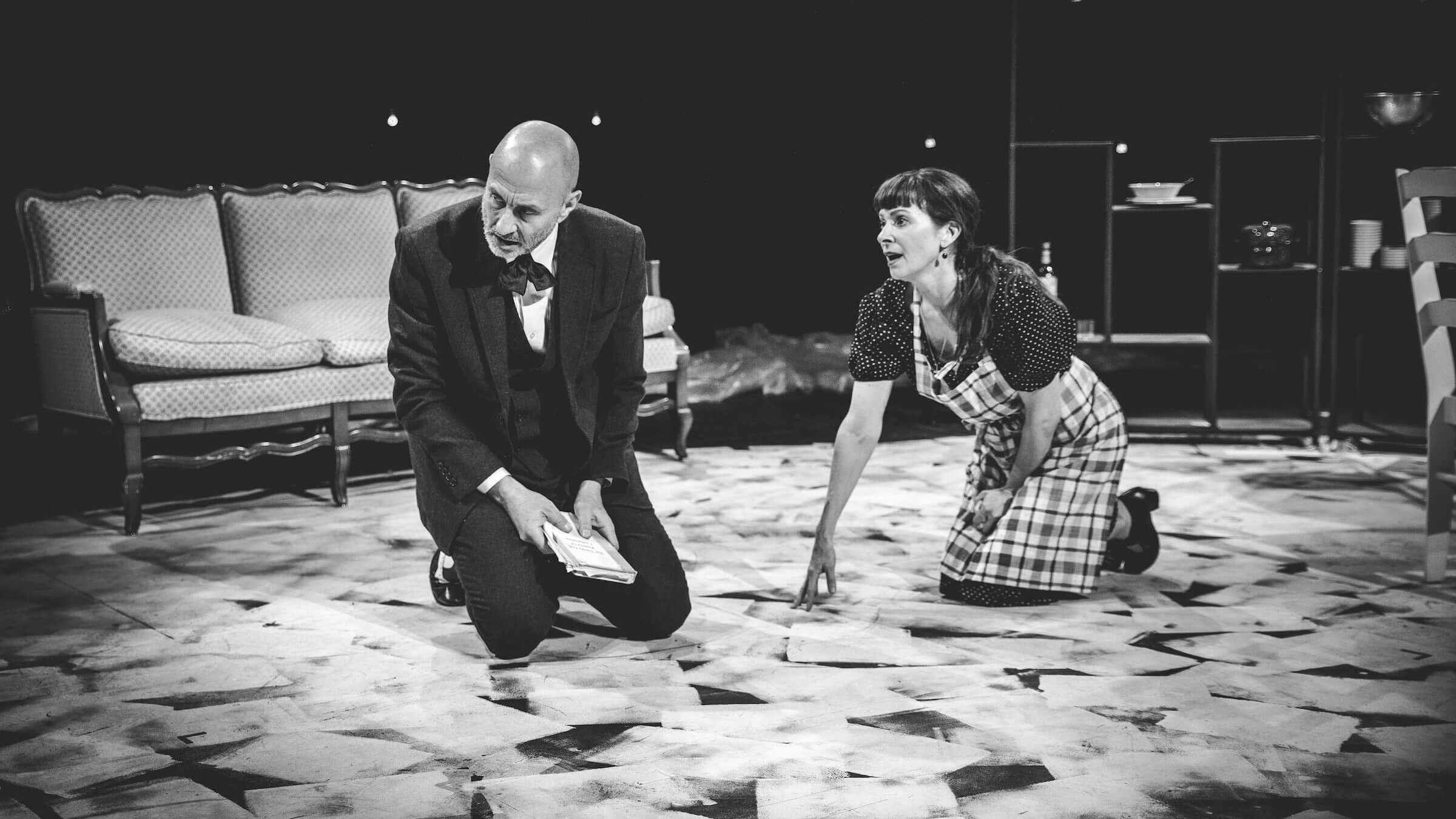
A scene from ‘Beneath the Ice of the Vistula’ Photo by Alexandra Vainshtein
The New York theater world has been enriched in recent years by small companies of artists who are Russian-born and work from a Russian sensibility, though often in the English language.
In an interview, Roman Freud, a playwright, actor, and co-founder of the Five Evenings Company, pointed out that many of the Russian theater artists now in New York, including himself, are Jewish, which cannot help but color some of their presentations.
In Freud’s newest play Beneath the Ice of the Vistula, the plot is simple but arresting. It’s Warsaw, 1939. Jewish composer Adam (played on alternate nights by Lev Grzhonko and Freud himself) is holed up in his apartment, demanding total solitude so he can concentrate on finishing his master work for cello.
As the Nazis’ round-up of Jews accelerates right outside his window, he develops a loving relationship with his Polish cook Lydia (played with total conviction and charm by Cady McClain), who begs him to escape to her Polish village. Their scenes together are wholly believable. Suspense builds. Will he complete his composition and thus have the will to escape? Will they make a life together? Looking back from 2026, we know the terrible odds against them.
But while the cook, who is also an artist (albeit in the kitchen), is aware of danger and anchors the story in real-world Polish history, and as their relationship becomes sweeter and yet more intense, Adam turns increasingly inward. We see this in scenes of his fantasies, memories and dreams, which pop up as Russian-inflected vaudeville moments.
Suddenly, for example, the living room furniture is transformed into a shower, and Adam joins Lydia under “water” made of cellophane. The sound of Lydia’s clashing saucepans drowns out dark passages of his solo cello. The impressionist composer Maurice Ravel, whom Adam reveres, appears in a rowboat, glowering in a string-mop wig. Occasionally, such drastic shifts between the realistic and the absurd seem confusing on the stage and could use a more secure overall vision of the whole as well as some smoother transitions.
However, the concept is strong. While Lydia sees Warsaw without illusion, Adam’s mad, even suicidal, determination seems titanic but lunatic. In this way, Freud presents us with two ways of experiencing life, utilizing two theatrical techniques — the Realistic and the Absurdist. This deeply serious plot flirts with an absurdist way of looking at life. To sensible people like the Polish cook, Adam’s nonsensical determination is indeed absurd. Although, to be fair, rounding up Jews is an absurd obsession as well.
Roman Freud said the theme of his play is the nature of art: the artist as an ordinary “regular” person who nevertheless is a vessel for creative purpose. Adam is noble in his way. But the audience can’t help but ask: Is his music actually great art? The sonorous notes of his cello (playing a composition composed and performed especially for this production), rising above Lydia’s clashing pots and pans, have a powerful effect. Yet it’s difficult to believe in his higher calling as purely as he believes in it himself, and sometimes, I’m afraid, especially at the end, it’s hard to sympathize with him as much as we should. You might even ask: Is even great art worth dying for?
Jews and Jewishness are not Freud’s only subjects. He’s written a play about Napoleon, for example, but he says it’s “natural” that Jewishness is important to him, and in fact considers this play a tribute to his family and to the Jewish culture silenced in the Holocaust.
The Nazis outside the window and Adam’s Jewish upbringing are basic to the play. He is bitterly angry at his family and community for forcing him to choose between them and the music he loves. A passage from the Song of Songs chanted offstage in traditional mode as Adam crouches under a twisted prayer shawl seems meant to evoke his ambivalence about his heritage.
It’s interesting to compare Beneath the Ice of the Vistula with Singing Windmills, another play by Freud, presented by the PM Theater company in 2021. Singing Windmills portrayed Solomon Mikhoels, the great Yiddish actor and beloved leader of the Russian Jewish cultural community, murdered by Stalin in 1948. Both plays explore what it means to be a great artist, the power of theater and the fate of the Jews.
New York is lucky to have small idealistic theater groups like Five Evenings Theater, New Wave Arts, and Eventmuze, which collaborated to bring Beneath the Ice of the Vistula to the stage. Most programs show headshots of the actors, and possibly the director. This show’s program has a photo of every member — stage manager, lighting and sound designers and so on — indicating their shared sense of idealism and commitment.
It takes courage to create, especially in theater, which demands a huge outlay in time and money simply to mount a production. So New York audiences must be courageous in turn, and try productions by unfamiliar artists in unfamiliar venues, in order to be rewarded by interesting, even memorable, theatergoing experiences such as this.
Beneath the Ice of the Vistula, directed by Eduard Tolokonnikov, plays through February 28 in the West End Theatre in Manhattan.
This is a moment of great uncertainty. Here’s what you can do about it.
We hope you appreciated this article. Before you go, we’d like to ask you to please support the Forward’s independent Jewish news this Passover. All donations are being matched by the Forward Board - up to $100,000.
This is a moment of great uncertainty for the news media, for the Jewish people, and for our sacred democracy. It is a time of confusion and declining trust in public institutions. An era in which we need humans to report facts, conduct investigations that hold power to account, tell stories that matter and share honest discourse on all that divides us.
With no paywall or subscriptions, the Forward is entirely supported by readers like you. Every dollar you give this Passover is invested in the future of the Forward — and telling the American Jewish story fully and fairly.
The Forward doesn’t rely on funding from institutions like governments or your local Jewish federation. There are thousands of readers like you who give us $18 or $36 or $100 each month or year.
Support our mission to tell the Jewish story fully and fairly.