Was George Orwell an Anti-Semite?
Graphic by Angelie Zaslavsky
“One way of feeling infallible is not to keep a diary,” wrote George Orwell in December 1943. The man considered by many to be the English language’s most influential political essayist of the 20th century never tired of questioning himself and was indeed a prolific diarist.

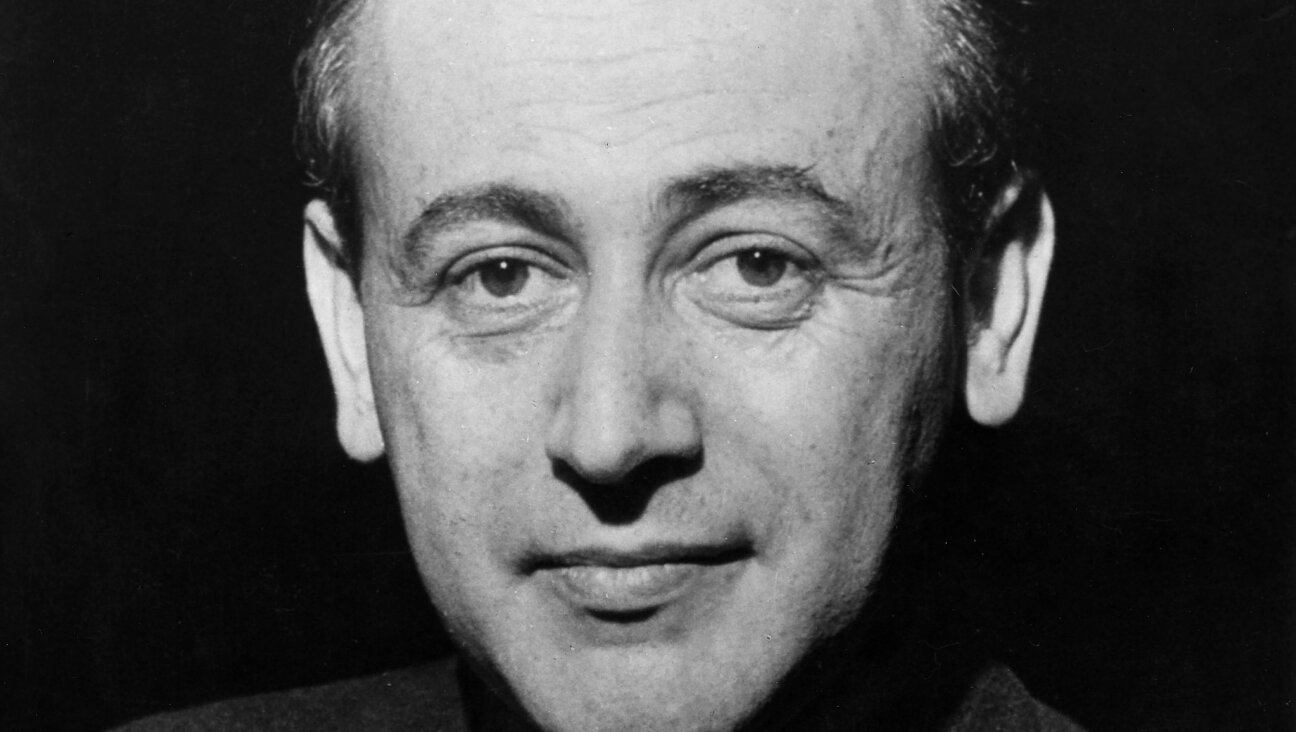
George Orwell
Next month, his diaries will be published in the United States (after being published two years ago in Britain). Though that in itself would be a festive literary occasion, what has added interest to the publication is the fact that the introduction was written by Christopher Hitchens, the British-American journalist and polemicist who died last December. Not only is it likely that this will be one of the last pieces written by Hitchens to see the light of day, but there is particular poignance in its being an appreciation of Orwell − the one writer he most admired and strived to emulate. It is also significant for being the first and only place where Hitchens has addressed at any length Orwell’s latent anti-Semitism.
Over the last decade, Hitchens’ writing has become the main prism by which Orwell is read and understood by many. Through his own wide popularity, Hitchens reintroduced Orwell to a younger generation and has served as apologist-in-chief for some of Orwell’s more disturbing tendencies.
Orwell and Hitchens had many traits in common, not least their willingness to address uncomfortable issues and challenge accepted thinking, but one glaring omission in Hitchens’ constant defense of his life-long inspiration, it has always seemed to me, as an avid reader of both authors, was his apparent complacency regarding one of Orwell’s most remarked-upon faults: his disregard for Jews.
In one of Hitchens’ earlier spirited defenses of Orwell, a 1996 response to the revelation that Orwell on his deathbed had compiled for the authorities a list of potential communist sympathizers, Hitchens admitted in a Vanity Fair column that Orwell “did have a slightly thuggish side to him on occasion, making unkind remarks about ‘nancy’ homosexuals and (when he was younger) Jews. But he always strove to overcome these scars of his upbringing.”

Christopher Hitchens Image by getty images
The parenthesis says it all: According to Hitchens, Orwell’s antipathy toward Jews was a passing phase, an adolescent misdemeanor that he outgrew. As a result, the younger writer didn’t feel that the issue warranted more than passing mention in his 2002 book “Why Orwell Matters,” in which he deals at length with the latter’s relations with the political left and right, British colonialism, feminism and even his literary merits. On all of these, Orwell’s record is championed for his unswerving commitment to penetrating truth and moral disambiguation.
Hitchens is right: Orwell accurately sketched, and in many cases foresaw the hypocrisies and contradictions of modern ideology, politics and media. For his brave refusal to conform to any party line, he paid a heavy price. After resigning from the colonial Burmese police force, he lived most of his life as an itinerant writer, forced to accept ill-paying odd jobs due to a lack of fixed income. In revolutionary Spain, he nearly paid with his life for his opposition and outspoken criticism to the communist takeover of the Republican cause.
Orwell achieved critical and commercial success only when he was already dying from tuberculosis, and yet 62 years later, most of his writings still resonate clearly in a world facing the challenges he was first to detect and define. Hitchens admitted that “George Orwell has always meant everything to me” and we can sympathize with that feeling. But his admiration seems to have clouded partly his critical faculty, for Orwell never fully grew out of his ill feelings toward Jews.
Hitchens and other admirers of Orwell have sought to cleanse him of this accusation of judeophobia by citing the long English literary tradition, from the days of Chaucer until well into the 1930s, of villainous Jewish characters, and by emphasizing the thoughtful way Orwell wrote about anti-Semitism later in his career and, of course, his large number of Jewish friends.
One of his most able biographers, D.J. Taylor, who has dealt seriously with the issue, quotes journalist Malcolm Muggeridge, who was surprised by the number of Jews who attended Orwell’s funeral, since he thought that he was “at heart strongly anti-Semitic.” Other contemporaries record Orwell, at late stages of his life, remarking to them about the preponderance of Jews working for the Observer newspaper for which he wrote, and indeed in his diaries he refers to the control of Jews over vast swathes of the media.
It is true: Nowhere in his later writings does Orwell write of Jews as crudely as he did in his very first book − “Down and Out in Paris and London” where, in addition to fantasizing about punching in the face a Paris pawnbroker, a “red-haired Jew, an extraordinarily disagreeable man,” the first thing he notices upon returning to London is in a coffee shop where, “in a corner by himself a Jew, muzzle down in the plate, was guiltily wolfing bacon.”
Even in his last years (he died in 1950) Orwell was always quick to identify people, gratuitously, as Jews, in a way in which their Jewishness is seen an explanation to their situation, actions or appearance.
His idol’s prejudices
We will probably never know why Hitchens, who described himself “as a wretchedly heretic and bastard member of the tribe” − famously discovering at the age of 38 (after he had already discovered Orwell’s work) that his late mother was Jewish − found it hard to seriously address one of his idol’s deepest prejudices. And it is rather ironic that his most serious consideration of this is seeing light posthumously. Hitchens must have realized, though, that readers of the Orwell diaries, coming upon repeated disparaging references to “Jews,” would demand some sort of answer.
“One of the many things that made Orwell so interesting,” he writes in the introduction, “was his self-education away from such prejudices, which also included a marked dislike of the Jews. But anyone reading the early pages of these accounts and expeditions will be struck by how vividly Orwell still expressed his unmediated disgust at some of the human specimens with whom he came into contact. When joining a group of itinerant hop pickers he is explicitly repelled by the personal characteristics of a Jew to whom he cannot bear even to give a name, characteristics which he somehow manages to identify as Jewish.”
Hitchens tries to stick here to the defense that Orwell’s antipathy was in his “early” pages and that “he strove to overcome” and self-educate himself away from prejudice. But he acknowledges the “unmediated disgust” at the appearance of Jewish characteristics, and later on deals with it at further length when he writes of Orwell’s “need to know things at the level of basic experience.”
Hearing a rumor in 1940 that “Jews greatly predominate among the people sheltering in the Tube [underground station],” Orwell notes: “Must try and verify this.” Ten days later, he is down in the depths of the transport system to examine “the crowds sheltering in Chancery Lane, Oxford Circus and Baker Street stations. Not all Jews, but, I think, a higher proportion of Jews than one would normally see in a crowd of this size.” He goes on, with almost cold objectivity, to note that Jews have a way of making themselves conspicuous.
Again, this is not so much an expression of prejudice as a form of confrontation − a stage in Orwell’s own evolution. Only a few months after he expresses the misanthropic and even xenophobic view that European refugees, including Jews, secretly despise England and surreptitiously sympathize with Hitler, he excoriates the insular-minded British authorities for squandering the talents of Jewish Central European emigre Arthur Koestler. When Orwell contradicts himself, as he very often does, he tries his best to be aware of the fact and to profit from it.
Hitchens nails down Orwell’s attitude to Jews as a self-aware and useful contradiction. A man can be disgusted at the sight of easily identifiable Jews while having numerous Jewish friends and even admired Jewish contemporaries, and while he knows and writes that anti-Semitism is wrong, he also acknowledges that it is ineradicable in human society, even from oneself.
But as Hitchens himself would probably admit, Orwell defined his own feelings about Jews. In his monumental essay “Antisemitism in Britain,” he hinted at his own inner feelings, writing that the “starting point for any investigation of antisemitism should not be ‘Why does this obviously irrational belief appeal to other people?’ but ‘Why does antisemitism appeal to me? What is there about it that I feel to be true?’ If one asks this question one at least discovers one’s own rationalisations, and it may be possible to find out what lies beneath them. Antisemitism should be investigated − and I will not say by antisemites, but at any rate by people who know that they are not immune to that kind of emotion.”
This essay was first published in April 1945 in Contemporary Jewish Record, the forerunner of today’s Commentary. One wonders whether today’s bastion of neoconservatism would run such a piece and whether its writer would not have been excoriated by the Anti-Defamation League.
But Orwell was nothing if not honest, and Hitchens is right to defend him. He did try to educate himself away from his native prejudices, and even if not entirely successful in defeating them, he was scathingly honest about them. And how many other writers can we say that about?
Everyone has irrational dislikes and pet hatreds, some of them morally wrong, but we either outgrow them or they evolve with us, and we have to handle them somehow. Orwell put the handling of his own feelings toward Jews on public display, an act of daring unimaginable today by any “respectable” writer. If the involuntary thought − “what is wrong with these Jews?” − goes through my mind, does that make me prejudiced? And what if I confide that thought in my diary or to a friend?” Orwell realized the ugly truth that we are all prejudiced, and tried to deal with it out in the open.
For more, go to Haaretz.com
I’m personally matching all gifts to the Forward, up to $36,000. Can I match your gift now?

Hello, fellow Forward reader! I’m Joel Brown, a Forward reader and supporter for more than 15 years, and currently the chair of the board of directors.
I’m an avid Forward reader because it ticks so many of my essential boxes: excellent journalism, Jewish focus and diverse viewpoints. In today’s political climate, what I most appreciate is the Forward’s independence — made possible by the generosity of its membership.
The Forward is committed to bringing you unbiased, nuanced Jewish news. From my position as board chair, I see an exciting future as we expand our position as the definitive independent voice of contemporary American Judaism.
— Joel Brown, Forward board chair
Support our mission to tell the Jewish story fully and fairly.