Jewish Cartoonist Georges Wolinski Among the Dead in Paris Terrorist Attack
Graphic by Angelie Zaslavsky

By Benjamin Ivry January 7, 2015
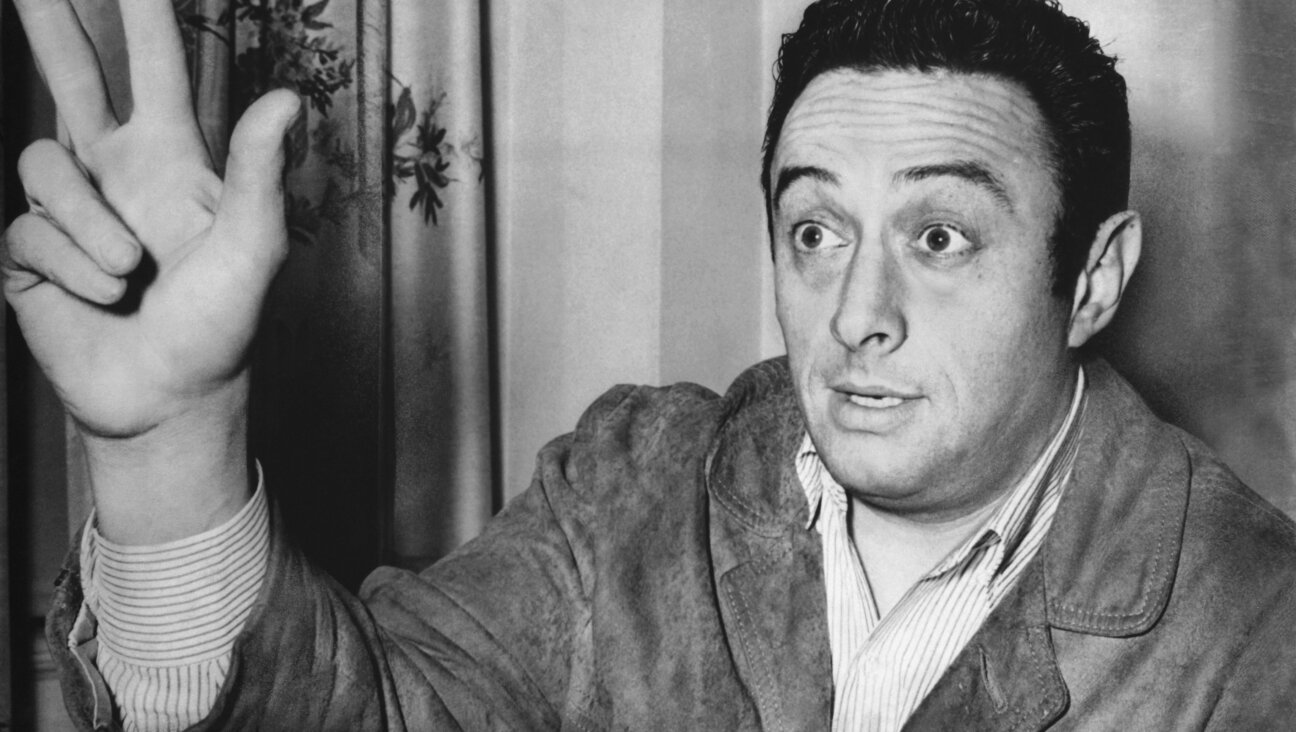
Today’s terrorist attack in Paris on the editorial offices of the satirical magazine has left a reported twelve people dead. Among the deceased is the 80-year-old French-Jewish Georges Wolinski cartoonist who was the subject of his wife Maryse Wolinski’s 2012 memoir, “George, If You Only Knew.”
According to Benjamin Ivry, writing for the Forward on January 4, 2012, “Wolinski was born in Tunis to Lola Bembaron, a Tunisian Jew, and Siegfried Wolinski, a Polish Jew. The latter, fleeing Europe’s pogroms, settled in Tunisia to open a wrought iron manufacturing business. In 1936 Siegfried Wolinski would be murdered by a disgruntled ex-employee, and although Georges was only a toddler at the time, he tells his wife today: “The ghost of my father has haunted me all my life.”
The younger Wolinski later sought solace in the Tunis pastry shop, Chez les nègres, owned by his maternal grandfather; he also ogled the city’s less family-friendly prostitutes’ quarter Sid Abdel Aguèche. In 1946, his surviving family moved to France, where Wolinski graduated from art school. Stationed during his French military service in Reggane, Algeria, a remote town in the Sahara Desert, Wolinski there admired poster art by the French artist of Polish Jewish origin Roland Topor, advertising a satirical magazine, “Hara-Kiri.”
Wolinski would soon become a friend and colleague of Topor in the pages of “Hara-Kiri” and subsequent publications. He also never abandoned his Jewish identity, providing knowing drawings for the French version of Dan Greenburg’s 1965 international bestseller, “How to be a Jewish Mother: a very lovely training manual.” Whatever the French-language version, “Comment devenir une mère juive en dix leçons,” from Les éditions Seghers may have lost in translation, it gained immeasurably by the witty visual inspirations of Wolinski.
Wolinski collaborated on a 2007 book with the Algerian-born French attorney Pierre-Philippe Barkats, “Thanks, Hanukkah Harry” in which the title hero valiantly faces down climate change and other ecological crises. The University of Melbourne hosted a 2012 tribute exhibit devoted to his early inspiration, Topor, and Wolinski himself has also become something of a modern-day classic.
Benjamin Ivry is a frequent contributor to the Forward.
This is a moment of great uncertainty. Here’s what you can do about it.
We hope you appreciated this article. Before you go, we’d like to ask you to please support the Forward’s independent Jewish news this Passover.
This is a moment of great uncertainty for the news media, for the Jewish people, and for our sacred democracy. It is a time of confusion and declining trust in public institutions. An era in which we need humans to report facts, conduct investigations that hold power to account, tell stories that matter and share honest discourse on all that divides us.
With no paywall or subscriptions, the Forward is entirely supported by readers like you. Every dollar you give this Passover is invested in the future of the Forward — and telling the American Jewish story fully and fairly.
The Forward doesn’t rely on funding from institutions like governments or your local Jewish federation. There are thousands of readers like you who give us $18 or $36 or $100 each month or year.
Support our mission to tell the Jewish story fully and fairly.