An Indian-Jewish Homecoming at NYC’s Haldi

Graphic by Angelie Zaslavsky

By Sigal Samuel November 30, 2014
Photographs by Sigal Samuel
Taking my first bite of bamia kuhta at Haldi, Manhattan’s new Indian-Jewish restaurant, I registered a surge of spiciness — and of guilt.
Suddenly, I felt sure that wherever she was, whatever she was doing at that moment, my Bombay-born grandmother could see me enjoying an Indian-Jewish feast that was — heresy of heresies! — not of her own making.
I tried to quell my grandmother’s imagined rebuke by telling myself that this bamia did not measure up to hers: the okra was crispier, the gravy too spicy, the chicken perplexingly and somewhat devastatingly replaced by lamb. But who was I kidding? As I went back for another forkful and another, I had to admit that I was happy to be here. Finally, a restaurant that brought the tastes of my Indian-Jewish family dinners to the city of my exile, New York.

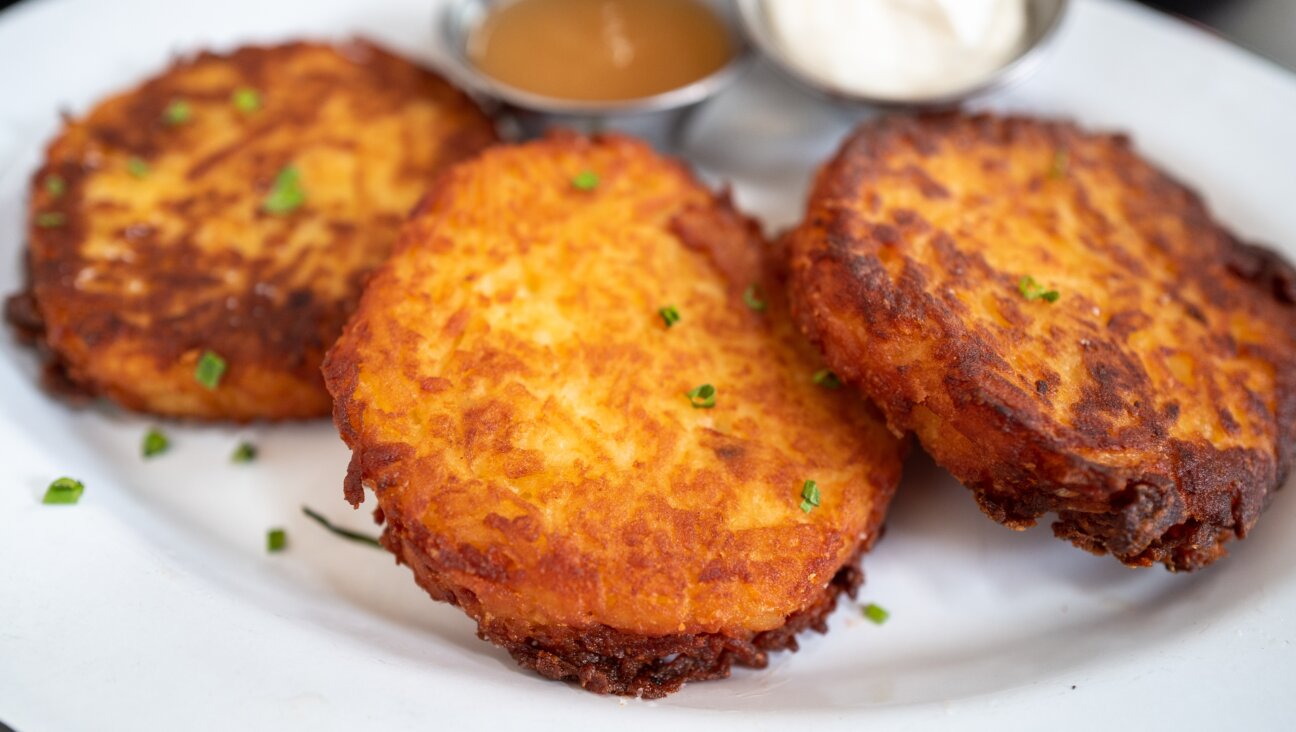
Aloo Beet Cutlet
In Curry Hill, a neighborhood crammed with Indian restaurants, Haldi stands out as an unusual hybrid, thanks to its focus on Jewish recipes. The menu’s offerings span the gamut of Bengal cuisine, but several dishes are specifically marked “Calcutta Jewish Influence.” These are the pride and joy of families like mine — Baghdadi Jews who settled in Bombay and Calcutta generations ago, and who fused their old Iraqi recipes with the culinary traditions of their new Hindu neighbors.
Even though these dishes still feature prominently on our Shabbat dinner tables, they’re not often presented in restaurants as explicitly Jewish, which is why dining at Haldi felt like a homecoming to me. Granted, the restaurant’s décor (copper woks lining the ceiling, green wine bottles framing the overhead lamps) isn’t Jewy in the least; but the name “Haldi,” which means “tumeric,” took me straight back to my grandmother’s kitchen. It’s the very first word she taught me in Hindi — which should give you an idea of how central the “golden spice” is to our style of cooking.

Rossogolla
Still, some of Haldi’s Jewish dishes were totally unfamiliar to me. And that was a good thing. Take the aloo beet cutlet, a starter that combines spiced potatoes, beets and peanuts into an oblong croquette, which you’re instructed to dip into a spiced ketchup. Or the chicken makmura, which features minced chicken balls in an almond-and-cashew gravy so rich and creamy it will take the edge off some of your hotter sides. Both of these dishes struck me as more successful than the bamia — but I admit that might just be because, having no familial equivalent to compare them to, I was free to enjoy them without guilt.
If you’ve got a sweet tooth, you can top it all off with the dangerously saccharine rossogolla (spongy cottage cheese balls soaked in sugar syrup) or gulab jamun (the fried milk ball version). But I’d recommend skipping the sugar coma in favor of a cocktail like the Highway Lassi, a (strongly) alcoholic twist on India’s popular mango yogurt drink. Trust me when I say it’s good for a “L’Chaim!” or two.
Sigal Samuel is a deputy digital editor at the Forward.
This is a moment of great uncertainty. Here’s what you can do about it.
We hope you appreciated this article. Before you go, we’d like to ask you to please support the Forward’s independent Jewish news this Passover. All donations are being matched by the Forward Board - up to $100,000.
This is a moment of great uncertainty for the news media, for the Jewish people, and for our sacred democracy. It is a time of confusion and declining trust in public institutions. An era in which we need humans to report facts, conduct investigations that hold power to account, tell stories that matter and share honest discourse on all that divides us.
With no paywall or subscriptions, the Forward is entirely supported by readers like you. Every dollar you give this Passover is invested in the future of the Forward — and telling the American Jewish story fully and fairly.
The Forward doesn’t rely on funding from institutions like governments or your local Jewish federation. There are thousands of readers like you who give us $18 or $36 or $100 each month or year.
Support our mission to tell the Jewish story fully and fairly.