
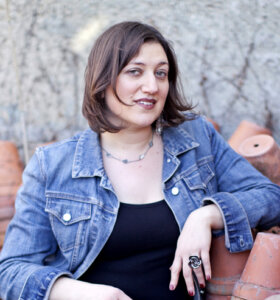
Aviya Kushner is the Forward’s language columnist and the author of Wolf Lamb Bomb and The Grammar of God.
Aviya Kushner is the Forward’s language columnist and the author of Wolf Lamb Bomb and The Grammar of God.

Recently, I unexpectedly found myself in an elegant hotel ballroom in Virginia, discussing Yehuda Amichai’s iconic poem “The Diameter of a Bomb” with a deaf and blind poet. As the poet and his interpreters communicated in Pro-Tactile American Sign Language — an emerging language using touch to convey sign language, much in the way that…

For word nerds, the Book of Esther contains a special treat — the longest word in the Tanakh. Technically, v’ha’achshadrapanim and its eleven letters makes it the length champion of the entire Hebrew Bible. It means “and the satraps” or “and the governors of the provinces of the Persian Empire,” and it comes near the…
Deaf Republic: Poems By Ilya Kaminsky Graywolf Press, $16, 80 pages The poetry world has been waiting for Ilya Kaminsky’s new collection for fifteen years — but this is the book that will bring him wide readership outside of the small yet passionate continent of poetry readers. This is the book that will let readers…

What We Talk About When We Talk About Hebrew (And What It Means to Americans) Edited by Naomi B. Sokoloff and Nancy E. Berg University of Washington Press, $30 In the 1980s, the king of minimalist fiction, Raymond Carver, published a story titled “What We Talk About When We Talk About Love.” Both the story…

Here’s something lovely and unexpected — “The Little Prince” published in Arabic transliterated into Hebrew, as well as in Arabic itself. Al-Amir Lehzir is accompanied by a CD of the Arabic narration. Readers of Hebrew can easily follow along, and a short sound clip is up at the publisher’s website. There is also a video…

The Israeli poet Yona Wallach memorably wrote that “Hebrew is a sex maniac.” Wallach, who died in 1985, was no stranger to attention-grabbing subjects: One of her poems discusses sex with tefillin. Today, pronouns are a hot topic, and Wallach’s poem “Hebrew,” which explains why gender-neutral language is easier to accomplish in English, is the…

When it comes to describing baffling human behavior, Yiddish excels, and perhaps the same is true for describing baffling government behavior. As Brexit descends into no-one-knows-what’s-happening mode, and as March 29th — or Brexit day — gets perilously closer, Twitter is lighting up with Yiddish explanations for British politics. “The Yiddish word for “Brexit” is…
“Fiddler on the Roof” has made headlines of late as public figures have expressed their love for Yiddish theater. Interestingly, what brings on the love is the Yiddish language itself. Alan Dershowitz is not primarily known as a theater critic, but he was so moved by a recent Yiddish performance of “Fiddler on the Roof”…




100% of profits support our journalism




