Is It OK To Dress Like A Nazi? New Zealand Group Says It Depends.
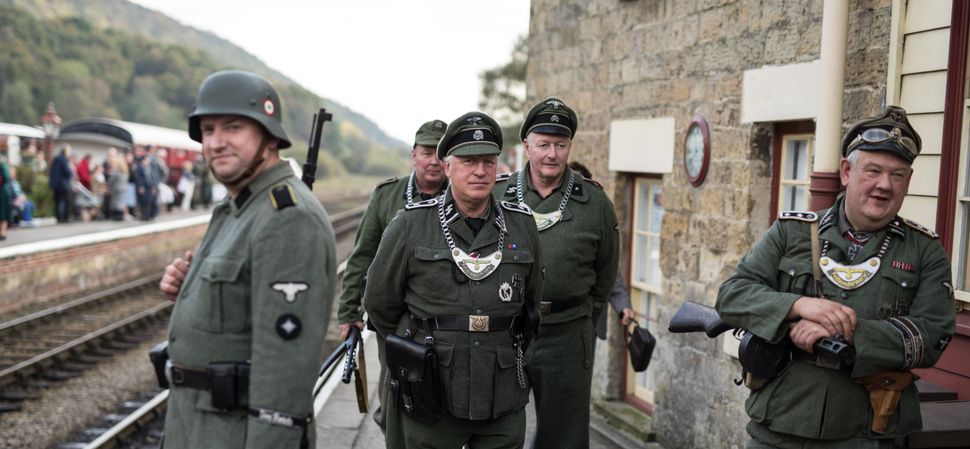
World War II reenactors dressed as German soldiers attend the 25th ‘Railway in Wartime Event’ along the line of the heritage ‘North Yorkshire Moors Railway’ in Pickering, northern England. Image by Getty Images/AFP Contributor/Contributor

By PJ Grisar August 23, 2018
While the Wehrmacht never set foot in New Zealand during World War II, a few days ago in an Auckland park they were out in force.
Newshub reports that a group of historical re-enactors dressed like Nazi soldiers, some of whom carried prop guns and wore helmets and uniforms bearing Reichsadler eagle crests and swastikas, were harassing passerby on Sunday in Auckland’s Glenbrook Vintage Railway park, which is on the ground of a train museum. When a woman upset by the display approached the role players, her husband said to Newshub, she was told “It’s history — if you don’t like it piss off.”
Stephen Goodman, President of the New Zealand Jewish Council, condemned the wearing of Nazi uniforms in displays such as re-enactments, which could be viewed as glorifying the Reich or legitimizing their cause.
“This is not acceptable to those that suffered under the Nazis including Jews, gypsies, gays and the disabled. It also shows no respect for those New Zealanders that fought against the tyranny,” Goodman told Newshub.
Niel Kruger of the Historical Reenactment Society of New Zealand told Newshub that the re-enactors were dressed as German infantrymen and not members of the National Socialist Party, arguing this distinction made the claims they were dressed as Nazis inaccurate. The Nazi insignia included in the costumes appear to belie this assertion. Kruger did not respond to the Jewish Council’s statement condemning the display.
However, Goodman when asked by Newshub if he’d advocate for some kind of a blanket ban on Nazi outfits, similar to such bans currently enshrined in German law, he said he wasn’t considering it. “It’s a delicate balancing act because you still want to promote free speech, and in many ways this is a free speech issue.”
What are the acceptable uses of Nazi costumes? Goodman’s answer: When they are used for educational purposes they can be appropriate, although he’s not thrilled about those uses. Karina Skorikova, a costume stylist at Elite Costume Hire in Auckland, told Newshub that most customers who rent out the Hitler costume stocked by Elite use it for educational film or theater productions.
Goodman confirmed to Newshub that the Jewish Council is concerned by businesses that peddle Nazi memorabilia and costumes that are used in a recreational, non-educational sense. “While not illegal in New Zealand, it is offensive that people want to make a profit out of the suffering of others,” he said.
As Newshub notes, the issue of stepping out in jackboots and other Nazi regalia has been the subject of some scrutiny in the past decade, most notably when a 20-year-old Prince Harry attended a costume party in a Nazi uniform and swastika armband in 2005. Still, Harry’s countryman John Cleese got laughs for a more explicit get-up on “Monty Python’s Flying Circus,” posing as a poorly-disguised Adolf Hitler — he goes by “Mr. Hilter” — hiding away at an English bed and breakfast. Given Cleese’s example, perhaps parody should also be accounted for in Goodman’s reckoning of acceptable use. Or has he never seen “The Producers?”
“You have to take it on a case-by-case basis,” Goodman told Newshub. Maybe context is key.
PJ Grisar is the Forward’s culture intern. He can be reached at [email protected]

Did you know that only 2% of Forward readers donate to support our nonprofit newsroom? That 2% make it possible for millions to read the Forward without a paywall or subscription — removing any barriers to the full and fair Jewish story.
But while the Forward is free to read, it isn’t free to produce. Big stories — like deep dives into the antisemitism data, political scoops or reporting trips to college campuses — take months of research and fact-checking. All while we keep you informed of what you need to know each day.
— Rachel Fishman Feddersen, Forward Publisher & CEO
Support our mission to tell the Jewish story fully and fairly.