His mother is Israeli, his father is Palestinian. His life? Complicated.
Ibrahim Miari’s autobiographical one-man play, ‘In Between’, is a valuable account of his dual identity
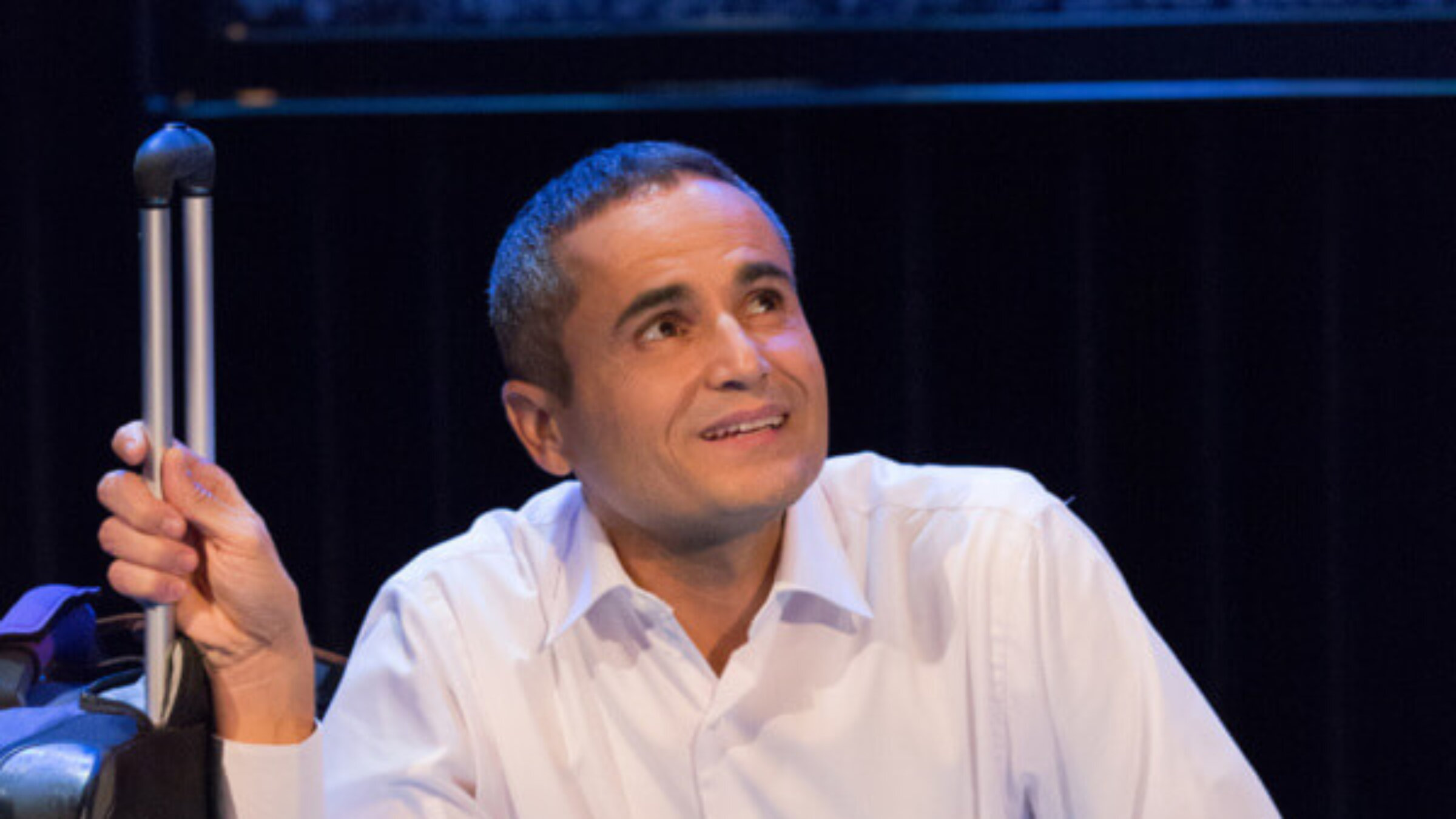
Miari, with a suitcase that will cause him oh-so-much-trouble Courtesy of Ibrahim Miari

By Noah Hirsch-Rechter January 19, 2026
Ibrahim Miari begins his one-man autobiographical show, In Between, by spinning in a circle, arms outstretched, his body swaying to the strains of Arabic music and his smiling face lit by the spotlight above.
It’s a lyrical opening that softens up the audience before Miari, who’s a playwright and lecturer, gets to the meat of the play: his identity. His father, we learn, is a Palestinian-Muslim, while his mother is a Jewish-Israeli. (She converted to Islam to marry his father.) Miari doesn’t know how they met, so he concocts a fantasy version, a meet-cute set to a Beatles soundtrack, for this weekday audience at Northeastern University’s Blackman Theater. It’s gooey and romantic, but it prefigures one of the play’s defining motifs — that, political turmoil be damned, all you need is love. If this was perhaps an overly rosy outlook in 2011, when Miari first performed In Between, today it seems positively far-fetched.
Miari’s parents eventually settled in Akko, a mixed Arab-Jewish city on the coast of northern Israel. In the first of a series of episodes from Miari’s childhood, he attends a mainstream Israeli school — over his father’s objections — where he celebrates Israel’s Independence Day and, for a Purim costume contest, dresses up as a garden in bloom, winning first prize. His father tells his son that next year he will dress up as a cactus, the better to let his classmates know they’re on stolen land.
Miari speaks unaccented Hebrew; his teachers and friends call him Avraham. Later, he transfers to a nearby Palestinian-Arabic school, and there he commemorates Independence Day rather differently, as the Nakba, or Catastrophe. His teachers and friends call him Ibrahim.
Such episodes illustrate not just Miari’s duelling cultural obligations, but the difficulties he will face reconciling them — after all, we never see him in an environment where both are equally embraced. (It should be noted we are given his mother’s perspective only too rarely.)
Miari toggles easily, impressively, between his life’s principal characters. Props are only occasionally employed. His eyebrows do much of the heavy lifting: they furrow, and Miari is transformed, no longer a wide-eyed, adolescent Avraham/Ibrahim, but his gloomy father.
At a Canadian summer camp for peace activists, Miari, now an adult, meets and swiftly falls for a Jewish-American woman, Sarah Goldberg — they get engaged, but finding a wedding officiant open to a hybrid ceremony proves difficult. Even a Buddhist cleric (Sarah is a so-called BuJew) turns the couple down. Miari, who has a tendency to over-explain, laments that he’s “not Jewish enough, not Muslim enough, not even Buddhist enough!”
The play’s other set piece is from later in Miari’s life, an airport encounter-turned-interrogation with an El Al security agent suspicious of Miari’s overstuffed suitcase — which he’s borrowed from Sarah. Narrowing his eyes at the suitcase’s name label, the agent says, “You don’t look like a Sarah, and you definitely don’t look like a Goldberg.”
The idea that the agent is an oaf and a bigot is plausible enough, but he’s so much a caricature that the seriousness of Miari’s point, that he’s forever suspended between Arab and Israeli, neither one thing nor the other, gets muddled. Miari gives Sarah’s mother the same treatment: meeting him for the first time, she provides little more than a whistlestop tour of stereotypes of elderly Jewish-American women. It’s grim to watch.
Both characters exemplify In Between’s biggest shortcoming: its lack of subtlety. Sure, it’s a funny play — Miari is a gifted physical comic — but the hijinks don’t really illuminate the challenges of Miari’s Arab-Jewish identity; mostly, they’re a distraction. (Case in point: Miari’s scene partner, when he searches for a wedding officiant, is an eight-foot puppet dressed as an Orthodox Rabbi, which Miari ventriloquizes.)
In short, there’s a poignancy deficit, which is made all the more stark by the play’s standout moment. Near the end, Miari talks directly to the audience about his grandmothers, one Jewish, the other Palestinian, both of whom have passed away. They lived barely five miles from each other, but never met. “I’m sad they won’t see my wedding,” Miari says, “or meet their grandchildren.” He sits glumly on a chair, looking like a lost child. It’s sad and tender, a welcome moment of introspection in an otherwise helter-skelter production.
In Between concludes on an upbeat note, Miari informing the audience that he and Sarah were married in a cross-cultural, officiant-less wedding. Marriage — love — has quieted his existential turmoil, he tells us. He has at last found the belonging he’s coveted for decades.
It’s a sweet message but solipsistic — not least with today’s Middle East as a backdrop. I found it hard to believe Miari’s marriage meant he could forget his decades-long struggle over his split identity, especially when that happy union, at least in the play’s telling, did not address this issue so much as ignore it. Still, it’s an ending in keeping with the play’s broader tone — heavy on humor and shtick, lighter altogether on substance.