For Israel’s foremost chiropterologist, every bat is a mitzvah
Professor Yossi Yovel, author of ‘The Genius Bat,’ hopes to show that the nocturnal creatures are not, in fact, the stuff of nightmares
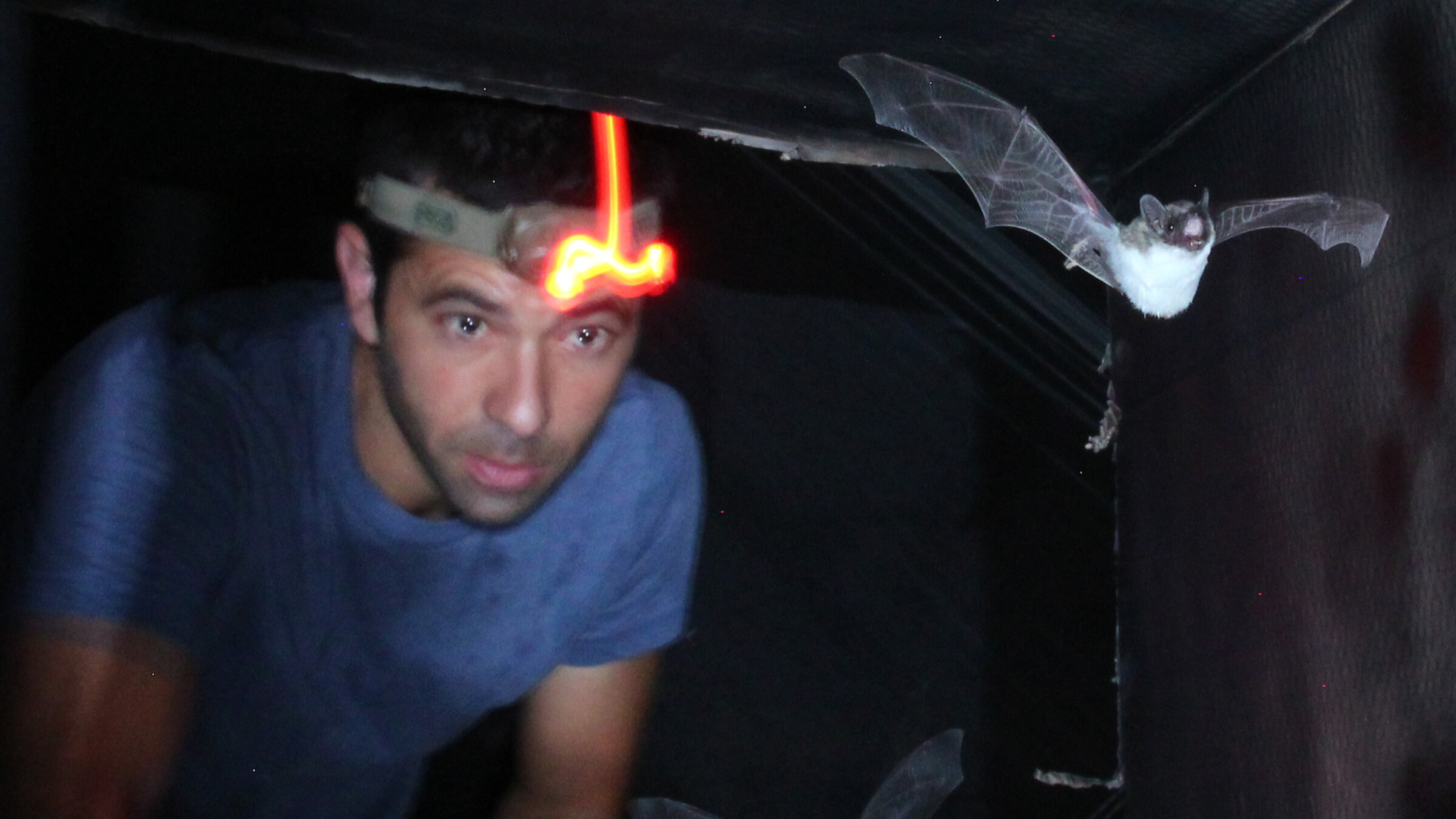
Professor Yovel, in his element Photo by Ofri Eitan

By Noah Hirsch-Rechter February 5, 2026
Bats get bad press. Short-sighted and cave-dwelling, they generally make the news only when carrying disease, transfiguring into vampires, or else lending their name to paranoiac military commanders (e.g. Colonel ‘Bat’ Guano, in Dr. Strangelove).
All of which is grossly unfair — at least according to Yossi Yovel, a professor of zoology at Tel Aviv University, and author of The Genius Bat, recently named a ‘Book of the Year’ by the science journal Nature.
“Usually, bats are very nice,” said Yovel.
Indeed, the flying mammals have been remarkably tolerant towards Yovel and his small team of researchers, who’ve studied bat echolocation for the better part of a decade, and have proved that bats are smarter creatures than previously thought. And only rarely, Yovel said, has he gotten bitten. “But you can’t blame them,” he added. “Because you’re holding them in your hand, and you’re a big creature.”
Yovel first encountered the study of bats, or chiropterology, as an undergraduate at Tel Aviv University, where he took a course on bat echolocation, the first ever held in Israel. He was immediately hooked. “Suddenly, I discovered this new world! Of using sound for vision, basically,” he said.
Sensory zoology, as the broader research field is known, meant Yovel could combine two of his abiding interests: animals and physics. The ways in which animals used sound to get around provoked mathematical questions, not just biological ones.
When Yovel started his research in the late 2000s, he was the first Israeli zoologist to focus explicitly on bats’ sensory behavior. Previously, researchers had only explored bat physiology: how they maintained heat, how they hibernated, what they ate, and so forth. Yovel, by contrast, was “all about sound.”
His most important contribution to the field to date, one described in detail in The Genius Bat, is using GPS devices to track bats and show that they are, in fact, thinking, feeling creatures.
To create the gadgets, Yovel approached an Israeli startup that specialized in manufacturing minuscule GPS instruments — the company had initially designed them in the early aughts, intending to put them inside cameras — with an unusual request: Could they make one that Yovel could stick, using biological glue, to bats?
“So they developed it for me,” Yovel said. “And though the main thing is the GPS, there’s also a microphone in there. And that combination is what’s so unique, because we wanted to record sound echolocation as the bats are flying.”
The research can be hands-on (Yovel attaches the trackers himself) and not without its challenges — chief among them retrieving the devices, which by design fall off the bats within a few days.
Yovel and his team wear antennae, which pick up signals from a “small pinger” attached to the GPS, but still can spend hours searching.
“It’s a huge bottleneck that people are not aware of,” he said. “It’s like a treasure hunt, and often we climb mountains or have to go through thick vegetation.”
To tackle this problem, Yovel and his team constructed a lab — “our own bat colony,” he calls it — at Tel Aviv University, where dozens of bats roost. But the bats are allowed to roam free, so they “go out and come back,” Yovel said.
Thanks to the facility, Yovel can track bats for months, even years, though they haven’t exactly gone undetected. “Sometimes, people complain to me about bats pooping on their cars and on their houses,” he said. “I say to them, ‘tell me where you live, and I can check if our bat visited your backyard or not!”
By studying the bats’ sonar activity, Yovel and his team have shown that bats possess what he describes as a “cognitive map in their brain.” They’ve demonstrated, for instance, that bats can map time, avoiding objects — a tree, say — that they’ve previously visited. “They know that a long time has passed,” said Yovel, “and so they will not return to this tree, because they assume that there’s no more fruit on it.”
Bats even respond to illness in a fairly recognizable manner, often deciding simply to stay at home. “Sick bats will usually avoid any contact, and will not fly out, just like we prefer to be in bed when we’re sick,” Yovel said.
Whether this rises to the level of full-on consciousness is a matter of some debate, though Yovel believes that bats — indeed, most animals — have at least some degree of consciousness. The challenge, then, is finding “sophisticated ways to probe these degrees.” After all, how do you measure such a thing without language as a guide?
He reaches for an unusual comparison to emphasize the dilemma: toddlers. “Pre-lingual toddlers are obviously conscious, right? But we need to find ways to examine this using behavioral experiments, because we can’t ask them,” he said. Artificial Intelligence will certainly play an important role. “That’s the future,” Yovel said. “Using AI models to simulate bat behavior.”
So Yovel will continue to use bats to explore what he calls the “consciousness-gap” between humans and animals. “Or,” he added, grinning a little, “the lack of a gap.”
This is a moment of great uncertainty. Here’s what you can do about it.
We hope you appreciated this article. Before you go, we’d like to ask you to please support the Forward’s independent Jewish news this Passover. All donations are being matched by the Forward Board - up to $100,000.
This is a moment of great uncertainty for the news media, for the Jewish people, and for our sacred democracy. It is a time of confusion and declining trust in public institutions. An era in which we need humans to report facts, conduct investigations that hold power to account, tell stories that matter and share honest discourse on all that divides us.
With no paywall or subscriptions, the Forward is entirely supported by readers like you. Every dollar you give this Passover is invested in the future of the Forward — and telling the American Jewish story fully and fairly.
The Forward doesn’t rely on funding from institutions like governments or your local Jewish federation. There are thousands of readers like you who give us $18 or $36 or $100 each month or year.
Support our mission to tell the Jewish story fully and fairly.