Forever curious, never daunted, Frederick Wiseman sought to repair the world through film
The great documentarian, who has died at 96, leaves behind a legacy of films that offer a moral accounting of the American soul
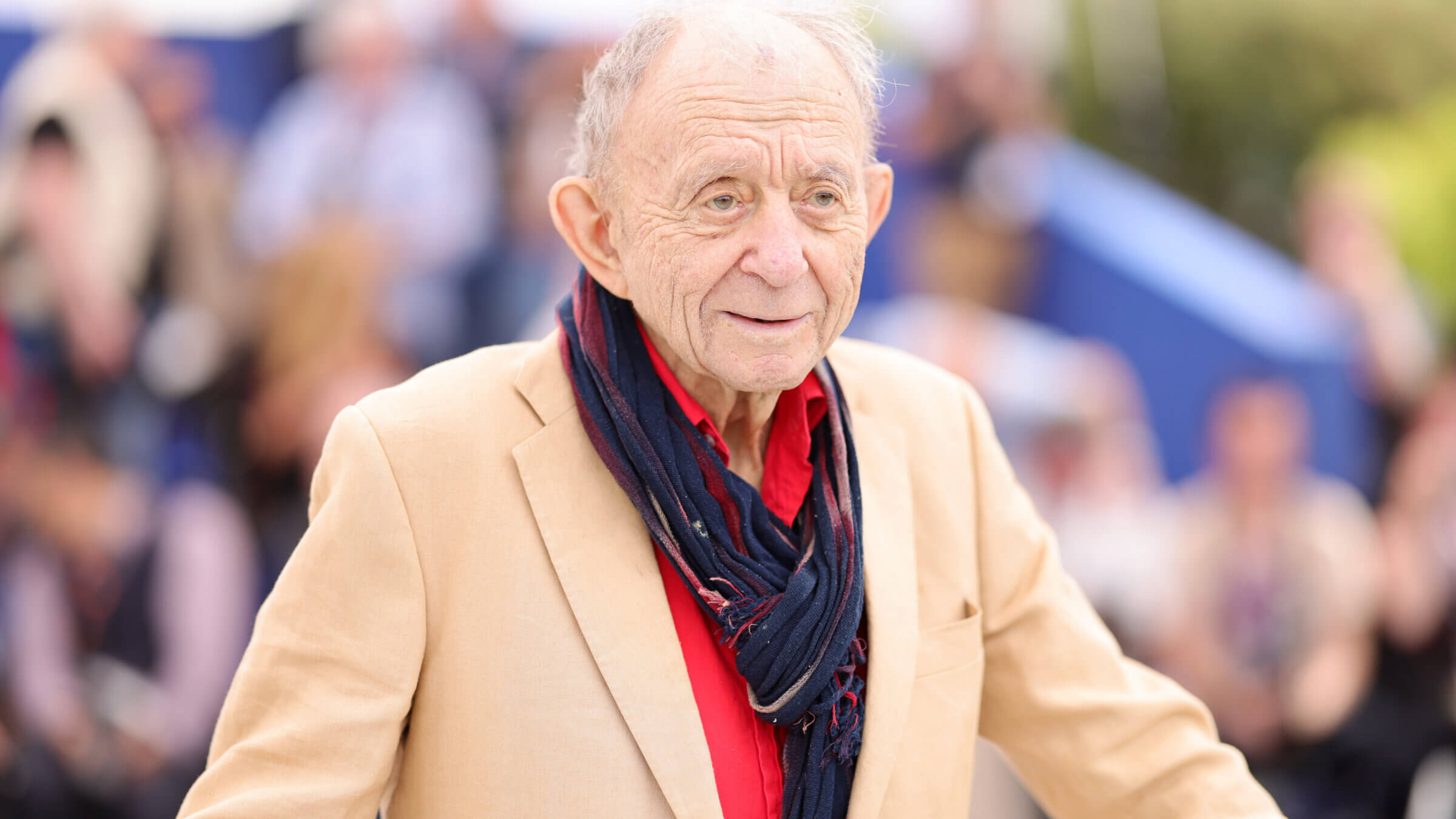
Frederick Wiseman at the 2024 Cannes Film Festival. Photo by Neilson Barnard/Getty Images

By Dan Friedman February 16, 2026
Frederick Wiseman, whose 60-year project of quietly asking America to look at itself — without sermon or embellishment, yet wielding the camera with an ethical ferocity‚ has died at the age of 96. Wiseman was a documentarian par excellence, but — as his yearlong 2010 MoMA retrospective and his winter-long 2025 Lincoln Center appreciation show — he was more than a filmmaker and more dynamic than the institutions he critiqued. The 45 films he made between 1967 and 2023 embody the very process of American self-reflection.
Born Jan. 1, 1930, in Boston, Wiseman grew up in a Jewish household that never made a big show of its Jewishness, yet never let it slip from mind. His father, Jacob Leo Wiseman, was an accomplished lawyer; his mother, Gertrude Leah Kotzen, had a number of jobs, but Wiseman once told the Forward that “not being able to study acting was her life’s regret.” In countless interviews, Wiseman described his upbringing as secular but culturally Jewish — one with plenty of Yiddish and the Forverts on the kitchen table. It was a childhood that inculcated a moral restlessness that he would spend his entire creative life channeling through film.
Before the camera, there was the classroom: Williams College, then Yale Law School. Law was his first chosen arena, and there is something telling in that. To be a good lawyer, you need curiosity, patience and the stamina to sit with contradiction. Wiseman found the law constricting and he turned, gradually and then completely, to filmmaking, where the rules were up for grabs but the moral stakes were never abstract.
After helping to produce Cool World, a 1965 feature about drug addiction, violence and economic hardship set in Harlem, Wiseman bought a 16 mm camera and went to Bridgewater State Hospital to film Titicut Follies. His first film remains one of his most notorious, not least for influencing Miloš Forman’s 1975 One Flew Over the Cuckoo’s Nest. The state hospital for the criminally insane becomes, through Wiseman’s lens, both theater and trial. The patients are on display for us, as are the guards, but we, the audience, are on trial too: How do we treat the weakest among us? How do we look away?
Although the film represents an early example of his unobtrusive style, it was so uncomfortably honest that the Massachusetts government succeeded in banning it from general American distribution for 20 years. It was the first known film to be censored for reasons other than obscenity, immorality or national security. This is where his Jewishness lived — in the refusal to flinch from the unspeakable. Wiseman spent six decades getting us to see what we really mean by the places we build, the rules we enforce, and sometimes the people we push to the margins.
His “reality fictions,” as he preferred to call them, are quiet but not passive. They have no narration — no voice-of-God explanations or neat moral conclusions. The camera simply sits, bearing witness to public housing in Chicago, an inner-city high school in Philadelphia, Boston city government, a Dallas department store, a welfare office, a library in Queens, small-town Indiana, and two views of domestic violence in Florida. What emerges is an archive of American power and American fragility.
Even more than his contemporaries D.A. Pennebaker and the Maysles brothers, Wiseman avoided tying his stories into a single ideological bow. But, just like his friend and follower Errol Morris, he never stopped asking questions. He once said he disliked the word “documentary” because it suggested a neatness and authority that reality refuses to offer. Like a scribe working on a Torah scroll, Wiseman would spend a year or more in his editing room shaping hundreds of hours of footage into a final cut.
Every editing choice was an act of interpretation, and every interpretation was a kind of moral accounting. To watch a Wiseman film is to practice a secular version of cheshbon nefesh — an accounting of the soul. We see the small humiliations of bureaucracy, the quiet heroism of nurses, the petty tyrannies of principals, the warmth and indifference that coexist inside every institution. His films remind us that institutions, including marriage, are made up of people, and people are both better and worse than the systems they create.
Though Wiseman never foregrounded his Jewishness in public, it filtered through his choice of subjects — and his abiding belief in the dignity of ordinary lives. He loved the messy, pluralistic, contradictory spaces where authority and people meet, like a library, a community center, a city council meeting. He loved making films and was annoyed not to be able to film or edit after his 2023 feature, Menus-Plaisirs – Les Troisgros, about a Michelin three-star restaurant and the family that runs it.
He once called his films “epic poems,” but they are also commentaries, in the rabbinic sense: teasing out what is hidden in plain sight, turning it over and over until it yields something that might help us live with ourselves. Wiseman was excited in 2025 when a group of archivists finished the process of restoring and digitizing 33 of his films so that his entire oeuvre can be more easily examined for years to come.
Wiseman’s focus was mainly on the United States, though he did film elsewhere — especially in Paris, where he filmed at a strip club and a dance rehearsal at the Paris Opera Ballet. In later years, when asked how he chose what to film, he said simply: “Curiosity.” But curiosity, for Wiseman, was never passive. It was a demand to see. In this, he practiced a form of tikkun olam — repair of the world — that was all the more radical for being so understated. He didn’t shout. He didn’t score cheap points. He invited us to do the hard work ourselves.
He was honored, eventually, by the very institutions he made his life’s work dissecting. A MacArthur “Genius Grant,” a Guggenheim Fellowship, an honorary Academy Award, the Golden Lion for Lifetime Achievement in Venice. Yet he remained — in temperament and in practice — the same outsider who first brought his camera to that state hospital in 1967, sure only that the camera should watch and listen, and that we should, too.
Wiseman’s wife, Zipporah Batshaw, passed away in 2021, but he is survived by his two children and a generation of filmmakers who learned from him that moral clarity need not come at the expense of complexity. They carry forward the project of asking the unasked questions, of looking at what we’d rather ignore. In that way, his legacy is not a monument but a living tradition — an ever-expanding conversation about what it means to be human, to be responsible for each other, and to stand, clear-eyed, in the face of the world as it is.
May his memory be a blessing, and may we, like him, never stop seeing.
This is a moment of great uncertainty. Here’s what you can do about it.
We hope you appreciated this article. Before you go, we’d like to ask you to please support the Forward’s independent Jewish news this Passover. All donations are being matched by the Forward Board - up to $100,000.
This is a moment of great uncertainty for the news media, for the Jewish people, and for our sacred democracy. It is a time of confusion and declining trust in public institutions. An era in which we need humans to report facts, conduct investigations that hold power to account, tell stories that matter and share honest discourse on all that divides us.
With no paywall or subscriptions, the Forward is entirely supported by readers like you. Every dollar you give this Passover is invested in the future of the Forward — and telling the American Jewish story fully and fairly.
The Forward doesn’t rely on funding from institutions like governments or your local Jewish federation. There are thousands of readers like you who give us $18 or $36 or $100 each month or year.
Support our mission to tell the Jewish story fully and fairly.