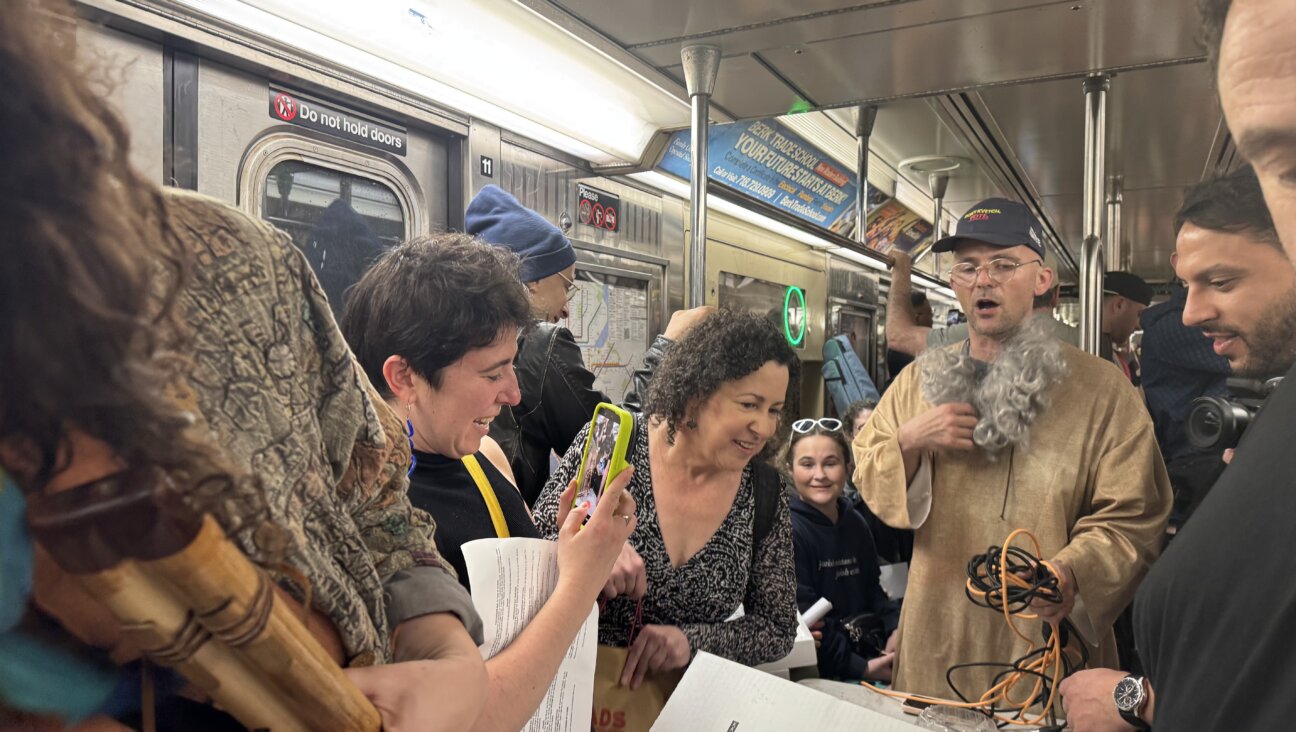
Why the loudest Jewish celebrity voices are not always the most influential
Jewish celebrity advocacy surged after Oct. 7. But actors embedding Jewish life into television and film may be shaping cultural perception in deeper ways
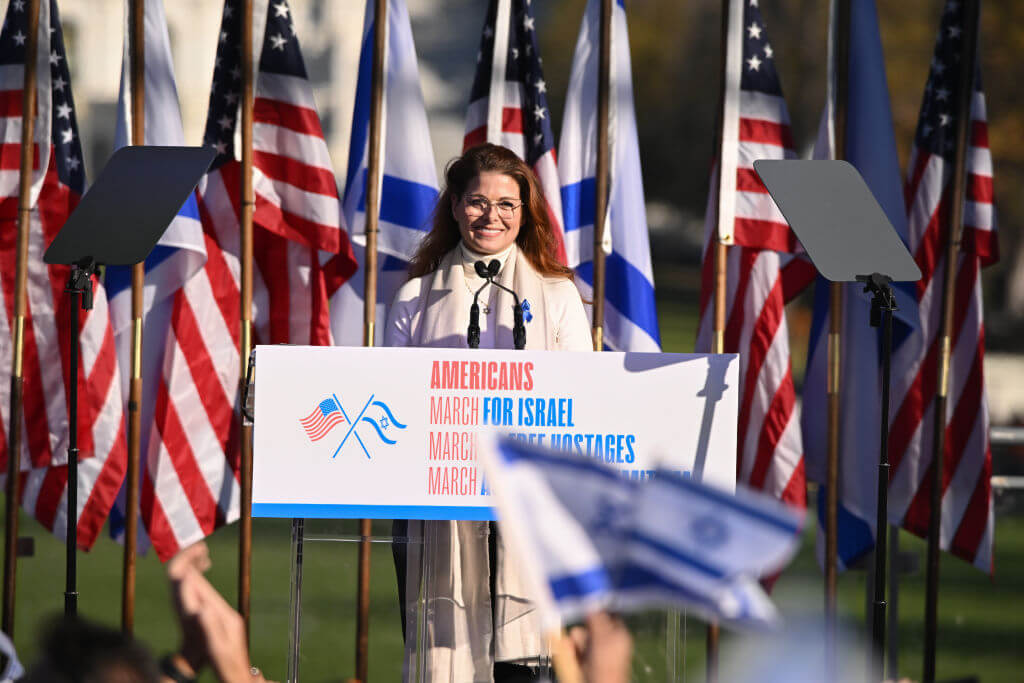
Debra Messing speaks during the March For Israel at the National Mall in Washington, D.C., on Nov. 14, 2023. Photo by Noam Galai/Getty Images

By Benyamin Cohen March 4, 2026
The photo from Carnegie Hall last week of a couple dozen celebrities dressed like they were attending a bat mitzvah was striking not just for the cause — a UJA-Federation benefit to help rebuild Kibbutz Be’eri after the Oct. 7 Hamas attack — but for the cast.
Among others on stage were Debra Messing (Will & Grace), David Schwimmer (Friends), Julianna Margulies (ER) and Mark Feuerstein (Caroline in the City, Fired Up, Conrad Bloom, and Good Morning, Miami!). It was like a veritable Mad Libs of NBC’s Must-See TV lineup from the 1990s and early 2000s.
It looked less like a zeitgeist moment than a really well-booked synagogue fundraiser.
There is nothing unusual about celebrities appearing at benefits. What is unusual is which celebrities keep appearing at Jewish solidarity events.
Since the Oct. 7, 2023, Hamas attack, a certain cohort of Jewish celebrities has reentered public view through outspoken advocacy around Israel and antisemitism. In a fragmented culture, familiarity still travels fast. A face people already know can function like shorthand, offering solidarity, legitimacy, reassurance.
Debra Messing has posted frequently about the war in Gaza, campus protests and rising antisemitism. During the mayoral race last fall in New York City, where Messing lives, she shared memes attacking Zohran Mamdani — posts that labeled Mamdani, who would become the city’s first Muslim mayor, a “jihadist” and “Osama bin Mamdani.”
Actress Patricia Heaton, a Catholic and a Christian Zionist, saw her fame peak when she starred in Everybody Loves Raymond (1996-2005) and The Middle (2009-2018). She has drawn attention again after founding the October 7th Coalition, a network of Christians speaking out against antisemitism. She’s traveled to Israel, spoken at community events, and launched a campaign to get non-Jews to put mezuzahs on their door.
Julianna Margulies generated headlines, and later apologized, after she asserted that parts of the Black and LGBTQ+ communities were “brainwashed to hate Jews.” Figures whose peak fame predated the algorithm found their visibility driven less by current projects than by purpose.
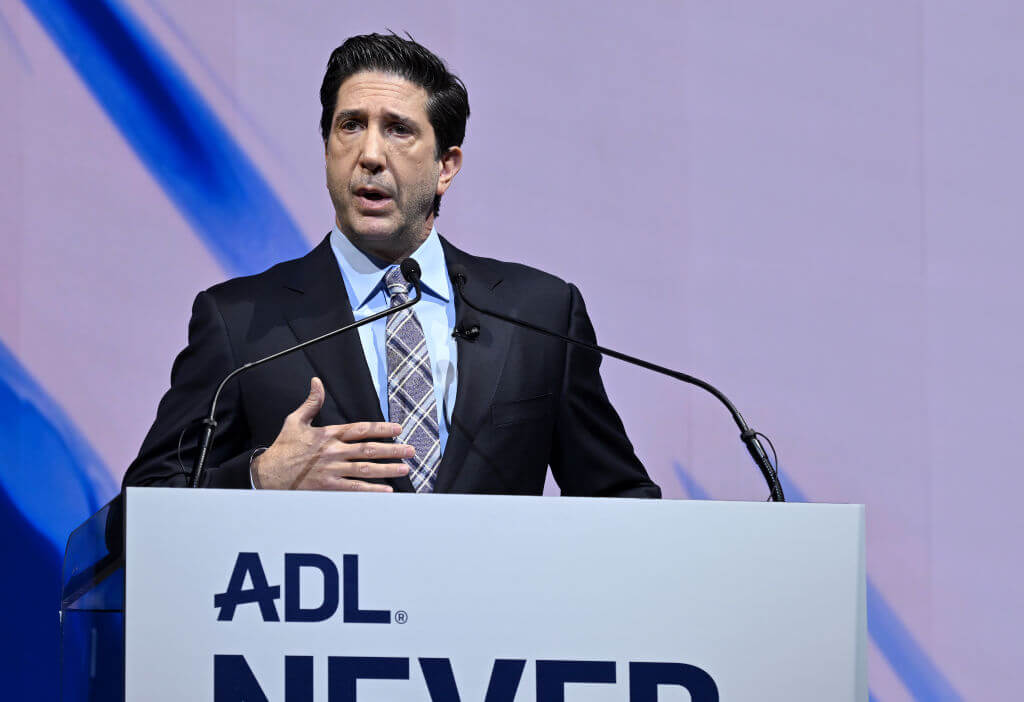
David Schwimmer has urged his fellow celebrities to “speak out against antisemitism.”
What has emerged is a recognizable media loop. The Anti-Defamation League, American Friends of Magen David Adom, and federations across the country operate within the same attention economy as Hollywood, and recognizable names carry symbolic weight even when their last major role aired when Netflix was a mail-order DVD company.
The other stage
But there is another path to visibility for Jewish actors — one that operates less through commentary than through craft.
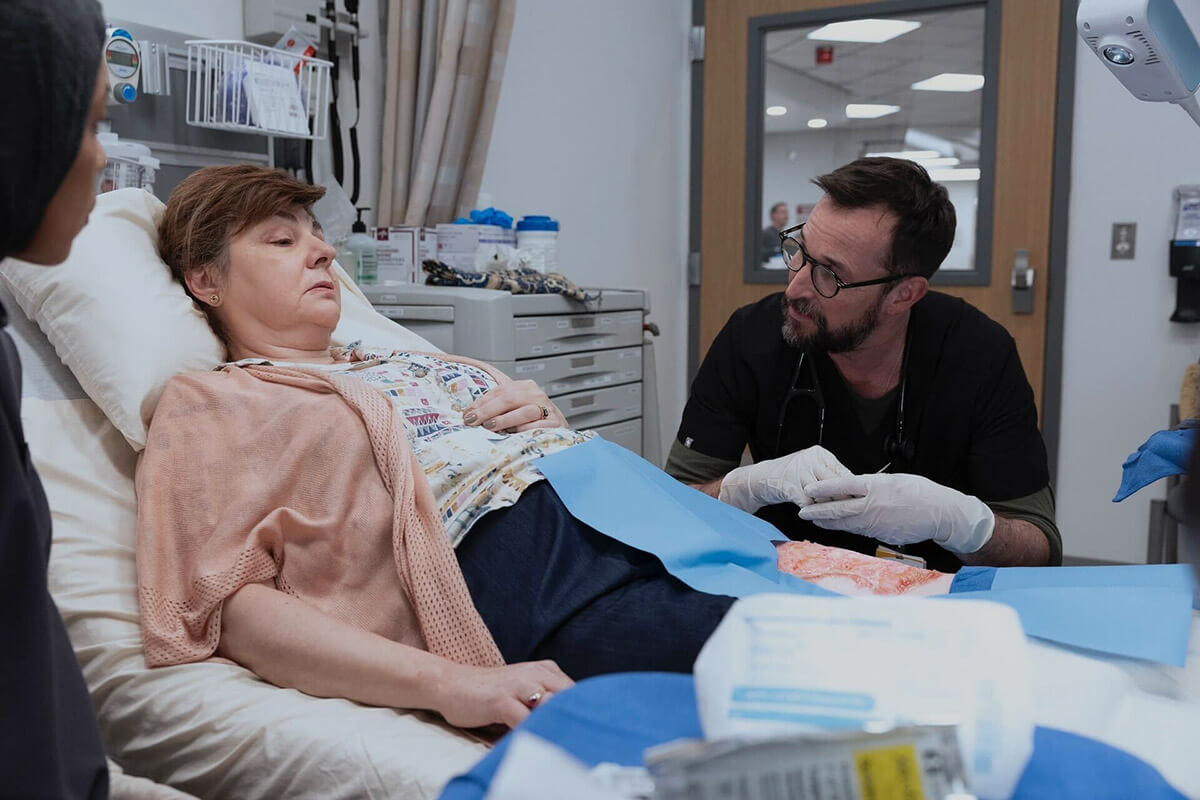
Noah Wyle, himself a card-carrying alumnus of NBC’s Must-See TV era, has experienced a career resurgence with The Pitt, the HBO Max medical drama at the center of the current cultural conversation.
As star and co-creator, Wyle has woven explicitly Jewish moments into the show — reciting the Shema prayer at a moment of crisis, tackling the post-traumatic stress of the deadliest antisemitic attack in U.S. history, and ending a recent episode with “May his memory be a blessing” — allowing audiences to encounter Jewish experience in context rather than as declaration.
Jesse Eisenberg’s A Real Pain operates in a similar register. Drawing on his family’s Holocaust history, Eisenberg created a film that is unmistakably Jewish without behaving like it is trying to prove something.
Scarlett Johansson’s directorial debut, Eleanor the Great, centers on an elderly woman who begins recounting her late friend’s Holocaust survival story as her own — a story about grief, memory and the fragile ethics of testimony. Johansson cast real Holocaust survivors in the film, giving them space to share their stories on screen.
Viewers encounter Jewish memory the way audiences encounter most identity in art: through story first, recognition second.
None of these projects announce themselves as advocacy. They do something quieter and, arguably, harder: They place Jewish life inside stories audiences were already planning to watch. (Schwimmer did star in a TV movie about the Warsaw Ghetto uprising at the height of his Friends fame, which has a 100% rating on Rotten Tomatoes and won an Emmy for “best stunt coordination.”)
The distinction matters. Messing, Schwimmer, Margulies and the other usual suspects at the Carnegie Hall event — Tovah Feldshuh, Matisyahu, Jonah Platt, David Draiman, Emmanuelle Chriqui (from HBO’s Entourage, another early 2000s series) are preaching their message in an echo chamber.
You rarely see Wyle, Eisenberg and Johansson at these types of communal functions. But their stories often travel further, reaching people who did not intentionally seek out a conversation about Jewish identity.
None of this makes advocacy less meaningful. In moments of fear or grief, visible solidarity matters. Familiar faces reassure. They say: This is not happening in isolation.
But in an era defined by public statements, the deeper influence may belong to the work that doesn’t read like a social media post. The loudest voices carry inside the room. The quieter stories walk out the door.
This is a moment of great uncertainty. Here’s what you can do about it.
We hope you appreciated this article. Before you go, we’d like to ask you to please support the Forward’s independent Jewish news this Passover. All donations are being matched by the Forward Board - up to $100,000.
This is a moment of great uncertainty for the news media, for the Jewish people, and for our sacred democracy. It is a time of confusion and declining trust in public institutions. An era in which we need humans to report facts, conduct investigations that hold power to account, tell stories that matter and share honest discourse on all that divides us.
With no paywall or subscriptions, the Forward is entirely supported by readers like you. Every dollar you give this Passover is invested in the future of the Forward — and telling the American Jewish story fully and fairly.
The Forward doesn’t rely on funding from institutions like governments or your local Jewish federation. There are thousands of readers like you who give us $18 or $36 or $100 each month or year.
Support our mission to tell the Jewish story fully and fairly.