It’s time to reconsider what we know about Jewish birthing rituals
At the Museum on Eldridge Street, ‘First Light: Birth in the Jewish Tradition’ merges tradition with modern understandings of birthing customs
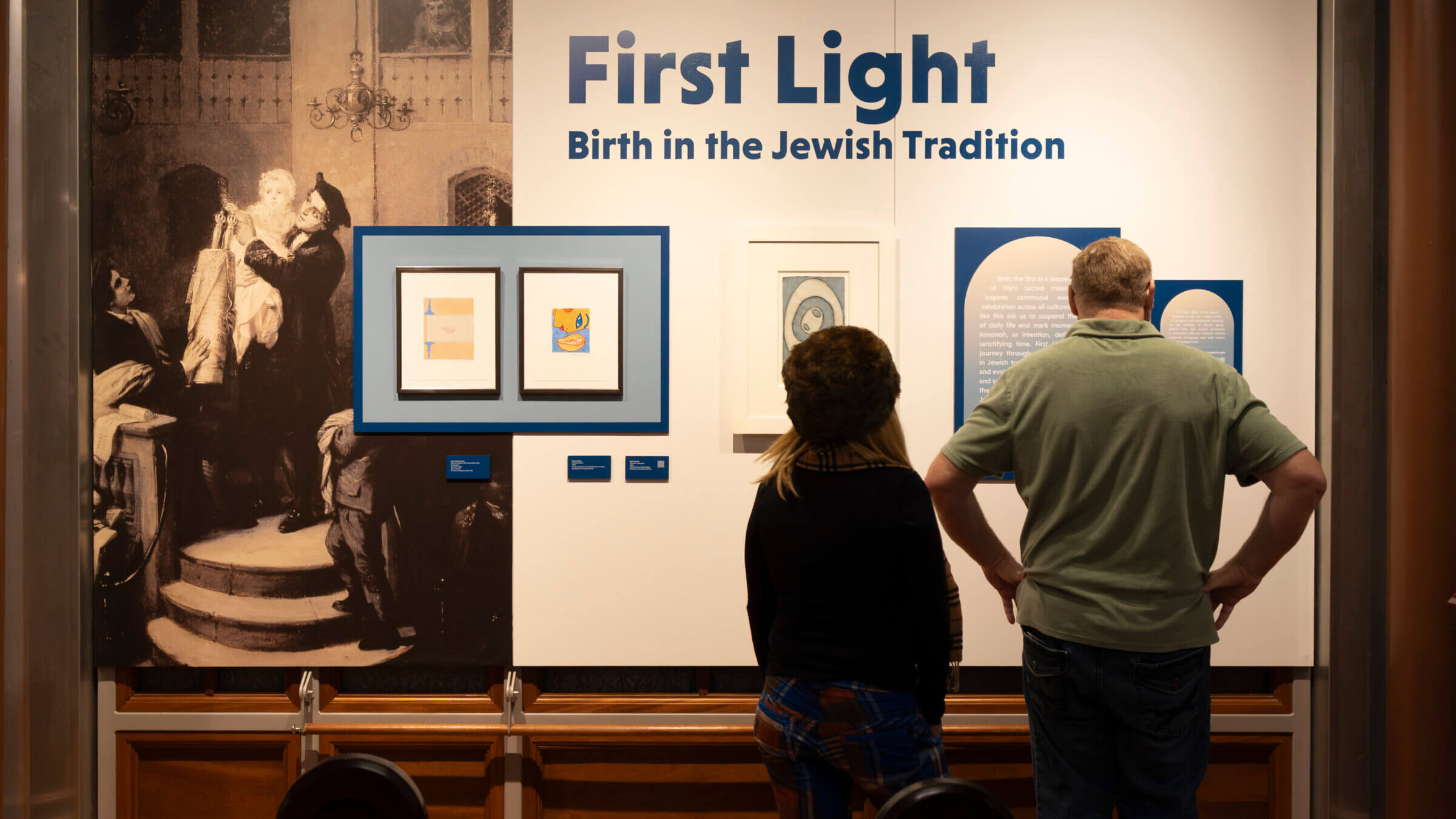
Visitors at the exhibition opening of First Light: Birth in the Jewish Tradition. Photo by Scott Brevda, 2025. Courtesy of the Museum at Eldridge Street.

By Olivia Haynie December 5, 2025
For all living things, birth is our introduction to the world. So it’s a fitting theme for the first exhibit in the Museum at Eldridge Street’s new initiative, “Opening Doors to Intercultural Understanding.”
The multiyear project is centered around three themes: sacred space, sacred community and sacred time. First Light is inspired by sacred time, which focuses on lifecycle events and holidays in the Jewish calendar. The museum staff worked with curator Warren Klein, the director and curator at Herbert & Eileen Bernard Museum of Judaica, to come up with the idea for an exhibit on birth.
“Of course, there’s a universal resonance there,” Amanda Gordon, the museum’s director of public engagement, said. “But really First Light is all about examining Jewish birth traditions and different observance practices, how they’ve evolved, but also different kinds of aesthetic craftsmanship ideas.”
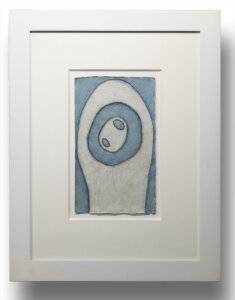
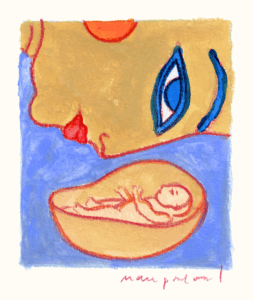
Visitors are first greeted with contemporary paintings from artists Tobi Kahn and Mark Podwal that depict the significance of birth both personally and biblically. Kahn’s abstract painting evokes one of his children’s sonograms through its textured exploration of rounded shapes. This is juxtaposed with Podwal’s depiction of Pharaoh’s daughter finding Moses in the Nile, using a classic Egyptian style to depict the female face looming over baby Moses, almost protectively. Further along in the exhibit are older examples of birth-related rituals both in art and in historic objects.
-
-
YLAMH by Tobi Kahn is based on one of his children’s sonograms.
Courtesy of the Museum at Eldridge Street
-
-
Pharaoh’s Daughter by Mark Podwal.
Courtesy of the Museum at Eldridge Street
“These rotating exhibitions,” Gordon said. “They give us a chance to showcase not only cultures outside of Ashkenazi Jewish culture, but also contemporary work. So to have, you know, Tobi’s work and Mark Podwal’s work here in conversation with these pieces from the 19th and 18th century.”
One of the first photographs in the exhibit is of a two-seater bench; one seat is for the sandek, who holds the baby during the bris, and the other is for Elijah the Prophet.
Klein explained that Elijah is imagined to be at every circumcision ceremony, and some communities reserve a seat for him, much like how many families save him a glass of wine during a Passover seder.
“It’s hard to kind of pinpoint where the custom was created,” Klein said. “Across the board, Ashkenazi and Sephardic communities will have a chair reserved for Elijah.”
The exhibit also explores lesser-known traditions; though most people think that Jewish birthing customs are limited to “circumcision or bris milah and that’s it,” Klein said. “It’s truly not.”
For example, there is Pidyon haben, the redemption of the first born son, a tradition that dates back to the days of the high priest, when Israelites had to offer their firstborn sons as priestly assistants. In the era of rabbinic Judaism, the redemption became more symbolic, and families would offer coins on a platter to “purchase” their child back from the rabbi. In the exhibition, a photo of an ornate silver platter filled with coins illustrates the practice.
Although the exhibit could house only a limited number of physical objects, it displays a wide range of customs. There’s a decorative amulet case from the 19th century that once held a prayer to protect its holder from Lilith, a demon — or, according to some stories, Adam’s first wife before Eve — thought to harm the mother and child during labor or right after birth. One glass case hosts a printed prayer book for a German mohel, or ritual circumciser, dated to 1744. What makes this facsimile particularly interesting, Klein explained, is its depiction of women, who are usually not seen in the visual images of the bris.
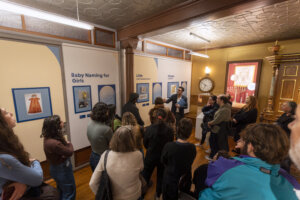
Klein wanted to make sure women were more represented in this exhibit than they usually are in discussions of Jewish birthing customs. One photograph shows a girl’s baby naming in 20th-century Morocco and another depicts the outfit worn by a female baby at a Greek ceremony.
The exhibit also features a wimpel, a long piece of cloth used to tie the Torah scroll. Traditionally, wimpels are made from the cloth that swaddled a baby during his bris, and are decorated with prayers for the boy to grow strong, learn Torah and get married.
“These then would be deposited or used in the synagogue, maybe on his bar mitzvah, maybe on special occasions, and then given to the synagogue almost as a census that this person was a part of the community,” Klein said. “There would be communities that had truly thousands of these.”
“Unfortunately, this is a custom that almost died out after the Holocaust,” Klein said. “There was a resurgence in the 20th century and certain communities still practice it. But it is very rare to find.”
Both Gordon and Klein expressed hope that visitors of all backgrounds would gain something from the exhibit.
“It was my hope that, you know, visitors would come in with their traditions or their kind of preconceived notions on what maybe Jewish birth traditions and customs are,” Klein said. “And to also kind of have some ideas to take with them into their own communities.”
The exhibit First Light: Birth in the Jewish Tradition will be on view at the Museum at Eldridge Street until April 26, 2026.
This is a moment of great uncertainty. Here’s what you can do about it.
We hope you appreciated this article. Before you go, we’d like to ask you to please support the Forward’s independent Jewish news this Passover. All donations are being matched by the Forward Board - up to $100,000.
This is a moment of great uncertainty for the news media, for the Jewish people, and for our sacred democracy. It is a time of confusion and declining trust in public institutions. An era in which we need humans to report facts, conduct investigations that hold power to account, tell stories that matter and share honest discourse on all that divides us.
With no paywall or subscriptions, the Forward is entirely supported by readers like you. Every dollar you give this Passover is invested in the future of the Forward — and telling the American Jewish story fully and fairly.
The Forward doesn’t rely on funding from institutions like governments or your local Jewish federation. There are thousands of readers like you who give us $18 or $36 or $100 each month or year.

Support our mission to tell the Jewish story fully and fairly.