Rembrandt has been hailed for his love of the Jewish people — was it all a myth?
A new exhibit at Boston’s Museum of Fine Arts digs into the artist’s much-scrutinized Jewish interactions, real and otherwise
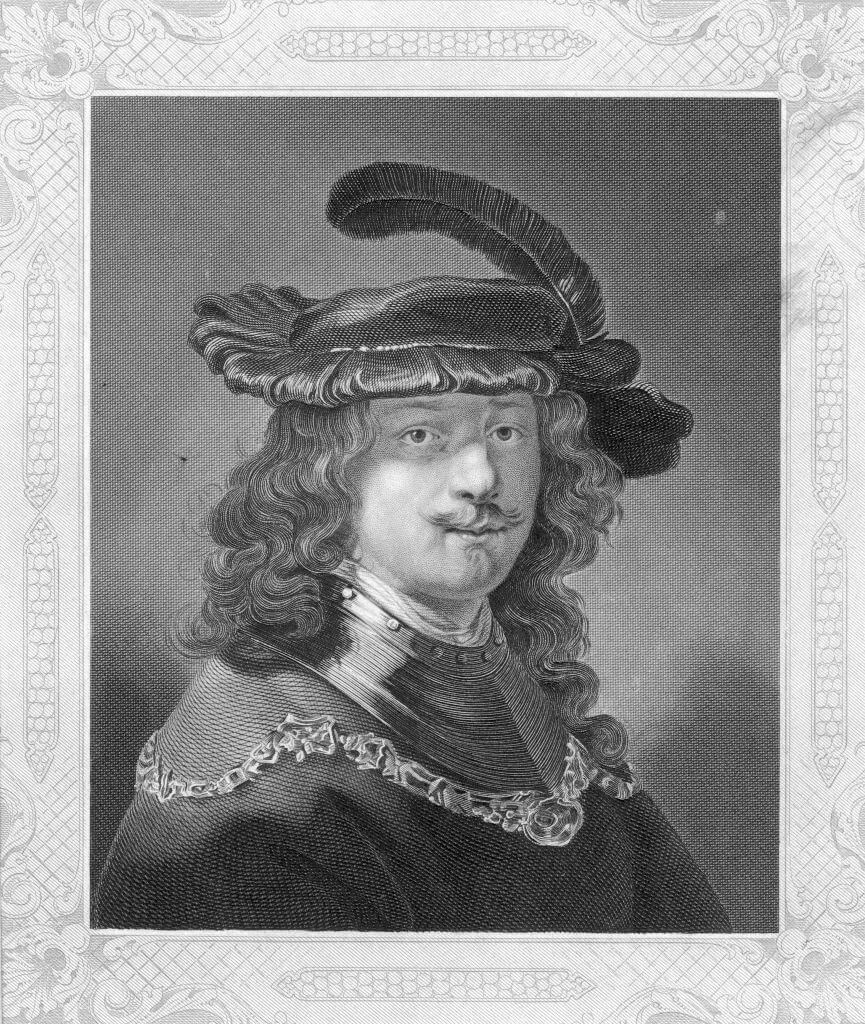
Rembrandt, in c. 1650, in one of his many self-portraits Photo by Archive Photos/Getty Images

By Noah Hirsch-Rechter February 19, 2026
In a preface to the 1932 Hebrew edition of the painter Leonid Pasternak’s study of Rembrandt, Russian-Jewish poet Hayim Nahman Bialik observed that although the Dutch artist was not Jewish, we “must consider him as ‘a Jew of honor,’ for his love and empathy towards the Jews.”
Bialik was not alone in his admiration. Rembrandt’s close ties to his Jewish neighbors in mid-17th century Amsterdam — to say nothing of his sensitive portraits of them — were held up for generations as a model of philosemitism.
Recent scholarship, however, has shown that Rembrandt’s affection for Jews has been generally overstated. He had, for example, perhaps a couple of Jewish sitters, but nothing like the dozens once ascribed to him.
Yet a new Rembrandt exhibit at Boston’s Museum of Fine Arts, entitled “Reality and Imagination: Rembrandt and the Jews in the Dutch Republic,” embraces not only the hard facts of the Rembrandt-Jewish relationship, but the myths, too.
Co-curators Michael Zell and Simona Di Nepi have juxtaposed the real with the imagined, introducing visitors to the artist’s known Jewish interactions — the “reality” — as well as his so-called imagined encounters: that is, the biblical Jews he often painted. The result is a fine overview of the Dutch maestro’s associations with Amsterdam’s Jews, as well as a fascinating window onto the relative freedoms enjoyed by Dutch Jews at large in the 17th century Dutch Republic.
Importantly, neither Zell nor Di Nepi was all that interested in proving, at least explicitly, Rembrandt’s alleged special affinity for Jews. “We just concentrated on the evidence that we have for relationships, commissions, interactions,” said Zell, professor of Baroque and 18th Century Art at Boston University.
The exhibit, which runs until December of this year, is a collaboration between the MFA’s Center for Netherlandish Art (CNA), and art history undergraduate and graduate students at Boston University; the students were involved in every curatorial decision. “It’s a really unprecedented experiential learning and professional development opportunity,” said Zell. (This is the fifth such partnership between the CNA and an academic institution. Previous partners include Yale and Brown).
Perhaps the most striking piece in the gallery’s “reality” section is a 1647 portrait of the artist’s neighbor Ephraim Bonus, a Sephardi physician, and the only securely identified portrait of a Jewish sitter by Rembrandt. The portrait is the gallery’s “linchpin,” Zell said: an etching of a Jewish subject for which Rembrandt had only to depict what was in front of him, instead of conjuring up a mix of stereotype and theology (more on that later).
Next to the Bonus portrait are four images Rembrandt drew for Menasseh Ben Israel, a hugely influential Dutch Rabbi and scholar. Ben Israel would go on to use the sketches as visual representations of key biblical stories in his treatise Piedra Gloriosa (The Glorious Stone).
Rembrandt, often very precious about his work, agreed to alter two of the prints after the Rabbi insisted they did not align sufficiently with the biblical text. And though scholars have puzzled over the nature and extent of Rembrandt’s relationship with Ben Israel, it’s the images’ very existence that Zell wants to highlight. “This moment of interfaith collaboration is just remarkable,” he said.
The Ben Israel prints, however, are not only evidence of Rembrandt’s dealings with Amsterdam’s Jews. By calling attention to such a towering figure as the Rabbi, they underscore the exhibit’s other defining motif: the Jewish community’s considerable — relative to their European counterparts, at least — freedom and influence in the mid-17th century Dutch Republic. (Established in 1581, the Republic was a confederation of seven Dutch provinces that had broken away from Catholic Habsburg rule. Notionally Calvinist, it was renowned for its enlightened attitude towards religious and ethnic minorities and its patronage of the arts and sciences.)
And so also on display are several pieces of Judaica that testify to the Dutch Jewish community’s vibrancy in Amsterdam — a city so full of Jewish life that author Israel Zangwill later called it the “Jerusalem of the West” — and further afield, too. There’s a brilliantly detailed map of the so-called Holy Land, with the names and places written in Hebrew; a brass Hanukkah lamp in the Dutch-Jewish style; a Sephardi Ketubah, with engraved still-lifes that climb up the side of the document like ivy; and an 18th century copy of a portrait depicting the 1675 opening of Amsterdam’s Grand Sephardi synagogue, the world’s biggest at the time.
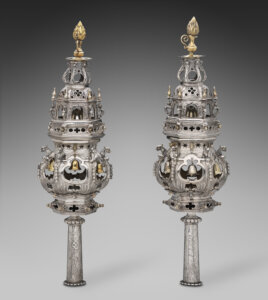
What caught my attention most of all was a pair of silver Torah finials, whose conical shape, intricate flower engravings and tinkling bells were inspired by Dutch architecture and Christian reliquaries, said Di Nepi, who’s the MFA’s Charles and Lynn Schusterman Curator of Judaica. Made in 1649 in Rotterdam, a port town whose trade activity attracted scores of Jews, the finials are the oldest surviving in the United States. And given that they were crafted by a Christian silversmith — the Dutch Republic may have been atypically tolerant, but Jews still were not allowed into its guilds — they are an excellent shorthand for both the achievements and difficulties of 17th-century Dutch Jewry.
The power of imagination
Though the physician Bonus is today accepted as Rembrandt’s only undisputed Jewish sitter in a surviving work, the artist, like many of his contemporaries, was fond of depicting biblical stories — and not just from the New Testament. According to the museum, scenes from the Hebrew Bible were painted more often in the Protestant Dutch Republic than anywhere else in Europe, and inventories of Jewish households at the time revealed that these depictions often were collected by Dutch Sephardim.
The “imagination” section of the exhibit, then, features Rembrandt’s take on biblical episodes like Abraham’s sacrifice and Abraham’s Casting out Hagar, as well as two iconic pieces that scholars once held up as proof of Rembrandt’s philosemitism (‘The Jewish Bride,’ notably) but which have since been re-assessed.
Taken together, a portrait emerges of how Rembrandt understood Jews; of the influence of 17th-century Amsterdam and the importance of the artist’s solidly, immovably Christian worldview.
The prints, generally speaking, are heavy on stereotype. “This is an imagined version of the biblical characters of the ancient Jews,” Di Nepi told me. “There is this mixture of a look that evokes the Middle East, which was at the time run by the Ottoman empire. A lot of turbans, very lavish silk with gold and silver embroidery, and sashes that probably came from Persia.”
The 1648 sketch “Jews in the Synagogue,” for instance, depicts a huddle of Jews in floppy hats, long robes and turbans. To portray what he understood to be a representative Jewish figure, Rembrandt produced a blend of ancient Israelite and 17th century Dutch Jew, a formulation he repeated across his other so-called Jewish portraits. This, Zell said, “is Rembrandt’s Christian perspective shaping the way that the Old Testament scenes are portrayed.”
Far from indicating a special affinity for Jews, these Old Testament works help illuminate Rembrandt’s response to the minority groups he mingled with in diverse 17th-century Amsterdam. Jews, Zell said, were part of the “vast, undifferentiated realm” of the biblical past, separate from Christianity.
Still, even if his outlook was traditionally Calvinist — which, at its heart, aimed to convert Jews and all other non-Christians — this need not overshadow the fact that Rembrandt, to paraphrase one reviewer, could paint in three dimensions. “He possessed a gripping naturalism,” Zell said. “And so he created these unprecedentedly lifelike figures.”
This is a moment of great uncertainty. Here’s what you can do about it.
We hope you appreciated this article. Before you go, we’d like to ask you to please support the Forward’s independent Jewish news this Passover. All donations are being matched by the Forward Board - up to $100,000.
This is a moment of great uncertainty for the news media, for the Jewish people, and for our sacred democracy. It is a time of confusion and declining trust in public institutions. An era in which we need humans to report facts, conduct investigations that hold power to account, tell stories that matter and share honest discourse on all that divides us.
With no paywall or subscriptions, the Forward is entirely supported by readers like you. Every dollar you give this Passover is invested in the future of the Forward — and telling the American Jewish story fully and fairly.
The Forward doesn’t rely on funding from institutions like governments or your local Jewish federation. There are thousands of readers like you who give us $18 or $36 or $100 each month or year.
Support our mission to tell the Jewish story fully and fairly.