24 visions of Leonard Cohen, no clear picture of who he was
‘The World of Leonard Cohen’ compares the mythologies of the musician and poet
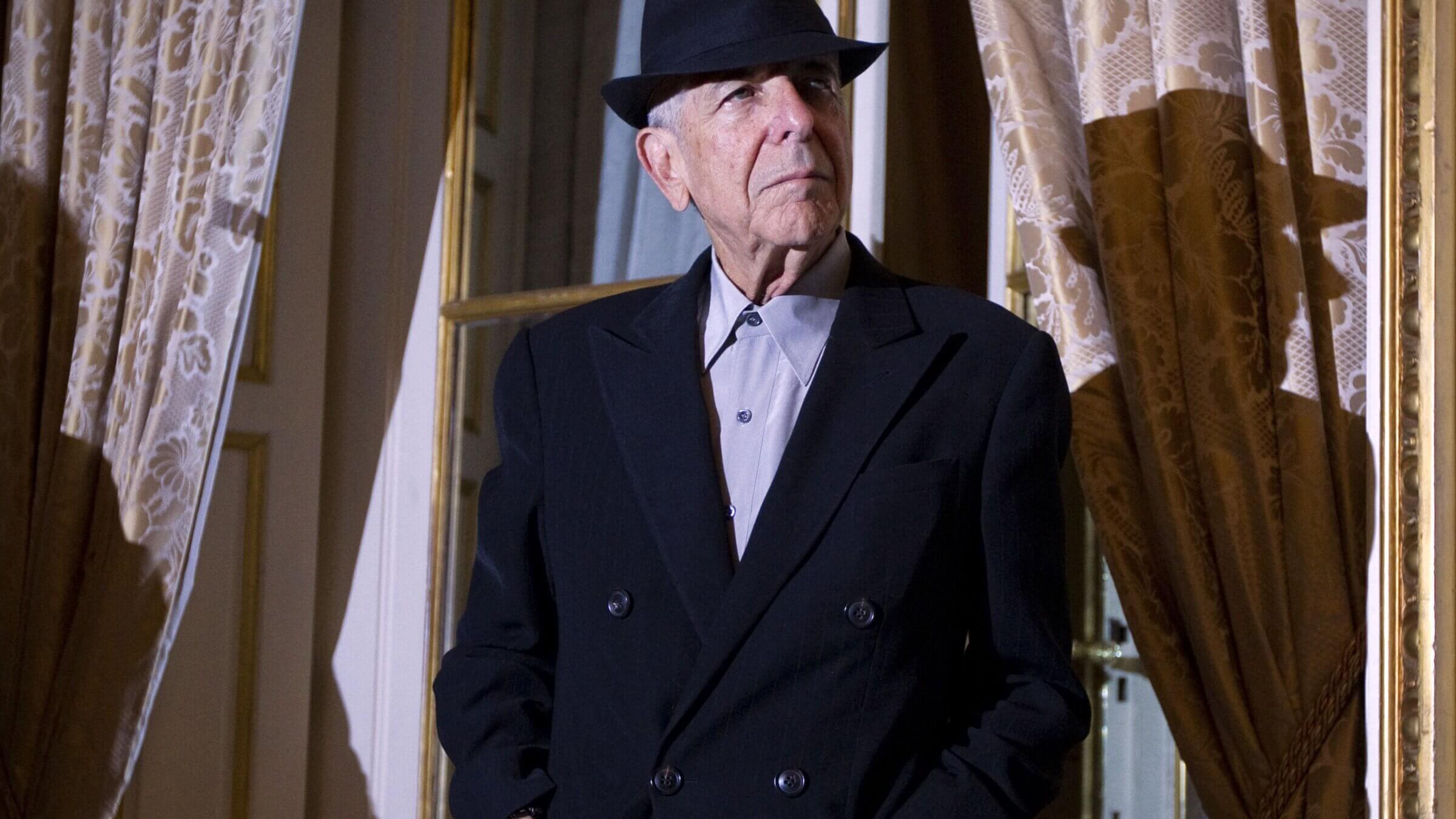
Leonard Cohen contained multitudes. A new book gets at some of them. Photo by JOEL SAGET/AFP via Getty Images

By PJ Grisar January 29, 2026
The World of Leonard Cohen
Edited by David R. Shumway
Cambridge University Press, 398pp, $35
The Torah has 70 faces — how many did Leonard Cohen have? To go by bibliography, 70 seems conservative.
Books devoted to the singer-songwriter and poet, including a graphic novel treatment, are a cottage industry. There are texts on the “Mystical Roots” of his genius, Alan Light’s authoritative study of his song “Hallelujah,” an account of his tour of the Sinai during the Yom Kippur War and surveys about the critical response to his oeuvre. Entering the mix is The World of Leonard Cohen, a 24-essay collection breaking down the multitudes the man contained.
“More than Dylan or anyone else in popular music, he remains a mystery because he doesn’t fit any of the usual categories,” editor David R. Shumway writes in his introduction. “Almost any statement you can make about him must immediately be qualified or be met with a contrary.”
Indeed, Cohen defies a strict taxonomy: an English-speaking Jewish Buddhist monk who grew up in a Catholic francophone town and established himself as a poet and novelist before entering the music industry. Throughout his life, he shape-shifted, from enfant terrible of the Montreal literary scene to depressive psalmist, wizened ladies’ man and — after a years-long exile on Mount Baldy — a humble, appreciative elder statesman whose popularity peaked sometime after his AARP eligibility.
Shumway’s book begins with essays covering Cohen’s creative life, then moves onto his musical, religious and cultural contexts with a kind of epilogue for his legacy and a tease of the treasures to come in his archive.
Many of the early details — provided in Ira Nadel’s quick, first chapter biography — may not be new to Cohen acolytes. The familiar tale of 9-year-old Cohen burying his first poem in his father’s bowtie and his “messianic childhood” are given their proper due.
Gillian A.M. Mitchell’s consideration of how Cohen — who discovered The People’s Song Book as a Jewish summer camp counselor — floated in the folk music periphery hints at the trickiness of genre. Shumway’s subsequent chapter, which suggests Cohen was the ur-singer-songwriter, may be overstating its case. (He himself seems to admit the lack of a confessional quality sets Cohen apart from the likes of Joni Mitchell, even if their dalliance inspired her move away from folk.)
Most engaging in the volume, on a man who relished contradictions, are the diverging details, which build out on a minimal p’shat — or surface text — with what feels like midrash.
A Flamenco guitarist, who taught Cohen his limited repertoire of chords (what Cohen called his “chop”) gets an early mention. Only later do we read their lessons were cut short by the guitarist’s suicide. Some chapters note how the press assigned Cohen the moniker “The Canadian Bob Dylan.” Later ones note how Cohen, at a party with the Montreal group of poets, “solemnly announc[ed] that he would become the Canadian Dylan, a statement all dismissed.” Who brought the Dylan records to that shindig is a detail left up for grabs.
Many chapters tell the origin story for Cohen’s New York debut with Judy Collins, placing it at Town Hall. Others contend the incident — which saw Cohen leave the stage in fear — put the incident earlier at the Village Theatre. Sylvie Simmons, author of I’m Your Man: The Life of Leonard Cohen, discovered the discrepancy in a letter Cohen sent to his lover Marianne Ihlen, putting Simmons at odds with other biographers.
The final chapter, on the Cohen archive, quotes that letter and gives a fuller picture of what, exactly, went wrong.
“I stepped up to the mike, hit a chord on my guitar,” Cohen wrote, “found the instrument had gone completely out of tune, tried to tune it, couldn’t, decided to sing anyhow, couldn’t get more than a croak out of my throat, managed four lines of ‘Suzanne,’ my voice unbelievably flat, then I broke off and said simply, “Sorry, I just can’t make it,” and walked off the stage, my fingers like rubber bands, the people baffled and my career in music dying among the coughs of the people backstage.”
He then reports the “curious happiness” of his failure, which, when Collins coaxed him back onstage, became a success.
This being Cohen, several essays are given to his spiritual seeking. Sadly, the entry on his Jewishness is at times the most opaque.
“From Cohen’s perspective, to fulfill its prophetic mission, Judaism must serve as the speculum through which to envision the universalization of the particular in the particularization of the universal.” writes Jewish mysticism scholar Elliot R. Wolfson, chasing that observation by noting how the “Jew attests figurally to the fact that the general must always be measured from the standpoint of an individuality that withstands collapsing the difference between self and other in the othering of the self as the self of the other.”
Clearer is the section on Buddhist affinities, by Christophe Lebold, author of Leonard Cohen: The Man Who Saw the Angels Fall. Lebold teases out how Cohen’s zen practice informed his lyrics and poetry, fusing with his Jewishness to create a syncretic philosophy.
The essay on Christianity by Marcia Pally is fine, but insists at times on a mono-reading of Cohen’s words. It also contains a risible parenthetical: “Jesus sustained covenantal bonds; no one else has (save Abraham and Moses).” This, to me, may as well have read “Jeff Buckley sang ‘Hallelujah;’ no one else did (save Leonard Cohen and John Cale).”
The overall effect of this volume, which also includes essays on the use of Cohen’s music in film, his image management in documentaries and his appeal to women, is to come away with great insights and still be at a loss.
David Boucher’s section on Cohen’s politics makes a case for Cohen as a contrarian who concealed his purportedly conservative politics to better cater to his liberal fanbase.
Somehow, even after being pistol-whipped by Phil Spector while recording Death of a Ladies’ Man, he was “undoubtedly a proud NRA member.” In a 1988 documentary for Canadian television, he opined that drugs coming into America constituted a legitimate “attack” and suggested the Army “go in and bomb the countries” responsible. (The man who wrote “The Future” showed some prescience here.)
Was he just being provocative for the fun of it? Probably. He did a fair amount of drugs. In a notebook from his archive that points to Cohen’s infatuation with Velvet Underground chanteuse Nico, he wrote how he “asked her to get heroin.”
Cohen studies continue, soon to be aided by the digitization of his archive of notebooks, film, photographs, visual art and recordings. Will these artifacts bring us closer, or further away, from understanding the man?
He spent a lifetime trying to figure himself out. We don’t stand a chance.