In ‘The Secret Agent,’ a peek into Brazilian Jewish history — and a warning against propaganda
Set during the Brazilian dictatorship of the late 20th century, a fugitive meets a Holocaust survivor mistaken for a Nazi.

Wagner Moura plays a fugitive in 1977 Brazil in ‘The Secret Agent.’ Courtesy of Victor Juca

By Olivia Haynie December 3, 2025
When we first meet Marcelo in the fiction film The Secret Agent, the only thing that’s clear is that he’s on the run — we’re not sure that Marcelo is his real name, who he’s on the run from, or why. As the story, set in 1977 Brazil, unravels, we learn government officials and hired killers are working together to take Marcelo down and strip him of any credibility he had in his pre-fugitive life — even if that means manipulating the press.
But the film also spends time on the characters Marcelo meets while hiding among others being persecuted by the military dictatorship in the city of Recife, illustrating the diversity of the people affected by the fascist regime.
One of those characters is a man many assume is an escaped Nazi; in fact, however, he is a Holocaust survivor.
The audience’s introduction to the survivor, Hans, played by German actor Udo Kier in his final film role before his death, is not a pleasant one. A corrupt police chief named Euclides brings Marcelo to Hans’ tailor shop, insisting there is something interesting he must see there. Euclides then forces Hans to lift his shirt and show his scars — something Euclides clearly regularly has the man to do as we can see by Hans’ immediate sour reaction to the chief.
Euclides believes the intense, sprawling scar tissue tells a glorious military story of a Nazi who evaded capture.
“He’s just fascinated with, I don’t know, maybe Nazi Germany, with the German soldier, or the idea of the German soldier,” explained director Kleber Mendonça Filho in a video interview. “And he seems to have a one track mind in terms of thinking that Hans, because he’s German, must have been a heroic soldier in the German army in the Second World War, which explains why he’s still alive.”
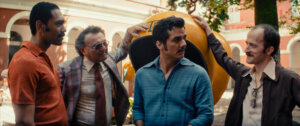
But, as the audience learns through a conversation Hans has with an employee in German — and a shot of the menorah he has tucked away in his office — he is actually a Jewish Holocaust survivor. His wounds are a testament to surviving violent antisemitism, not markers of fighting for militaristic ideals the police chief believes they share.
“Identity can be on your body,” Filho said. “In the scars that you have, in the tattoos that you have, in the way that you have collected physical experience throughout life.”
Like many of the elements in the film, the character of Hans was inspired by Filho’s own memories of growing up in Recife during the Brazilian military dictatorship, known for its violent suppression of media and political dissidents, that ruled the country from 1964-1985. Even though Filho was only 9 years old at the time the film is set, he remembers a lot from that time in his life, including an old Romanian tailor his father visited in the downtown area that they recreated in the film.
Filho combined this character from his life with the experience of growing up in an area with a strong Jewish presence. Recife was the site of Brazil’s first organized Jewish community, which consisted of Dutch Jews, who arrived with other Dutch colonialists, and Sephardic Jews escaping the Portuguese and Spanish Inquisitions. Between 1636 and 1640, these Jews built the first synagogue in the Americas, Kahal Zur Israel, which was turned into a museum in 2001.
In 1654, the Portuguese expelled Dutch Colonists and Jews from Brazil, but another wave of Jewish immigration from Eastern Europe in the 1910s revitalized Recife’s Jewish population. Even though Filho isn’t Jewish, he had a lot of Jewish friends throughout his life, even styling the marine biologist in the film off of one of them.
Although The Secret Agent takes place in 1977, Filho saw events similar to those he wrote into the film play out around him under the presidency of Jair Messias Bolsonaro, which lasted from 2019 to 2023.
Filho said that “a lot of the logic of what was happening under the Bolsonaro regime seemed to mimic” the military regime of the 20th century “in a fetishistic way.”
“Words like torture were now being thrown around,” he said, “misogynistic treatment of women in words that would be questionable in 1977 and completely alien and unacceptable today.”
Filho said the country also experienced a renewed period of racism and xenophobia under Bolsonaro, encouraged by the policies of the government. And those were sometimes overtly inspired by admiration for Nazi Germany; then-Special Secretary Roberto Alvim was removed from his post after just a few months for plagiarizing a speech from Nazi Propaganda Minister Joseph Goebbels.
Today, in the United States, many are worried that Nazis are being reimagined as the good guys, as Holocaust deniers like Nick Fuentes are given increased attention by news pundits and the Trump administration normalizes relations with the far-right groups.
Much of the plot of The Secret Agent concerns the rewriting of history through propaganda and media censorship. And the intimate and abusive interaction between the police chief and Hans feels like a particularly salient demonstration of how easily facts can be written over to fit the world someone might want to see.
This is a moment of great uncertainty. Here’s what you can do about it.
We hope you appreciated this article. Before you go, we’d like to ask you to please support the Forward’s independent Jewish news this Passover. All donations are being matched by the Forward Board - up to $100,000.
This is a moment of great uncertainty for the news media, for the Jewish people, and for our sacred democracy. It is a time of confusion and declining trust in public institutions. An era in which we need humans to report facts, conduct investigations that hold power to account, tell stories that matter and share honest discourse on all that divides us.
With no paywall or subscriptions, the Forward is entirely supported by readers like you. Every dollar you give this Passover is invested in the future of the Forward — and telling the American Jewish story fully and fairly.
The Forward doesn’t rely on funding from institutions like governments or your local Jewish federation. There are thousands of readers like you who give us $18 or $36 or $100 each month or year.

Support our mission to tell the Jewish story fully and fairly.