‘Marty Supreme’ is an outstanding celebration — and indictment — of chutzpah
Josh Safdie’s period epic sees Timothée Chalamet vying for ping-pong supremacy
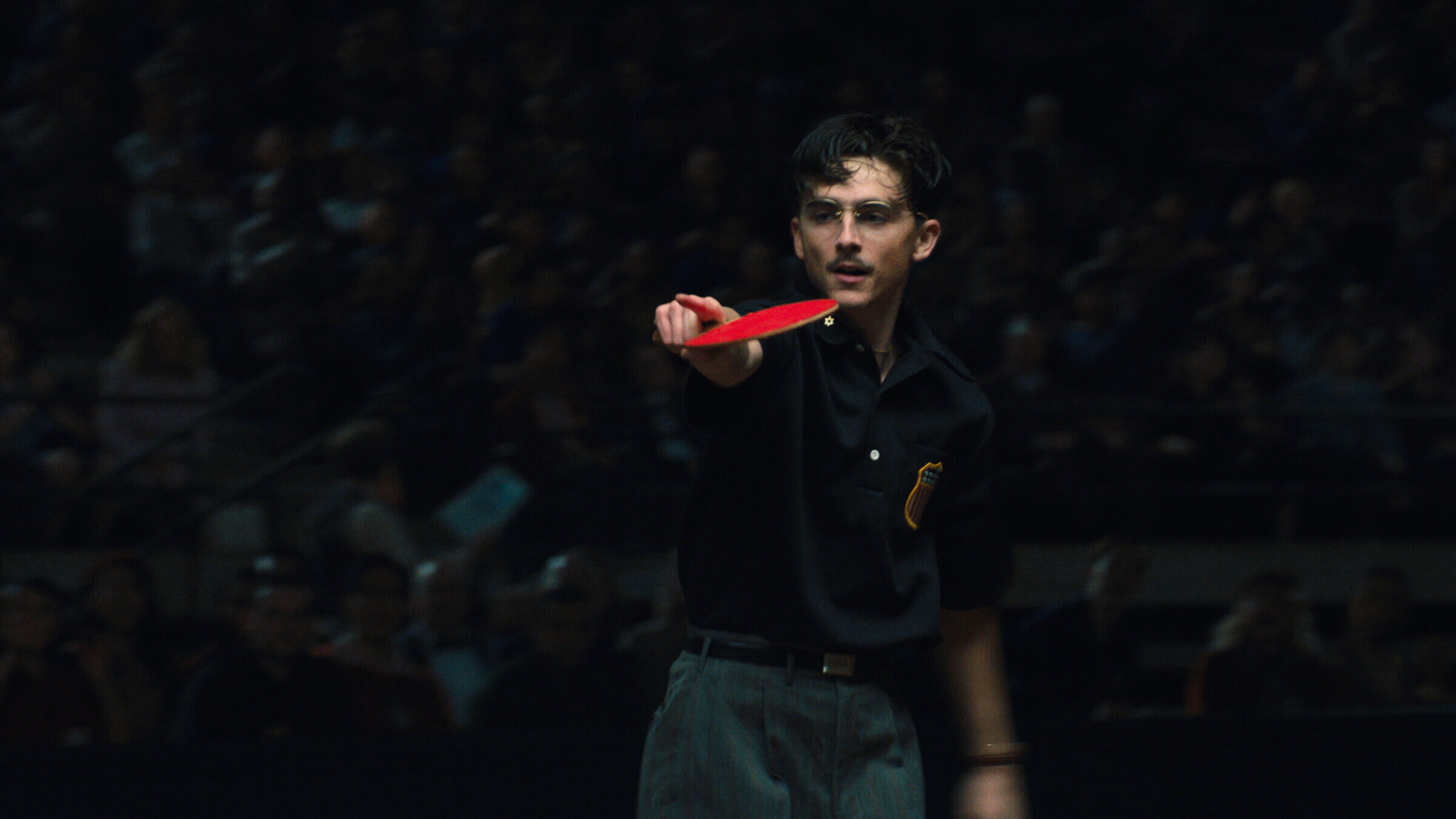
Timothée Chalamet plays Josh Safdie’s latest Jewish striver in Marty Supreme. Courtesy of A24

By PJ Grisar December 4, 2025
Marty Mauser will have the beef Wellington and caviar, as they are the most expensive items on the menu.
The 23-year-old table tennis phenom, heralded as “the chosen one,” is dining at the Ritz in London. Seated opposite him, his recent opponent, Bela Kletzki. The two are friends, but this didn’t stop Mauser from telling a gaggle of reporters before their match of his plans to “do to Kletzki what Auschwitz couldn’t.” He can say that, he assured them — he’s a Jew.
This, like Mauser’s remark that he is the “ultimate product of Hitler’s defeat,” is all bluster. (He’s really a lowly Lower East Side shoe clerk who stole money from his shop to fly to the tournament.) But we soon see what Auschwitz meant for his survivor companion: defusing bombs on the camp outskirts and once managing to sneak honey from a beehive onto his person, which his fellow prisoners licked off him for nourishment.
We get a flashback of Kletzki. It’s lensed like a Renaissance painting, with honey glistening off of the hairy chest of actor Géza Röhrig, (Hungarian star of the Sonderkommando drama Son of Saul).
You may wonder what exactly this moment is doing in Josh Safdie’s Marty Supreme, a walloping period piece that follows Mauser’s picaresque ploys to become a global icon by hustling, stealing and lying his way into a tournament in Japan. But there’s rarely a moment in the frenetic picture, set over eight months in 1952, where only one thing is happening. While Kletzki tells his haunting honey story to pen magnate and potential patron Milton Rockwell (Kevin O’Leary, Mr. Wonderful, indeed), Marty makes eyes at Rockwell’s wife from across the room, another sort of honeypot in mind. The contrast is the point.
Unlike Kletzki, Marty — very loosely based on ping-pong champ Marty Reisman — is an American, New York-born, and believes in the Augie March doctrine of first knocked, first admitted. To get his foot in the door so he can stare down from his rightful place on a Wheaties box, he will shove anyone and everyone out of the way. He refuses to demean himself by playing Harlem Globetrotter halftime shows with Kletzki, or throwing a match for Rockwell — but his principles are malleable when the straits are dire.
Mauser feels entitled to everything: the money in his uncle’s safe at the shoe shop; a suite at the Ritz; other men’s wives; a chunk of the pyramids, which he presents to his manipulative mother (Fran Drescher) with the words, “We built that.”
We know from how he speaks about this hunk of Egyptian rock — and about Kletzki, the Holocaust and Hitler — his entitlement comes in part from a legacy of immiseration and violence he never suffered personally. But Mauser, this New Jew coming of age after the Shoah, claims redemption as his birthright while also striving to float above his people’s history of oppression and retail drudgery, concocting a mythology of self-invention and radical individualism. (Meanwhile, Kletzki, a world champ before the war, is all too happy to be treated kindly and paid decently for hitting balls with skillets for the Globetrotters.)
The tension between the horror of the recent past, and the just-dawning promise of an America where antisemitism is unfashionable, plays through Marty’s vision of what’s to come. He dreams up orange-colored ping-pong balls, a hue only approved for use by the International Table Tennis Federation in 1993. The 1980s synth-pop needle drops, remixed by composer Daniel Lopatin, lean into futurism. Our hero is ahead of his time, chafing at the present to which he’s tethered. He wants an unready world to acknowledge his greatness now. He has no patience for a rocky transition.
If the opening credits of Uncut Gems bespeak a past-one’s-prime ritual — a colonoscopy — Marty Supreme’s titles are set to a burst of youthful virility (inventive, hilarious, if a more inspired twist on something I’ve seen before in a lesser film).
Timothée Chalamet, outfitted with prosthetic acne scars and eye-shrinking contact lenses, is incandescent and somehow stays to the right side of insufferable as he wrecks the lives of all around him with his singular focus. Unlike Gems’ Howard Ratner, a sleaze with a gambling addiction and little else to offer, Mauser’s talent is undeniable, but like any Safdie protagonist, he takes his licks.
The film, co-written and co-edited with Safdie’s constant collaborator Ronald Bronstein, is a rich Jewish text that alternates between wish fulfillment and nightmare. Mauser competes for the WASPy Rockwell’s patronage while shtupping his icy blonde wife (Gwyneth Paltrow). On the other side of the ledger, his lover, Rachel (a pitch-perfect Odessa A’zion), is attacked near a Forverts delivery truck. Marty’s uncle Murray (music journalist Larry “Ratso” Sloman) chides a cop’s goyishe kopf for ordering the roast beef over pastrami at the Garden Cafe. It’s no mistake that, at his lowest, Mauser faces a treyf humiliation orchestrated by Rockwell: lose and kiss a pig.
But Marty Supreme is too dense with plot points and people to insist on a solely Jewish gloss, even as critics for the non-Jewish press have been tempted to apply one.
Exploring the warrens of postwar New York — the wings of a Broadway theater, the back alley of a Chinatown restaurant, stockrooms, airshafts and fire escapes — all outstandingly revived by legendary production designer Jack Fisk, Safdie proves he’s not only ready for a solo effort of scale away from brother, Benny, but ready to leap over space and time. He may not be willing to say goodbye to all that (New York stuff), the backdrop for all his features up to now, but he easily could.
In this epic of chutzpah, we have a mature work via a singularly immature avatar. Mauser may have never reached the recognition he felt he was owed, but coming into awards season, there’s little doubt that Safdie’s film is a cross-category contender.
Should the gentleman order the caviar, there’s no doubt he’s earned it.
Correction: A previous version of this article incorrectly stated that Marty Supreme was Josh Safdie’s solo feature debut. His solo feature debut was The Pleasure of Being Robbed from 2008.
This is a moment of great uncertainty. Here’s what you can do about it.
We hope you appreciated this article. Before you go, we’d like to ask you to please support the Forward’s independent Jewish news this Passover. All donations are being matched by the Forward Board - up to $100,000.
This is a moment of great uncertainty for the news media, for the Jewish people, and for our sacred democracy. It is a time of confusion and declining trust in public institutions. An era in which we need humans to report facts, conduct investigations that hold power to account, tell stories that matter and share honest discourse on all that divides us.
With no paywall or subscriptions, the Forward is entirely supported by readers like you. Every dollar you give this Passover is invested in the future of the Forward — and telling the American Jewish story fully and fairly.
The Forward doesn’t rely on funding from institutions like governments or your local Jewish federation. There are thousands of readers like you who give us $18 or $36 or $100 each month or year.
Support our mission to tell the Jewish story fully and fairly.