How the Forward got a cameo in ‘Marty Supreme’
Production designer Jack Fisk said this bit of decoration paid homage to the past, and solved a modern-day headache
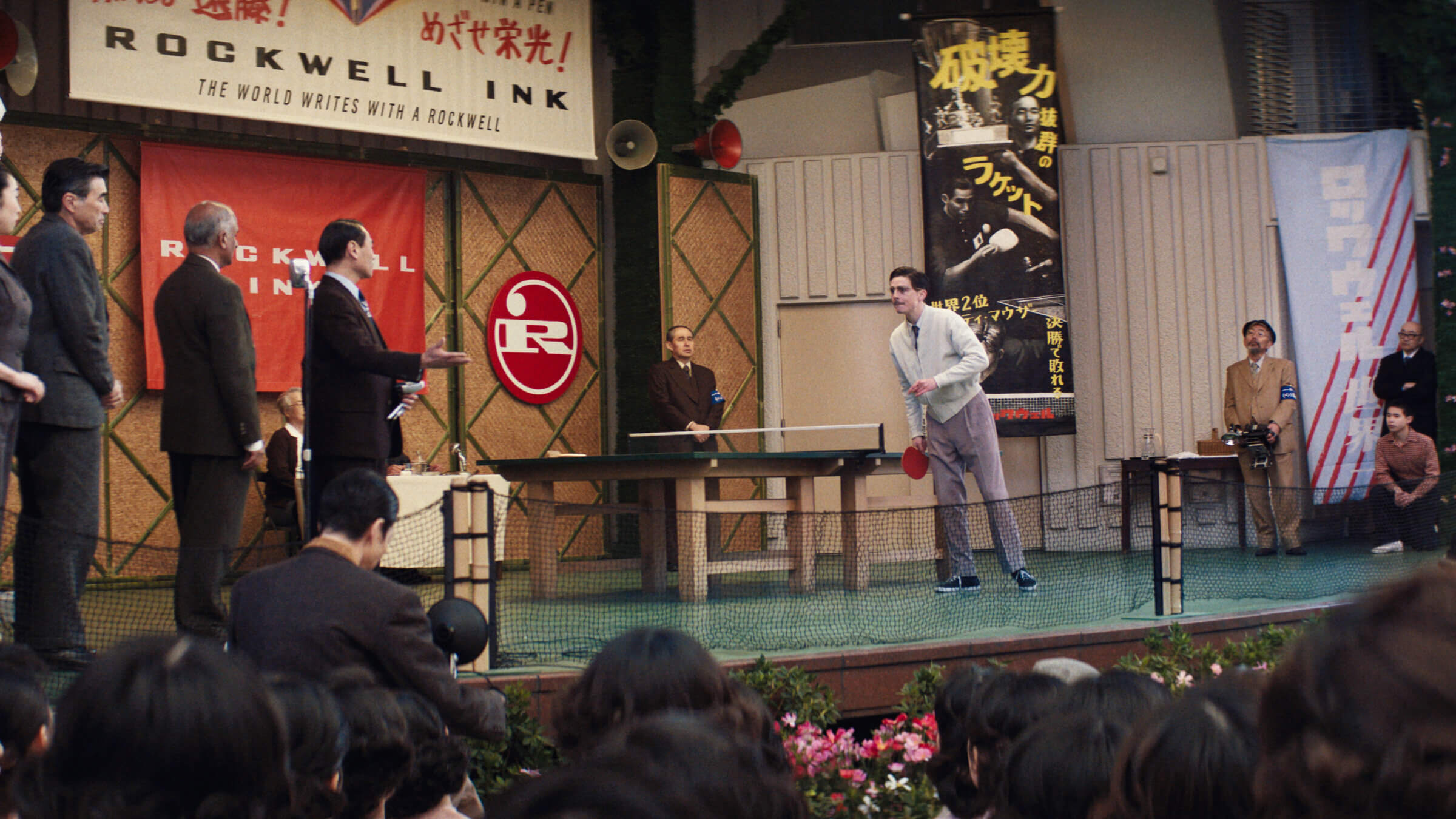
For Marty Supreme, Jack Fisk built sets in Japan and the East Village, and recreated an Auschwitz barracks in New Jersey. Courtesy of A24
By PJ Grisar December 9, 2025
“The challenging thing about any film, for me, is you’re trying to build these worlds, so you’ve got to find the elements,” said Jack Fisk, production designer for Marty Supreme, and regular collaborator with major filmmakers like Terrence Malick, Paul Thomas Anderson, David Lynch and Brian De Palma.
“We’re trying to piece together bits of reality to tell our story, and that look right for the period,” Fisk said in a video call the day Marty Supreme got three Golden Globe nominations, including best picture, musical or comedy. “So the challenge is to find them, that you can get to them reasonably and within the day, and that will fit in your budget.”
Often the on-the-ground reality of the filming location inspires the scene, but sometimes it gets in the way and forces the art department to get creative. Both were the case in a blink-and-you’ll-miss-it moment in Josh Safdie’s epic of a schvitzer table tennis champ.
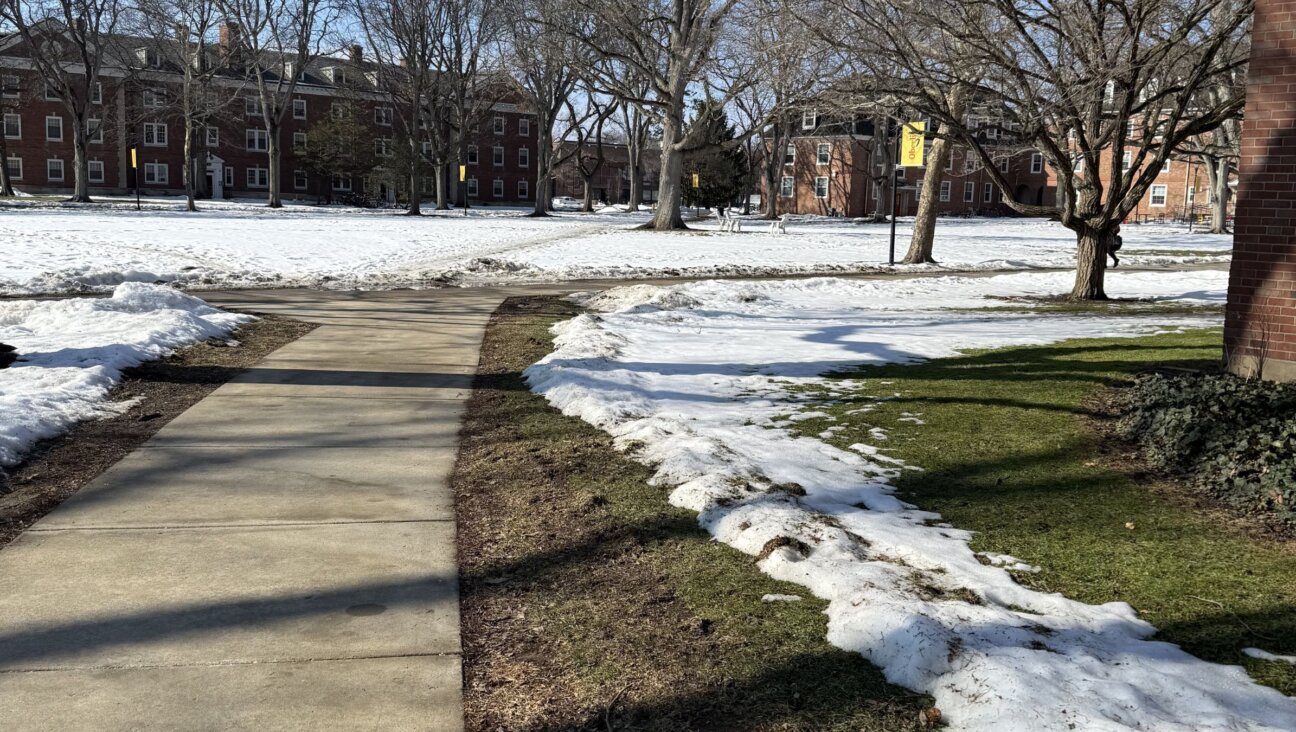
While shooting a scene on location at Seward Park on the Lower East Side, the original Forward Building, with its historic preserved façade, loomed in the background. It fit the film’s early 1950s setting, and the biography of Marty Reisman, the real ping-pong pro whose 1974 book The Money Player inspired the film, and who grew up on East Broadway and learned the game at the Education Alliance on the same street.
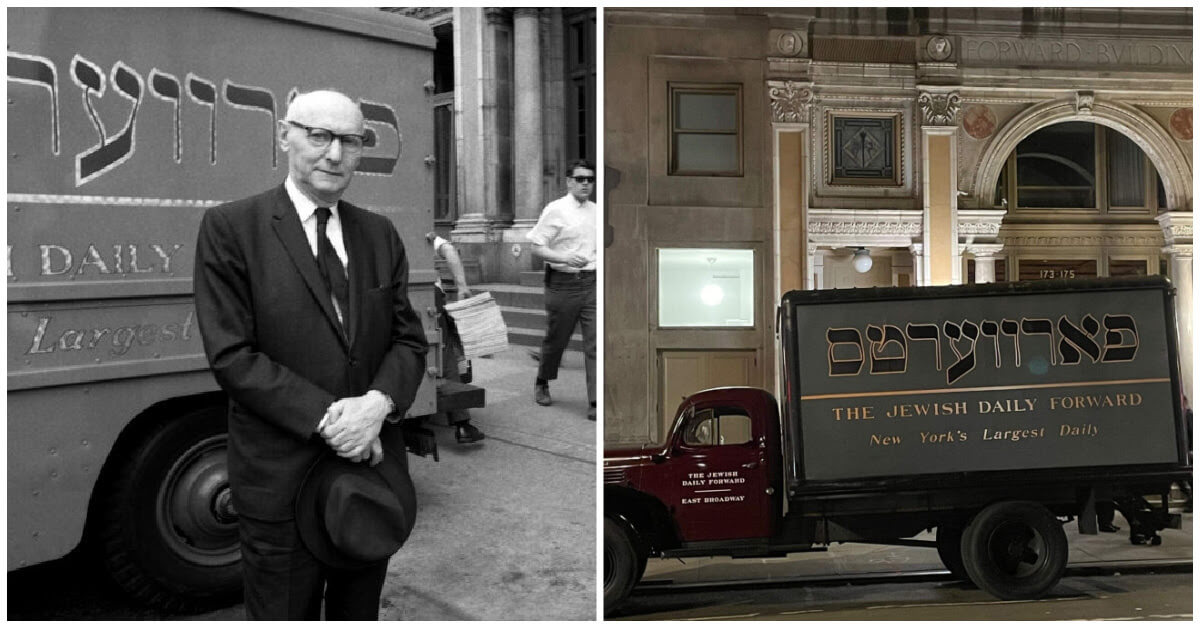
“Josh told me that, you know, ‘That’s this Jewish newspaper, it’s been here forever,’” said Fisk.
It was more than a bit of trivia from a lifelong New Yorker. It was a fix to a problem: modern street signs opposite the park, which were decidedly out of place but which the city wouldn’t bother removing for a one-day shoot.
So Fisk and his team, drawing inspiration from the locale, built a Forward delivery truck to block out the signs. He even recalls printing up some papers. The graphic artists relied on reference photos to reproduce the font — painting the cargo bed immediately after a period-appropriate truck arrived. Fisk thinks it may have still been wet on shooting day.
Every time Fisk entered a neighborhood for this New York shoot — his first since 1974’s Phantom of the Paradise, directed by De Palma — he looked for traces of the past to take advantage of. (In the case of Phantom, Fisk opted to use the Brooklyn building of the Pressman Toy Corporation — a Jewish-owned outfit known for manufacturing Chinese Checkers and the family firm of Hollywood producer Edward R. Pressman — as a prison instead of filming in a real jail; Fisk said all the ones he scouted looked “too nice.”)
Recreating the lost world of Marty Mauser, played by Timothée Chalamet, posed its own challenges.
Central to the film, if only briefly seen in the final cut, is Lawrence’s Broadway Table Tennis Club on 55th Street. The building was demolished, but Fisk, together with producer Sara Rossein (who is also Safdie’s wife), was able to get hold of blueprints and black-and-white photos through tax records, government archives and a magazine feature. Rossein’s discovery of a 16mm piece of film clued Fisk in on the color palette.
Fisk got his start in film working for B-movie maven Roger Corman (“Every other page there was a bare breast or something,” he recalled of the scripts), so he is no stranger to improvising on a shoestring. In fact, he relishes it. On Marty Supreme, as maximalist a picture as Safdie has ever made, the budget — while reportedly the most-expensive A24 production yet at around $60-70 million — often creaked, calling for some creative problem solving.
There’s a scene where Marty volleys an apple into a bowl in a building across from his hotel room. There wasn’t money to retrofit the room in the window, so the period stove viewers see is an image printed from a plotter — a massive printer — pasted to the wall. Norkin’s Shoe Shop, where Marty works, was an actual location on Orchard Street, but the crew built modular units of the storefront so they could move the shots away from a modern-looking hotel recently built nearby.
While Marty Supreme is largely rooted in New York, with some detours to New Jersey, London and Tokyo, there’s a memorable sequence set at Auschwitz, as former world champion tennis pro Bela Kletzki (Géza Röhrig) recounts his life in the camp.
“It’s kind of horrible and challenging at the same time,” Fisk said of recreating a part of the death camp. “Everybody’s knowledge of Auschwitz and concentration camps really helped make the set.”
The dimly lit barracks were built inside a house that doubled as the set for a farm in New Jersey where Marty tries to retrieve a lost German shepherd.
Fisk said Röhrig, who starred in the Auschwitz-set film Son of Saul and converted to Orthodox Judaism after a visit to the camp, was excited for the scene. (Fisk noted that Röhrig is part of Terrence Malick’s upcoming film, The Way of the Wind, where the actor will play Jesus, possibly the first Orthodox Jew to embody that role on the big screen.)
Fisk’s work on Marty Supreme has been noted in nearly every review — even the rare pan in Time singled out his production as “the best thing about the movie” — but it’s technically not his only film this year.
Springsteen: Deliver Me from Nowhere shows the Boss watching Malick’s Badlands on his home television; the crime drama was the inspiration for the songwriter’s 1982 album Nebraska, the making of which is the crux of the biopic. Fisk is grateful Badlands is still resonating, as it marked the beginning not only of his most prolific collaboration, but was the set where he met his wife, Sissy Spacek.
While Fisk is a sought-after talent for the ambitious auteurs looking to wind back the clock — his most recent credit is Martin Scorsese’s Killers of the Flower Moon, for which he was nominated for his third Oscar — his most personal connection was with David Lynch, his friend since high school.
Lynch died in January, during the production of Marty Supreme. Fisk was in Japan working on one of the last scenes soon after his passing, and was gratified to see people hosting film festivals in diners in Lynch’s honor.
Marty Supreme is the first film Fisk has done with Safdie, and while it is a relatively early work (Safdie is just 41, though this film is his seventh feature, and his second without his brother, Benny), the veteran production designer was impressed by his enthusiasm and his attention to detail.
“I always tried to prepare myself so I have a little bit more detail than he asked, which is very hard to do,” Fisk said.
It’s that eye for minutiae — and the need to block out the blight of modernity — that paved the way for the Forward’s brief cameo. Fisk, for his part, likes the look of the Yiddish.
“It’s so graphic and beautiful and you can move it around,” Fisk said of the truck. “The camera’s gonna miss it, you can just back it up five feet to see it.”